Audi A3 E-Tron: Step One

news-2017-audi-a3-e-tron.jpg

The Audi A3 e-tron gives the premium German marque an entry point to electric motoring. Based on the previous generation Sportback wagon, it combines a 150-horsepower 1.4-liter gas engine with a 102-horsepower 75 kW electric motor to make a combined 204 horsepower drivetrain. With 258 lb.-ft. of torque, it pulls the compact wagon from 0-60 in 7.6 seconds.

Electric vehicles, even half-electric ones, use the MPGe rating, which offers an efficiency standard that you can use to compare competing vehicles. For example, you can measure the A3 against the plug-in Prius or the Chevrolet Volt. The A3 e-tron earns an 86 MPGe rating using electricity and gasoline, and a 39 MPG with gasoline only. I averaged 96.4 MPGe during my test week. The window sticker claims I’ll save $3,750 a year in fuel costs over the average new vehicle.

EPA fuel economy ratings are 8 for Smog and a perfect 10 for Greenhouse Gas. The 138 grams per mile of CO2 is lower than most cars, but, of course, higher than an all-electric car.

One way to compare plug-in hybrids is by the range they can drive on electricity alone. The A3 claims 17 miles, and in my 18-mile commute, I found that to be accurate. Just before I arrived at my office, the gauge indicated the switchover. So, I plugged in and had enough to get almost home, and so it went. By charging at both ends, I used very little gas for commuting.

Charging is simple. Plug in to standard 240-Volt (level 2) chargers at work or in other public places, or use your own household current, which is 120 Volts (level 1).  It’s an eight-hour process at home, comfortably overnight. On a level 2 charger, it’s just two and a quarter hours. You won’t be hogging the chargers while others wait. They’ll appreciate that.

The A3 is on the lower end of the range listing for plug-ins, but it still makes a big difference. The Chevy Volt offers an honest 53 miles of charge before switching over to its gas engine, which generates electricity to run the electric motor. The Audi is typical of a hybrid, using the gas engine and electric motor interchangeably as needed.

The A3 e-tron offers four driving modes, which you select on the dash. EV mode uses the electric motor only. In Hybrid mode the car’s computer picks the most efficient power source for the driving conditions—EV, gasoline, or both. In Hold Battery mode, the car is a hybrid only, saving the battery charge for driving all-electric later. The Charge Battery mode uses the engine to charge the battery while you’re driving at freeway speeds.

I ended up taking a six-hour round-trip to an exciting but farther away than I thought microbrewery, so for that trip, the A3 behaved like a normal hybrid car. And that’s what distinguishes a plug-in from an all-electric car. You can pretty much go wherever you want to, but drive hyper efficiently when you stay local.

The 8.8 kWh lithium-ion battery pack sits under the rear seat, and because it doesn’t take up any cargo space, the wagon is fully usable to carry your stuff. Other plug-ins like the Prius and Volt are hatchbacks, so the A3 has an advantage with a lower sill for easier placement of, say, a bass, in my case.

The A3 Sportback wears a new name: e-tron, which Audi will use to identify other, future electric and hybrid models, too. For now, it looks and feels like an A3, which is a good thing. The premium craftsmanship inside, simply presented at this level, is pleasant and feels substantial and carefully thought out. My Misano Red Pearl Effect test car greeted me with a sweet leather aroma when I opened the door for the first time. The switchgear works nicely, the eyeball vents swivel satisfyingly, and the it’s a pleasant place to be.

The A3 e-tron comes in three levels: Premium, Premium Plus, and Prestige. Base price is $37,900. My tester was a Premium Plus, which added $4,100 to the tab. That got me extras like 17-inch, 15-spoke alloy wheels, 3-D optic inlays, the Audi music interface, heated front seats, and aluminum window surrounds. The $2,600 Technology package added a navigation system, Audi Connect online services, and more. They charged $575 for the fancy red paint (a typical Audi upsell). The bottom line came to $46,100.

If you’re an Audiphile, this is your high-efficiency choice. An all-electric e-tron model should be here soon.
4th Generation Prius–Wacky and Vastly Improved

IMG_5614.JPGThe Toyota Prius has been a green car icon for 20 years now (17 in the U.S.).  It’s substantially redone this year for its fourth generation.

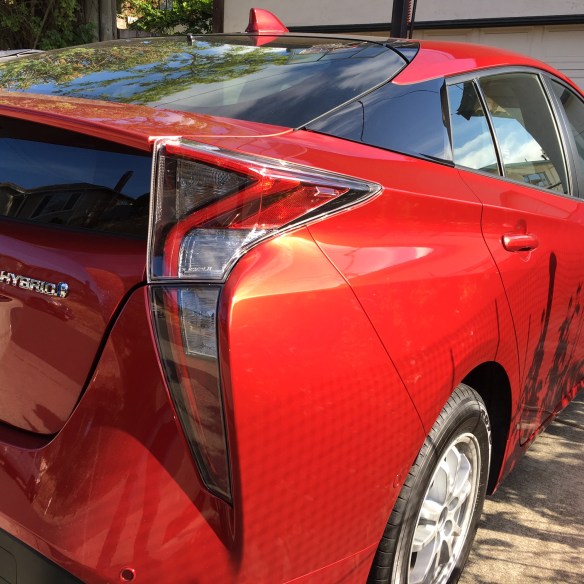
The most obvious change is the startling styling. The new Prius is longer, lower, and wider, but not like the mammoth late 1950’s American cars. It’s a radical interpretation of the now classic Prius proportions, with a squinting face and a finned tail. Thanks partially to that shape, the new car has one of the lowest cds (coefficient of drag) in the industry – 0.24.

PRS_MY16_0014_V002

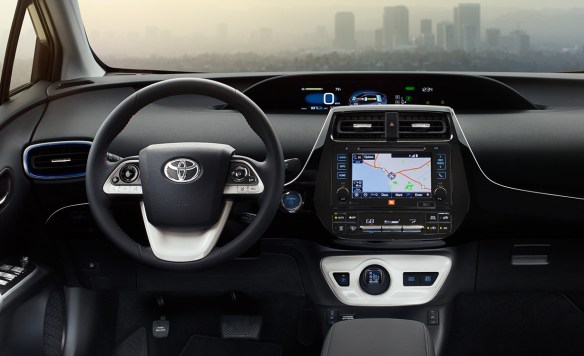
Since the second generation 2004 Prius, the interior has been space-age and swoopy, but the 2016 model is vastly improved. The sweep of the soft-touch panels from dash to doors is dramatic, and with a lower cowl and side windows, visibility is better too. The center-mounted instruments sit on a dramatically layered and in piano black panel. My tester’s only odd item was a white plastic center console (and on the steering wheel and dash), which reminded me of a porcelain bathroom sink.

The Prius has always provided an energy flow display, but the new one offers two. The center console houses the big, colorful one, but the little one in the slim band below the windshield helps you monitor when the engine is on. With awareness, you can lift off the accelerator slightly to move from gasoline to electricity. Being always informed lets you drive at the highest efficiency.

As a hybrid, the Prius uses both its 1.8-liter gas engine and two electric motors to move. For 2016, the engine is set to be on less, so the car runs as an EV more. Some components, such as the continuously variable transaxle and power unit, are smaller and lighter, and some body panels, like the hood, are made of lightweight aluminum.

The new Prius dumps the old nickel-metal hydride battery technology for modern lithium-ion. The battery pack is smaller and flatter, so it fits under the rear seat instead of beneath the cargo area, leaving more cargo space.

The EPA economy numbers are improved, at 54 City, 50 Highway, and 52 Combined. I averaged a splendid 57.2 mpg over a busy week. After you turn off the car, the instrument panel briefly displays a rating of your driving efficiency for that trip. I averaged as much as 80.1 mpg a ride. The screen displays a score, say 74/100, and suggests other measures of efficiency, such as lowering the climate control temperature or accelerating more gently. The Green numbers are 7 for Smog and a perfect 10 for Greenhouse Gas.

Unlike a pure electric, the Prius lets you drive as far as you like with great mpg. However, previous models weren’t a great joy to drive, feeling a bit removed from the road. The new model is greatly improved. Built on the Toyota New Global Architecture, it features a high-strength body structure and a double-wishbone independent rear suspension. This, along with a lower center of gravity, makes day-to-day driving much more engaging.

The new Prius is much quieter inside, thanks to numerous improvements in sound reduction. That benefits music listening, a necessity for the daily commute grind. My tester featured a JBL system with 10 GreenEdge speakers. I played music from a variety of sources, including an easy Bluetooth hookup with my iPhone. There’s a charging spot on the console, but it didn’t work on my iPhone. I think it’s better with Androids.

The Prius comes with the new Toyota Safety Sense technology. This includes a Pre-collision system with Pedestrian Detection, Lane Departure Alert, Automatic High-beam, and Full-Speed Dynamic Radar Cruise Control. There’s also an Intelligent Parking Assist system available. As you’d expect, the high-tech hybrid is a showcase for Toyota’s other technological breakthroughs.

You can get your Prius in six flavors. The entry point is the Two, at $25,035. The Three model adds more convenience and technology features, and the Four is the top-of-the-line model. The Two and Three are also available in Eco versions, which use weight-saving and technological tweaks to up the fuel economy a bit. At the top is the Four Touring—the ultimate Prius, at $30,835. All prices shown include the “delivery and handling fee.”

My tester came in a bright new color—Hypersonic Red. A $395 option, it makes the car stand out in traffic. My tester, with the Premium Convenience Package ($1,705) and Advanced Technology Package ($1,935), as well as a Four Season Floor Mat Package ($364) totaled up to $33,884.

The Prius Prime, a plug-in version of the Prius, arrives soon, for even great efficiency.

Today, hybrids have an important role in minimizing carbon emissions into the atmosphere. Driving a Prius is now more efficient and fun. And the extreme styling does grow on you.

Prius face.jpg

Chevrolet Volt – The Perfect Compromise

IMG_4787

The all-new Chevrolet Volt may be the best solution today for moving to greener driving to reduce CO2 emissions and mitigate the effects of climate change. It’s an electric vehicle (EV) without the drawbacks.

The many advantages of driving an EV include smooth, quiet motoring, minimal service requirements, and the feeling that you’re part of the solution and not the problem.

The downsides of EVs include limited range and the long time it takes to recharge the batteries.

Regular hybrid vehicles combine gas engines with electric motors to extend your fuel out over more miles, but you never plug in. Plug-in hybrids provide a small all-electric range before becoming regular hybrids.

The Chevrolet Volt, which debuted for 2011, was designed as an electric car with a range extender: The Voltec electric drive system. You could charge it up, drive about 35 miles, and then its small gasoline engine kicked in to generate electricity to keep the motor moving the car along.

The totally redesigned 2016 Volt continues on this path, with huge upgrades. Generation one owners gave GM plenty of feedback. Gone are the hard plastic panels with haptic touch controls. The styling is in line with current Chevy gasoline vehicles, like the midsize Malibu. The new car looks great inside and out, with colors and metallic trim befitting a fancier vehicle.

What’s most important, though, is that the new Volt offers an electric range of 53 miles. In a week with my Mosaic Black Metallic test car, I drove in silent, serene full-electric mode for all of my commuting (18 miles each way to work and home), and all of my normal errands. On only two occasions did I need the extended range. The combined range for gas and electric is 420 miles.

When my Volt switched over to gasoline, the instrument panel indicated I had moved from battery power. I could hardly hear the engine when it engaged, and even when the battery was depleted, the car sometimes used it with power generated from braking.

An electric car is rated for MPGe. MPGe assigns a comparative value to the efficiency of different EVs, but it also stands alongside MPG. My week with the Volt generated 118.1 MPGe. The EPA’s ratings are 106 MPGe for electric mode and 42 MPG for gasoline (combined city/highway numbers). Green scores are 8 for Smog and a perfect 10 for Greenhouse Gas.

Compare that to a standard Prius, which gets 52 combined MPG. The Chevrolet Cruze, the Volt’s gasoline cousin, earns 35 MPG combined, itself a laudable number.

The electric motor puts out 149 horsepower (111 kW), and a strong 294 lb.-ft. of torque. The gas engine generates only 75 horsepower, but it’s meant to charge the car rather than drive it. Chevy claims an 8.4-second 0-60 time. I felt confident in it driving uphill on a winding road in the rain.

The Volt comes in LT and Premier levels. My Premier tester flaunted attractive two-tone interior with tan inserts and silvery trim winding around the dash. The center screen is nicely rendered and there’s a jaunty blue plastic top on the “shift” knob. The rear seat now offers a center position, but there’s not a whole lot of legroom for that person. The hatchback is convenient, although it’s a high liftover.

IMG_4778.JPG

The Drive Mode switch lets you configure the Voltec system. Use Normal mode for maximum efficiency, Sport mode to take advantage of the bountiful electric motor torque, or Mountain mode for maximum power on steep upgrades. The fourth mode, Hold, lets you preserve your battery charge and use only gasoline.

Regenerative braking is crucial for hybrids and EVs, but the Volt lets you prime the pump with a paddle on the left side of the steering wheel for “Regen on Demand.” Use it like a brake, while banking charge. With practice, you can drive almost without using the brake pedal at all.

The Volt has its own personality, with a greeting sound and a “wind down” tone it makes when you turn it off. Because the electric motor is silent when you start the car, the blue Power button is more like turning on your iPhone than turning over your engine.

The LT starts at $34,820 and the Premier, with heated leather seats, a Bose stereo system, and more, starts at $39,270. My tester listed for $39,850. Various leasing options, plus some Federal and State rebates, can make these cars easier to drive home.

While an all-electric car may be the ideal way to go, it’s not practical for everyone today. But if you want a compact car that’ll do pretty much everything and let you drive electric most of the time, the Volt is a great solution.

EVs and their Sociable Drivers

Call it a cult, but EV drivers, I’ve found, are a sociable bunch. We love to talk about our cars, look at each other’s rides, and learn more about the EVs we don’t have yet, such as the Tesla Model 3, which has received more than 325,000 $1,000 deposits in just a few days.

I like to group my little Fiat, Fidelio, with other cars, too. Then, I talk with the owners. Sometimes, I just park him near the other EVs and snap away. Here are a few recent shots.

This one just happened – One Fiat, two Nissan Leafs, in repose.

IMG_5095.JPG

And for good measure, here’s Fidelio with one  of his Tesla friends–also at the office.

IMG_5102

And, tonight, three members of the Castro Valley Chamber Orchestra brought their cars together for a photo after a two-hour rehearsal. From left to right, Esteban’s 2016 Tesla, Bev’s 2016 Chevy Volt, and Fidelio, my 2016 Fiat 500e.

IMG_5116.JPG

They’re lucky. Although we all just started driving these shiny new cars, they get to keep theirs. But Fidelio has to go  back to the fleet in 10 days. I’m sad. When you live with an EV for months, it grows on you. The smooth, quiet ride, the silent cabin where the radio plays so clearly. The never stopping at the gas station. The torque.

The Tesla and Fiat 500e are pure electrics, while the Volt–in the center above–is a plug-in hybrid. But the Volt will go up to 53 miles on a charge, so if you don’t travel too far, you can use it as an electric car virtually all the time. In fact, Bev tells me that the new Volt will burn off the gas automatically if it gets too old!

New Flavors of Hybrid – Kia Niro

2017 Niro

2017 Niro

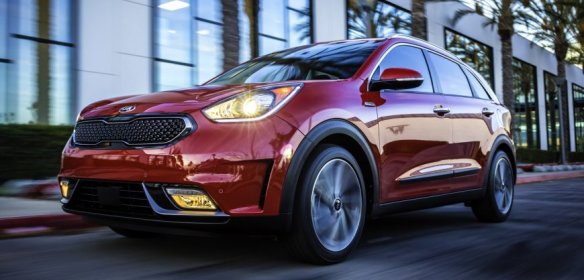
There are lots of ways to drive “greener,” and Kia is about to provide another. Already offering the Kia Soul EV all-electric hatchback and Sonata Hybrid, they now proudly present the Niro hybrid. About the size of the popular hybrid poster child Toyota Prius, it’s a crossover, so it’s taller, and looks like what folks increasingly are buying. Compact crossovers are hot hot hot. Great timing for Kia. We’ll find out more about this new entry as it hits the market later this year, but it looks like a winner so far.

Read the linked article above for details, but it looks like it’ll hit the 50 mpg target, competitive with the Prius. And like all Kias and Hyundais today, it has the creative eye of Peter Schreyer, former Audi design director, upon its fresh sheetmetal. Likely to be priced competitively, it just makes the choice harder (and better) this year.