Electric Cars: A Drop in the Bucket

Today, I read on the Clean Fleet Report website an interesting piece by Michael Coates about the Bestselling Electric Cars in the U.S. in 2015. Take a look and you’ll see the usual suspects.

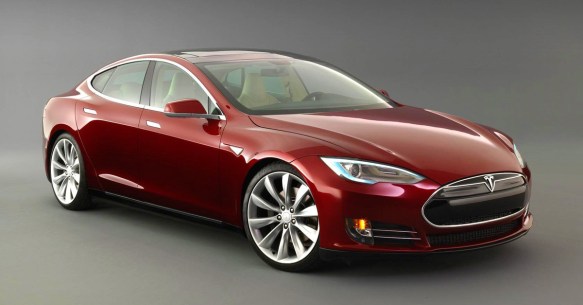
The top seller was, surprise surprise, the Tesla Model S, with 25,700 sold at $63,700 apiece after tax credits.

Tesla-Model-S

The Nissan Leaf, the previous leader, placed second, with 17,269, at a much more affordable $22,360 after tax credits. My baby, the Fiat 500e, came in at 7th place, with 6,194 sold at $25,700, after tax credits. Read all about them in the article.

The point, though, is that even though sales are increasing, this represents a minuscule portion of the car market. 2015 was a huge year, with around 17.5 million vehicles new vehicles sold. The industry has, by pretty much any standard, recovered, although not all companies are succeeding as well as others.

As I drive Fidelio to work and back I see a smattering of Volts and Leafs, an occasional “twin” 500e, and a Tesla or two, but we are a tiny minority. Mostly, we’re swimming in a sea of gas-burning cars and trucks of all shapes and sizes.

If we want to have an impact on the CO2 problem, there have to be LOTS more electric vehicles on the road as soon as possible.

Please join us. Even driving a new Chevrolet Volt, which features a gas engine along with its electric motor, has an all-electric range of up to 53 miles, which can make an impact.


Fidelio – Features I Like

When you settle in and start driving a car regularly, you find the features that stand out, or make you smile. It might even be a little smile. Of course, what I like best about my little Fiat 500e is its all-electric drivetrain, which means smooth, nearly silent operation and no gasoline–ever! But here are three small things I’ve enjoyed so far.

  1. Audio controls on the back of the steering wheel

IMG_4528

You can get these in any car sold by Fiat Chrysler Automobiles, including Jeeps, Dodges, and now, even Fiats. One of the safest and easiest ways to control your sound, the controls, one on each side of the steering wheel, do what dials and buttons used to do on the dash. Some cars have them on the front of the wheel, but these are better because you don’t even have to look at them (or even can look at them) and take your eyes off the road. Each pad has a round center button and a top and bottom section that you also push.

On the left, the center button skips from one preset to the next. The other two move you through the radio tuner, or tracks of a CD or Bluetooth stream. On the right, the center button changes mode, from AM/FM radio to CD, SiriusXM, or Bluetooth streaming. The other two adjust the volume. Once you get it, it’s so easy.

2. Push to lock

IMG_4535

To keep it simple and clean, to lock the door, just push the handle in towards the door. I think this may replicate the way the original 1950s and 60s models did it. See the little red bar? It means it’s locked.

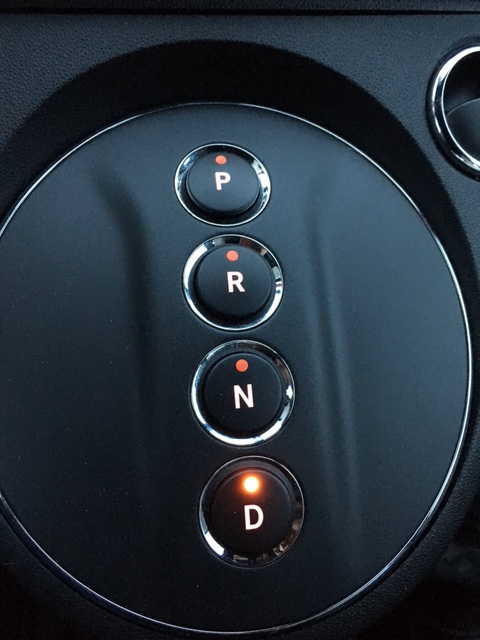
3. World’s easiest push-button transmission controls

IMG_4536

With only one speed (electric cars don’t need or use gears), it’s just a D for drive and you’re off. Simple, and takes up no space. Of course, it’s great fun to shift gears manually in a gasoline car, but this is the future, and I’m OK with that. Notice there’s no “L” for Low–you don’t need it. And the shaping of the panel keeps it  from looking flat and cheap.


EV Drivers – Pioneers and Tiny Minority

As I look over the pretty white dashboard with the silver rings in my Fiat 500e, I smile when I see another 500e on the road. Most of them have their stickers so they can ride in the car pool lane and skip tolls on the bridges. As a borrowed test car, mine doesn’t.

I enjoy seeing a BMW i3 whiz by. Nissan Leafs are common, distinguished from each other only by color. It’s nice to see the new 2016 Chevrolet Volt is taking off. I see them frequently, with their all-new look. Their unique taillamps flaunt a fresh signature on the way home at night.

But, we EV drivers are still a tiny minority on the highways and byways of America. For every one of us there are 100 Ford F150s or Toyota Camrys or Chevrolet Tahoes. Cheap gasoline has encouraged a boom in larger cars, so even intelligent choices like the Honda Fit or Hyundai Elantra languish.

Sergio Marchionne, head of Fiat Chrysler Automobiles, said he’s ramping up production of big Jeeps and reducing production of smaller, more efficient Dodge Darts and Chrysler 200s. Why? Because big Jeeps are the cars that people are buying, and he has to run his company at a profit. It’s a good–even necessary–business decision, but it’s not helping the environment. Marchionne has already stated that FCA loses thousands of dollars on every little Fiat 500e it sells (although the company gets credits towards its Federal clean air obligations).

The people are speaking, and most of them are not EV enthusiasts. They want what they want and like. You can’t blame them. Like the climate crisis in general, if you can’t see it, it’s hard to muster up the energy to do anything about it.

To my left, a giant, black Cadillac Escalade momentarily blocks out the sun. It’s going to be a long haul (but worth it).


Fiat 500e – Range Budgeting

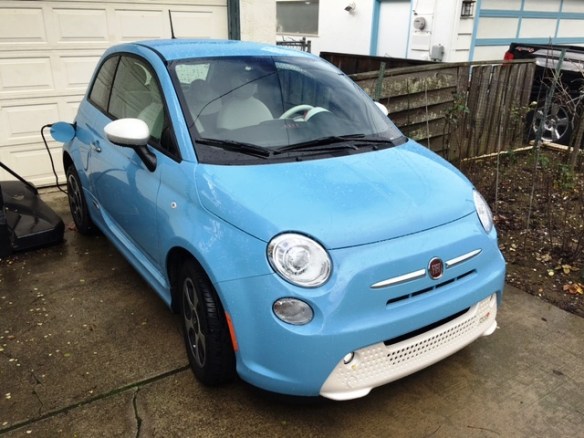
When you’ve got an electric car and lots of things to do, you need to plan accordingly. Yesterday, I would have taken Fidelio, the little blue Fiat 500e, on my errands around town, but I had to top off his battery so he’d be ready for a 30-mile trip today. Also yesterday, while my wife, son and I drove to a family dinner 80 miles from home, he remained here in the driveway, tethered to the charger. I think he looks a little sad, but it could just be the camera angle and the rainy weather.

IMG_4500

Today, he gets a nice freeway cruise into Oakland. I’m expecting little traffic, so there won’t be much chance to regenerate power. With a full battery, this should be no problem.

I’m sure this range business will be part of my life as long as my three-month test lasts, and it takes thinking and planning–something you don’t do with a normal gas-powered car. But I’m already finding that it helps you reduce driving in general, and cleverly combine trips to maximize economy. As long as you have a petroleum-drinking second car around, it’s all possible.


Fiat 500e – Home Charging

Well, it’s been a great week of commuting and charging at work, but now that I’m home for the weekend, it’s time to plug in in my garage.

I wish my garage wasn’t so full of accumulated junk, but it is, so I have to use the method I’ve used with my other electric test cars–I plug in the charging unit inside the garage, attach the charging plug into the socket inside the “gas” door on the right rear corner of the car (backed in, of course), and then lower the garage door down to about an inch away from the concrete.

This is easy in clear weather, but is less pleasant when it’s raining. I did check, though, and the water doesn’t seem to want to drain into the garage. With Fidelio, my blue 500e, visiting into the springtime, I really need to clean out the garage so he can sit inside.

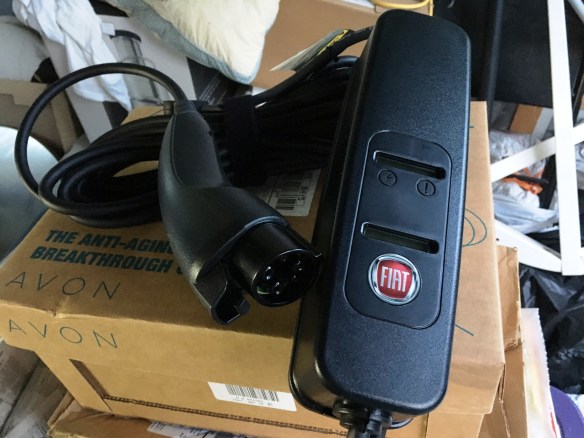
Since Fidelio came to me new, with just 79 miles on the odometer, I am the first journalist to drive him, so I got to take the charger out of its original plastic bag from the factory.

IMG_4493

It came with a slim User Guide, but I’m an old hand at home charging, so I left it in the bag for future journalists.

Fiat provides a sturdy, and long-enough, cord. You’re cautioned not to use any extension cords when charging. Most are probably not rugged enough to handle the job.

IMG_4494

When it’s plugged in, you can see it working by the movement of the green lights in the bar above the Fiat logo. There’s also a light inside the car, on the top of the dashboard, that shows an approximate level of charge in the car–kind of like the five dots on a Fitbit Flex.

So, I set it up and that was that. Sadly, home current, at 120 volts (known as Level 1 charging) is very slow. My level 2 ChargePoint chargers at work (240 volts) are much more efficient.

Here’s a record of my four visits to the chargers this week from the ChargePoint phone app. Fidelio had a partially full battery when I plugged in, but was topped off by lunchtime (on Wednesday through Friday).

IMG_4497

The first charge, on Jan 19, was in the afternoon, and the battery was 2/3 full. The others were typical, and show the amount of estimated range, time, and cost for the charge for each session. Interestingly, the addresses vary, although the six chargers are all right next to each other. 🙂


Regeneration Gives Extra Miles

When you’re driving an all-electric vehicle, you probably spend more time looking at the range number than the miles-per-hour indicator. If the number on it is close to the distance you’re planning to drive, it can be nerve wracking. Luckily, regenerative braking adds to that number.

For example, today, I drove 18.6 miles to work in stop-and-go traffic. I started out with 46 miles on my cute little Fiat 500e’s dashboard screen. Amazingly, halfway through the trip, it was at 45–just one mile down. At trip’s end, I pulled into my parking lot and saw 40 on the screen. I regenerated enough juice to take just 6 miles off the battery for an 18-mile ride. Nice!

Conversely, if I had gone the entire 18 miles at a steady 70 mph, it would probably read 28–or lower. It’s all a balance.

Electric cars use MPGe instead of MPG (miles per gallon). I earned 138.6 for this morning’s trip. 🙂

Fidelio is Here

Fidelio-rainbow

And what a nice welcome, with a rainy day diminishing briefly, displaying a beautiful rainbow.

I drove him around the building to see if any charging stations were open. Nope! I have 60 miles of charge, so I’m OK, but I’m hoping to top him off this afternoon. With only 120 volts at home, it would take longer. So, I’m already “worrying” about charging. But it becomes routine, and with my normal early arrival time, I’ll surely get on one of the chargers without a hitch tomorrow morning.

Fidelio--arrival


200 Mile Electric Range Means Progress

Chevy Bolt

At the Consumer Electronics Show in Las Vegas, two important electric cars are making their debut now. One, the Chevrolet Bolt, has been teased for months, but now it’s slated for arrival at the end of this new year! The exciting thing? It boasts a 200-mile range–a game changer in the everything but Tesla electric car field. That could make the difference in choosing electric over gas.

160106-volkswagen-budd-e

The other intro was VW’s BUDD-e, which disappointed some by not being the next Microbus, but with its sleek boxiness, it could be trendy, and it’s supposed to get well over 200 miles per charge. It’s not a 2016 or 2017 model, though, sorry, but it demonstrates a platform that will underlie numerous other VW electric products. Great timing, with the “Dieselgate” crisis still on folks’ minds.

As eager as you may be to buy an electric now, there’s a real incentive to wait, if the Bolt is as good as it looks. With the new Volt beside it in the showroom, this is a strong set of green rides from a surprising source.


Paris Is Just the Beginning

I’m excited about the Paris Climate Agreement, and think it’s a great start. But that’s just it–a start. In itself, the agreement won’t solve the problem.

My personal focus on carbon reduction is car-related, so I’ve been thinking more about what we can do now to make an impact.

You can buy an electric car, if you want to. There are lots of choices, and lease rates are cheap. Unless you opt for the super-luxury-priced Tesla, though, you’ll be out of luck if you want to drive your e-car everywhere you take your current gas model. Range is less than 100 miles, except for the 2016 Leaf, which is claiming 107. Still, the point is made.

But I was wondering. What if we got, say, even half of the driving population to switch to electric? We still need to create the electricity. Where we get it would make a big difference. If it’s from a coal-powered plant, we’re still pushing out CO2.

And what happens to all of those old gas cars? Someone else would buy them and drive them. That just transfers the problem to a new owner.

Not too long ago, the Federal Government instituted a “Cash for Clunkers” program to buy up old superpolluters for more than they were worth and give the seller a few bucks to go buy a newer, cleaner car. What if there was a program for folks to turn in their old car and buy an electric (or hydrogen fuel cell vehicle, when available)? Then, the old car gets crushed and all the materials in it are recycled. That might help a little. The cars that don’t get crushed will have to be retired, too, as soon as possible.

It’s hard to see ahead 35 years to 2050, when we will need to have succeeded in our Paris commitments to limiting the temperature increase since pre-industrial times to 2 degrees Celsius (3.7 Fahrenheit). 1.5 degrees would be even better, scientists say, but it’s a really tough goal, according to what I read.

We need to start now, and not wait around. But I’m just like everyone else. I like my lifestyle and I don’t want to be limited or have to make changes. But, if I don’t, how can I expect anyone else to?  And if WE don’t, the temperature will just keep on rising.


Seeking Green at the San Francisco Auto Show

As always, I made time during the Thanksgiving long weekend this year to attend the San Francisco Auto Show. The 2015 version was no different than last year’s event. It’s essentially a huge showroom without pesky salespeople–where you can look at all the cars, sit in them, grab a little information, and get exhausted.

This year, I focused on electrics, hybrids, plug-ins, and alternative fuel vehicles, while looking at what’s new, too, and strolling nostalgically past some classic treasures.

The first thing I noticed in the far-ranging Moscone Center was that most cars are none of the above. If you’re lucky, there’s one per brand. Some, like Ford, offer multiple options, but you still have to seek out the environmentally friendly models, and the areas around them were generally not busy.

The big news this year comes from a new Chevrolet Volt and Toyota Prius. Both were there in multiples.

IMG_4324

The Volt (above) has been totally redesigned, and is both more attractive and more efficient. While the old model was loosely based on a radical concept car, this new Volt looks more like other new Chevys–which is better. It’s also has a bigger range in pure electric mode.

I first saw the Volt as part of the PG&E display, and wore its logo on the side. PG&E wants consumers to understand what buying and living with an electric car means, as the friendly utility that supplies their car-charging juice, and they featured some helpful displays and take-aways.

The company also got a chance to display their hybrid Ford work trucks. According to the PG&E spokesman, who actually works on one of the trucks, the guys just love them.

IMG_4322

Over in Toyota land, several Prii (Priuses) sat next to one Toyota Mirai, the company’s entry in the hydrogen fuel cell segment. The Mirai, for lease to a tiny group of early adopters willing to be beta testers for a car with virtually no places to fill it up, is one of the least attractive vehicles I’ve ever seen, but if and when hydrogen becomes a viable fuel to power automobiles, Toyota hopes to lay claim to the “Prius” of hydrogen cars by starting now.

The new Prius still looks something like the generation two and three models, but has gone wild, much as the latest Camry has, in an effort to refute any accusations of being boring.

IMG_4331

Mind you, the Prius is fabulous for getting there on minimal fuel (an honest 50 miles per gallon), but has never been a sporty ride. The new car, with floating roof, head- and tail lamps that are splattered across the corners of the car, and a dash panel that hides the information away from your eyes, will be polarizing. According to reports I’ve read before getting my hands on one, it is more fun to drive, intentionally. I can’t wait to find out.

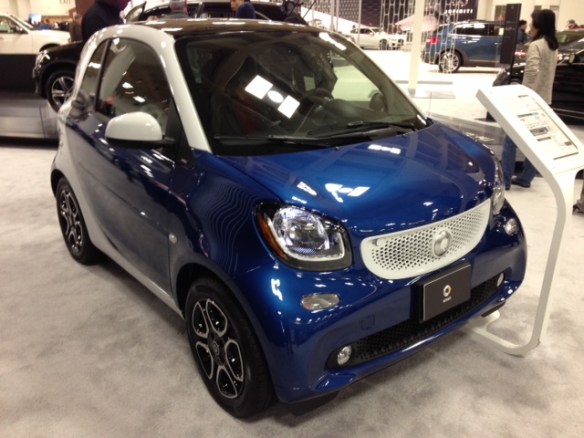
If you simply want to save fuel by driving a tiny car, the all-new Smart is here. Looking a bit more substantial, but still like half a car, it is not the highest in fuel economy (although an electric is offered). It is simply the best to park, and is still very cute.
IMG_4313

Where it gets more interesting is in places like Volvo, that now offers a hybrid version of its handsome, all-new XC90 crossover. Winning Motor Trend’s SUV of the Year competition places it more directly in front of potential buyers. The young woman showing it off told me that a pure electric is in the future, pending availability of more powerful batteries for longer range.

The Porsche 918 was there, as was the BMW i8, proving that you don’t have to drive a regular car to conserve fuel. The Porsche will set you back at least half a million dollars, while the BMW is a more “modest” $125K or so. Both surely occupy some teenage boys’ walls next to the Ferraris and Shelby Mustangs.

One note on regular cars. The new Honda Civic was there, and I was looking forward to seeing if it is as huge in person as in photos. The answer is Yes. The sweet little CVCC of 1973 has ballooned into a big sedan that looks like an Accord. Its styling is so bold and carefully rendered to not look cheap that it appears overblown and is hard to remember.

We need Honda to not just give us the Fit (pun avoided), but an even smaller model to compensate for this scary development. Of course, they’ll sell the usual 300,000 Civics to Americans in 2016, anyway. And, if it’s more efficient than an Accord, great! There isn’t a hybrid or electric model available yet.

With my family in tow, we wandered through other areas, including a huge ballroom full of customs, which included late-model BMWs and Subarus as well as a glorious low-riding 1959 Buick and some exquisitely customized muscle cars. Also, on the main floor, behind the Chryslers and Jeeps, the selection of new and historic Aston-Martins was dazzling. The Academy of Art University brought a fabulous assortment of fine classics, from a Stutz worthy of film royalty to a sweet Austin-Healey that looked exactly like one treasured by my dad in the 1960s.

And that is what makes it so challenging, and exciting, to be searching for an automotive answer to our climate problem while appreciating the beloved old internal combustion vehicles. When will a new car show include no more ICE models? Will we still love a 1941 Lincoln Coupe or a 1966 Porsche 911 25 years from now, even if they are part of what’s got us into this mess in the first place?