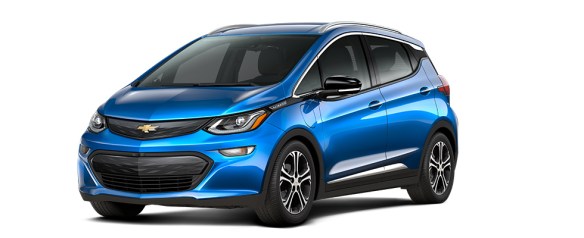
Chevy Bolt Gets a 238-mile Range!

Today, Chevrolet released the official EPA range for the new Chevrolet Bolt all-electric vehicle. It’s 238 miles–more than what was advertised earlier, and enough to put all the other EVs in the dust! Yeah, you can spend three times that amount for a Tesla, but in the world of regular earth-loving folks, the Bolt is set to change the story. And, with the newly updated website, you can now see the models and colors available and a lot more information.

Price is still not official, but they’re talking about $37,500 before the Federal and California rebates, so it could be a $30K car.

I personally can’t wait to order mine in brilliant blue!

bolt-9-13-16-blue

Now, we also know that the Bolt, like the Volt, will come in two levels–LT and Premier. Want leather seats and shinier wheels? The Premier it is. You also get roof rails, heated front and rear seats, various life-saving alerts, and more. The website lists the differences.

Based on my experience with the Volt, the upper level car will look and feel better, but will cost several thousand dollars more. I just hope that I like the LT and that I can get it with DC fast charging. That method of charging lets you add about 90 miles to the battery in the time it takes to have a relaxing cup of coffee and a snack on the way somewhere.

In a related piece of good news, Volkswagen, BMW, and ChargePoint (the largest car charger company) have teamed up to build 95 Level 2 and DC charging stations as part of the  Express Charging Corridors Initiative along the East and West Coasts. For me in California, that means Highway 5 and 1 between Portland and San Diego. Back east, it’s between Boston and Washington, DC. That’ll go a long way to helping folks with EVs with 90 mile ranges get out and see the country. Of course, the Bolt, Teslas, and upcoming 200-mile cars like the next Leaf, will become even more worth owning.

Chevy now has a new EV-themed site, Chevyevlife.com, that explains about living with an electric car. After all, they are going to have three models to sell soon, including the Bolt, the fine new 2016/2017 Volt plug-in hybrid,and the Malibu Hybrid. The tiny Spark, having blazed the modern EV trail for the brand, has quietly exited the building.

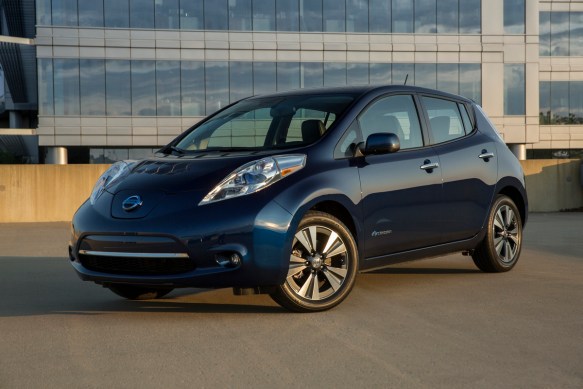
Nissan Leaf – EV Pioneer

2016_nissan_leaf_02.JPG

The Nissan Leaf was designed from scratch to be a gas-free all-electric model. They’ve sold more than 185,000 of them since its debut in 2010 as an ‘11, and a pioneer in mainstream EVs.

The Leaf hasn’t changed much over the years, though, until now. The 2016 model looks the same, but you now can get one with a 30 kWh lithium-ion battery. Adding just 46 pounds, it’s got higher power density, so it earns a 107-mile driving range from the EPA, versus 84 for the old 24 kWh battery, a 27 percent improvement.

For most driving, and many people, 107 miles is plenty. I drove my Deep Blue Pearl Leaf back and forth to work every day, in quiet comfort, the Bose audio system pouring out music from the standard Sirius XM radio and Bluetooth-connected selections from my Spotify stream.

The problem comes when you want to drive further. I got home one day with 85 miles on the range meter, and we had to take a quick trip that was about 70 miles. Because I wasn’t sure that was enough, we took our internal combustion engine car.

Although its design is aging, the Leaf feels smooth, solid, and friendly. With its virtually silent and vibration-free 80 kW motor, you fly along, almost by magic. Torque is available from the moment you step on the accelerator pedal, so there’s plenty of hustle from the 107 horsepower and 187 lb.-ft. of torque moving the 3,391-lb. car.

The EPA rates the Leaf at 124 MPGe City, 101 Highway, and 112 Overall. The Smog and Greenhouse Gas numbers are perfect 10s. The Leaf also gives you a miles-per-kWh rating, which was 4.1 for me. With 30 kWh, that looks like about 120 miles per charge.

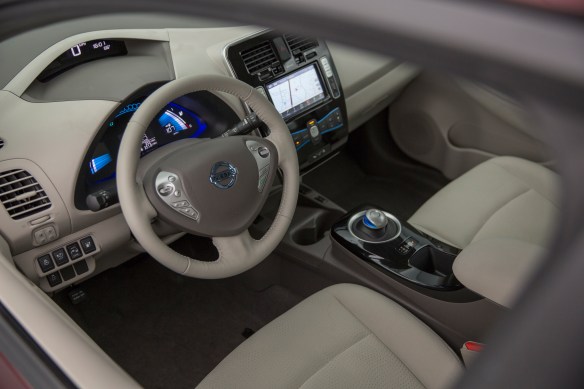
2016_nissan_leaf_27

The one-speed transmission is controlled by a “palm shifter,” which, with its bright blue plastic front edge, reminded me of a Duncan Imperial yoyo. Just slip it back into Drive or forward into Reverse or push the Park button on the top.

The battery below the floor means a low center of gravity, so the Leaf is stable, and you feel secure darting around through traffic. But you are encouraged to drive gently to preserve charge. Nissan gives you a little Eco indicator at the top of the instrument panel, which assembles a little tree. The completed tree shrinks and moves to the lower right and you start on another one. I normally grew two on my 18-mile commute.

Unlike some other EVs, the Leaf is rated as a midsize car, and fits five adults, while providing 24 cubic feet of cargo space with the rear seat up. Drop the rear seat for an additional six cubic feet. I hauled my upright bass with ease, although the storage area isn’t flat—it’s deeper at the rear.

To charge the Leaf, a panel flips up on the car’s nose. In there, you’ll find the standard plug for using a Level 2 (240-volt) charger or a cable to charge (slowly) at home at 120 volts. A Level 2 charge takes about 6 hours. Upper level Leafs include a Quick Charge plug, which lets you refill the battery to 80 percent capacity in half an hour.

The Leaf is so quiet that Nissan provides an “Approaching Vehicle Sound for Pedestrians.” It’s a low-volume beep, which emanates from a speaker under the hood at speeds below 16 mph. I only heard it when backing out of my driveway.

The three models start with the S, the price leader, at $29,860. It comes with push-button start, electric windows, locks and mirrors, air conditioning, and a decent audio system, but gets only the 24 kW battery.

The mid-level SV starts at $35,050. It has the 30 kW battery and the Quick Charge plug. It also features the NissanConnect system with Navigation, a larger 7-inch display screen, two more audio speakers, and 17-inch alloys in place of 16-inch steel wheels.

The SL, at $36,790, is distinguished mainly by its comfortable leather seats. You also get a photovoltaic solar panel on the rear spoiler, heated rear seats, a cargo cover, and a couple other items. My SL tester came with the Premium Package, with an upgraded Bose 7-speaker audio system and the Around View monitor (it gives a bird’s eye view). It topped out at $39,390. All prices listed include the $850 delivery charge.

Retail prices are perhaps irrelevant, since many EVs are leased at bargain rates, and there are government tax credits that can significantly reduce your costs. Figure in that electricity is much cheaper than gasoline and EVs require much less maintenance, and it could be a real bargain.

2016_nissan_leaf_23

The Leaf, built in Smyrna, Tennessee, has been the most popular EV out there, and if you’re not budgeted for a Tesla, is still a good option.

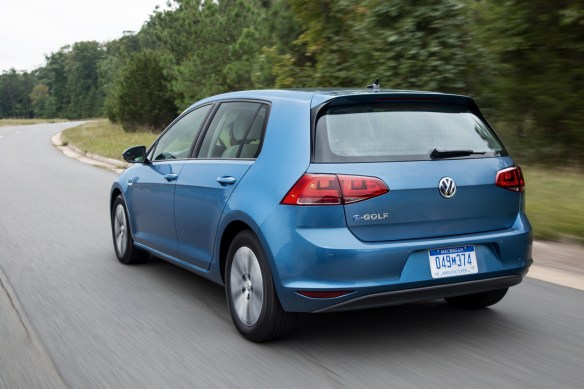
Volkswagen e-Golf Delivers

2016_e-golf_5254The Volkswagen Golf has been sold around the world for 40 years. A mainstream model in Europe, it’s less central to VW’s model mix in the U.S. However, with a major redesign for 2015 came Volkswagen’s first all-electric car, the e-Golf, and it was worth the wait.

The e-Golf is aimed at pure electric vehicles like the Nissan Leaf. There is no sacrifice in driving enjoyment or practicality in choosing the electric option. In fact, it boasts the same 95 cubic feet of capacity as the gas version, with its battery tucked away out of sight.

2015_e-golf_3913

The e-Golf’s motor puts out 115 horsepower and 199 lb.-ft. of torque through a single-speed automatic transmission. This electric Golf still delivers the same fine road feel as the sporty GTI, and at 3,391 pounds, doesn’t feel sluggish. Although it didn’t rocket ahead like a GTI, at 10 seconds from zero to 60, the feel of electric motor-driven acceleration is instant and exciting.

Naturally, the driving range of an all-electric vehicle is at the top of any driver’s mind. The e-Golf gets an official rating of 83 miles, but when I charged the car up, I saw a reading as high as 98 miles on the instrument panel gauge. How you drive, what kinds of roads you drive on, and how you program the car’s adjustable settings make some difference, but this car didn’t feel like it would leave you in the lurch.

The official EPA numbers are 126 and 105 highway. That’s MPGe – miles per gallon equivalent. Use these numbers to compare electric vehicles. Pretty impressive.

To ease your range anxiety, VW provides a roadside assistance program. If you run out of charge within 100 miles of home, they will take your car to a charging station and to get you home via taxi or other transportation method on their dime.

To maximize your e-Golf’s efficiency, there are three driving profiles: Normal, Eco and Eco +. The latter two progressively lower the horsepower and top speed, change the accelerator action, and in the case of the Eco + setting, turn off the climate control, to reduce energy consumption. You can also program the amount of regenerative braking to generate a small amount of juice in the normal setting or produce progressively more in two other settings.

VW provides the VW Car-Net app, so you can keep track of your charging, turn the climate control on or off remotely, and monitor performance data for your car. Part of owning an electric is the science project aspect, where you are thinking about what your car is doing rather than just sitting in it and going. It’s important and fun, too.

The VW Golf was all-new for 2015. It’s a two- or four-door hatchback, but also, in 2015 it took on the wagon role from the Jetta. Numerous engines and trim levels are available, but you can tell the e-Golf by its blue accents.

VW originally sent the e-Golf to market as the loaded SEL Premium model. That means full climate control, heated seats, leather steering wheel and shift knob, alloy wheels, heated mirrors, and the like. Now, VW also offers the SE, which shaves thousands of dollars off the price by swapping out the alloy wheels for steel, LED headlamps for standard halogen, and cloth seats in place of leatherette. Federal and state tax rebates help mitigate some of that cost as well.

Charging is simple. However, using household 110/120 volt current, it could take you 20 hours to fill the battery from empty. A 220/240 volt charger, which you’d install at your house if you owned the car, can do it in less than 4 hours. The e-Golf SEL or SE with the optional Quick Charge package has the SAE combined quick charge socket, so you can get an 80 percent charge in 30 minutes in a pinch.

2016_e-golf_5250

It’s particularly quiet inside the e-Golf because when VW removed the vibration-causing gas engine, they went after the little sounds that could annoy you, which were suddenly exposed. The car emits a little sound at low speeds, so oblivious pedestrians are warned of your approach.

Part of owning an electric is the knowledge that you’re reducing your carbon footprint and helping the planet. In that spirit, VW has teamed up with 3Degrees, a renewable energy service provider, to offset the e-Golfs greenhouse gas emissions from its production, distribution, and 36,000 miles of charging.

The SE starts at $28,995 with the SEL at $35,595. The SEL earns its extra price with things like Driver Assistance, Navigation, leatherette upholstery, quick charging, and more. The SE with the quick charge option is probably the sweet spot. Leasing remains the way to get into one of these cars surprisingly affordably.

My Pacific Blue tester was a delight. Electric motoring is smooth and pleasant. With an 11-mile commute at the time I tested it, I had plenty of charge left over at the end of the day. This is an ideal commute vehicle, with its quiet, spacious interior and gasoline-free ways, but as with any other electric car (except a Tesla), you’ll need another car for long trips.

2015_e-golf_4194

Volvo XC90 T8 Hybrid – Unique

The all-new Volvo XC90

The all-new Volvo XC90 is a handsome, luxurious, comfortable, fuel efficient, and expensive large crossover. All all new, it’s a huge step forward for the Chinese-owned Swedish brand.

The regular gasoline versions are badged T6’s, but my car I tested was a Volvo XC90 T8, the world’s first seven-passenger plug-in hybrid SUV.

All XC90s share a potent 2.0-liter four-cylinder engine that uses both super- and turbo-charging to put out 313 horsepower and 295 lb.-ft. of torque. The T8 adds an electric motor and a battery pack to deliver limited electric-only motoring and a total of 400 horsepower and 472 lb.-ft.  of torque. I drove my 18-mile commute entirely on electricity once, but normally achieved just under that. The center screen shows graphical and digital statistics, and where the power is flowing.

Hybrid system settings are Hybrid, the default mode, which switches back and forth from fuel to charge. Pure mode means all-electric. Power mode combines the motor’s instant torque and the gas engine’s size to provide V8 level performance. Save mode lets you retain the battery charge for later use.

An EV range in the teens is typical for plug-in hybrids, and remarkable for a 5,059-lb. vehicle. The EPA gives it a 53 MPGe rating (compare that to other battery vehicles). In pure EV mode, it’s much better. Gas-only delivers 25 MPG. My tester averaged 22.7 mpg over 63 hours and 1,578 miles, including previous journalist loans.

Green scores are 7 for Smog and a split number for the Fuel Economy/Greenhouse Gas rating—7 for MPG and an 8 for CO2.

Pricing for the T8 starts at $69,050. My tester, with the $3,500 Inscription level upgrade, plus a raft of safety, convenience, and style packages and features, came to $84,005. That’s a big price tag, but this car is a great experience.It’s filled with luxury features, including an Orefors crystal shift knob and some beautiful food trim.

The all-new Volvo XC90

The XC90 T8 was named Green Car Journal’s Luxury Green Car of the Year, and is part of what is a welcome resurgence for Volvo, a brand with a historic commitment to safety, today’s latest technology, and now, a greener way to move a family of seven.

Yeah, it’s not a full-fledged EV, but it’s a move in the right direction. I’m look forward to Volvo offering a full EV before too long.

IMG_5801

Mercedes-Benz’s Electric Option–B250e

IMG_5849

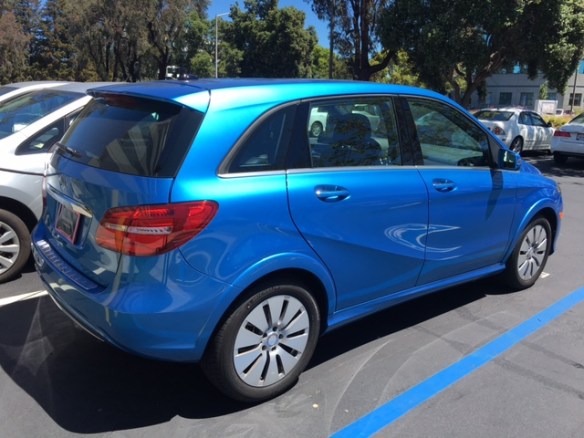
There’s an electric-powered Mercedes-Benz out there, but you can be forgiven if you haven’t noticed. Quietly, the B250e is rolling around town, if you happen to be in California or other EV friendly locales.

The B is a five-door hatchback–not the shape you expect from Mercedes. The B-Class is sold in other parts of the world, including Canada, as a small, utility-minded gasoline-powered car, but in the U.S., B-Class cars are EVs only (labeled Electric Drive). There’s a tiny A-Class sold overseas, too, but you won’t see one here.

It makes sense for the German giant to put an all-electric powertrain in a small vehicle. Roughly the size of a Nissan Leaf, it has less weight to labor the battery pack with. With a folding rear seat, it’s spacious in the back. In the bright blue of my colleague Pam’s new commuter car, it has a friendly aspect to it.

I’ve been eager to test Mercedes’ baby EV, so when I saw one attached to the chargers at my building, I slipped my card under the driver’s side wiper and waited for the owner to respond. Pam did, and offered to show me around the car–and even let me drive it for a few minutes.

The B may look like a generic hatchback (despite it’s dramatic character line that rises up the side), but inside, it feels like a Mercedes-Benz. While not furnished in rare woods, and rich leather, it has dignity and mass, and an instrument panel that looks like a Mercedes-Benz’ should. It feels more upscale than other EVs I’ve tested. It can’t match a Tesla, of course, but it’s not priced as one, either.

Driving the car is, judging from my brief test, pleasant and, of course, silent. There are settings for S (sport), E (eco) and E+ (eco plus), and, I think, a “normal” setting. If you set it to S, you get the full benefit of an electric motor’s instant torque and rocket ahead with a snap. In E or especially E+, the drivetrain feels anaesthetized, but that’s so you use less juice.

Stats: 132 kW electric motor, 177 horsepower, 251 lb.-ft. of torque, 0-60 in 7.9 seconds.

Pam, who stepped out of a reliable Mercedes-Benz M Class SUV, has been getting about 83 miles per charge in her new B, which puts it in the realm of the original Leaf and other cars like the Ford Focus EV and Fiat 500e. Mercedes claims 87 miles. But the future is looming, with 200+ mile range EVs on their way, so I’m guessing that the Tesla-sourced engine/battery will be getting an upgrade before too long. Meanwhile, for a commute from southern San Jose to San Mateo, California, the little Mercedes-Benz EV is just the ticket. Pam has level 2 (240 volt) charging at home and here at work, so she never has to run out, as long as she doesn’t stray too far from the normal path.

Pricing is officially $41,450, but as you might expect, leasing drops costs considerably. Pam leased hers for a little bit more than $300 a month with some money down. The Federal rebate was applied directly to the lease, and her California state rebate is on its way. She relishes her white carpool-lane stickers, too.

The B is a natural competitor to the BMW i3, and, as these two German competitors go, it’s the more sober, elegant one, versus the radical BMW. But by all means, you should cross-shop.

I’m eagerly awaiting my chance to spend a week with this car, but for now, it looks like a winner to me–for the right driver and purpose.

IMG_5850


Chevrolet Volt – The Perfect Compromise

IMG_4787

The all-new Chevrolet Volt may be the best solution today for moving to greener driving to reduce CO2 emissions and mitigate the effects of climate change. It’s an electric vehicle (EV) without the drawbacks.

The many advantages of driving an EV include smooth, quiet motoring, minimal service requirements, and the feeling that you’re part of the solution and not the problem.

The downsides of EVs include limited range and the long time it takes to recharge the batteries.

Regular hybrid vehicles combine gas engines with electric motors to extend your fuel out over more miles, but you never plug in. Plug-in hybrids provide a small all-electric range before becoming regular hybrids.

The Chevrolet Volt, which debuted for 2011, was designed as an electric car with a range extender: The Voltec electric drive system. You could charge it up, drive about 35 miles, and then its small gasoline engine kicked in to generate electricity to keep the motor moving the car along.

The totally redesigned 2016 Volt continues on this path, with huge upgrades. Generation one owners gave GM plenty of feedback. Gone are the hard plastic panels with haptic touch controls. The styling is in line with current Chevy gasoline vehicles, like the midsize Malibu. The new car looks great inside and out, with colors and metallic trim befitting a fancier vehicle.

What’s most important, though, is that the new Volt offers an electric range of 53 miles. In a week with my Mosaic Black Metallic test car, I drove in silent, serene full-electric mode for all of my commuting (18 miles each way to work and home), and all of my normal errands. On only two occasions did I need the extended range. The combined range for gas and electric is 420 miles.

When my Volt switched over to gasoline, the instrument panel indicated I had moved from battery power. I could hardly hear the engine when it engaged, and even when the battery was depleted, the car sometimes used it with power generated from braking.

An electric car is rated for MPGe. MPGe assigns a comparative value to the efficiency of different EVs, but it also stands alongside MPG. My week with the Volt generated 118.1 MPGe. The EPA’s ratings are 106 MPGe for electric mode and 42 MPG for gasoline (combined city/highway numbers). Green scores are 8 for Smog and a perfect 10 for Greenhouse Gas.

Compare that to a standard Prius, which gets 52 combined MPG. The Chevrolet Cruze, the Volt’s gasoline cousin, earns 35 MPG combined, itself a laudable number.

The electric motor puts out 149 horsepower (111 kW), and a strong 294 lb.-ft. of torque. The gas engine generates only 75 horsepower, but it’s meant to charge the car rather than drive it. Chevy claims an 8.4-second 0-60 time. I felt confident in it driving uphill on a winding road in the rain.

The Volt comes in LT and Premier levels. My Premier tester flaunted attractive two-tone interior with tan inserts and silvery trim winding around the dash. The center screen is nicely rendered and there’s a jaunty blue plastic top on the “shift” knob. The rear seat now offers a center position, but there’s not a whole lot of legroom for that person. The hatchback is convenient, although it’s a high liftover.

IMG_4778.JPG

The Drive Mode switch lets you configure the Voltec system. Use Normal mode for maximum efficiency, Sport mode to take advantage of the bountiful electric motor torque, or Mountain mode for maximum power on steep upgrades. The fourth mode, Hold, lets you preserve your battery charge and use only gasoline.

Regenerative braking is crucial for hybrids and EVs, but the Volt lets you prime the pump with a paddle on the left side of the steering wheel for “Regen on Demand.” Use it like a brake, while banking charge. With practice, you can drive almost without using the brake pedal at all.

The Volt has its own personality, with a greeting sound and a “wind down” tone it makes when you turn it off. Because the electric motor is silent when you start the car, the blue Power button is more like turning on your iPhone than turning over your engine.

The LT starts at $34,820 and the Premier, with heated leather seats, a Bose stereo system, and more, starts at $39,270. My tester listed for $39,850. Various leasing options, plus some Federal and State rebates, can make these cars easier to drive home.

While an all-electric car may be the ideal way to go, it’s not practical for everyone today. But if you want a compact car that’ll do pretty much everything and let you drive electric most of the time, the Volt is a great solution.

Hooray for Public Chargers!

As I ascended the hill on the way to Pleasanton yesterday, I looked down at my range indicator and saw that it might be a little risky making it home on the return trip. The number was in the 20’s, and with the climb back, I got a little nervous. The solution? Public charging!

Because I’ve been organized around charging at work and occasionally at home, I haven’t really used public chargers. But I was set up for it, and that’s what I did.

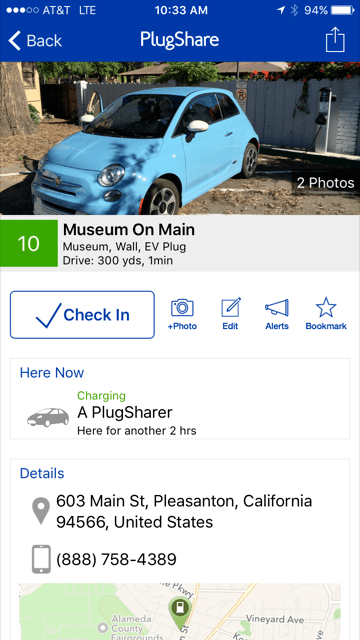
First, I consulted the Plugshare app on my phone. It showed me two options within a couple blocks of my brunch destination.

IMG_5157.PNG

I pulled in behind the old Library on Main Street, and there was a single Chargepoint station, ready for me.

IMG_5154

I backed in, and plugged in and that was that. With Plugshare, I was able to check in, and even post a photo of Fidelio getting his electricity.

We had a relaxed brunch at Nonni’s Bistro, a favorite destination, and walked around a bit in downtown Pleasanton, a place that deserves its name. I checked the progress of my charge using the ChargePoint app. Notice at the bottom, the progress–miles of charge–is displayed.

IMG_5156.PNG

By the time I got back to the car, it was 100% charged. Now that’s the way it’s supposed to work. And it cost me $1.00 an hour.

It was a happy story, but I wondered what would have happened if the charger was occupied? What if there wasn’t one nearby? We need to build out the infrastructure as more and more EVs hit the roads, just for this purpose. Charging at home and at work is great, but sometimes you need it on-the-go.


EVs and their Sociable Drivers

Call it a cult, but EV drivers, I’ve found, are a sociable bunch. We love to talk about our cars, look at each other’s rides, and learn more about the EVs we don’t have yet, such as the Tesla Model 3, which has received more than 325,000 $1,000 deposits in just a few days.

I like to group my little Fiat, Fidelio, with other cars, too. Then, I talk with the owners. Sometimes, I just park him near the other EVs and snap away. Here are a few recent shots.

This one just happened – One Fiat, two Nissan Leafs, in repose.

IMG_5095.JPG

And for good measure, here’s Fidelio with one  of his Tesla friends–also at the office.

IMG_5102

And, tonight, three members of the Castro Valley Chamber Orchestra brought their cars together for a photo after a two-hour rehearsal. From left to right, Esteban’s 2016 Tesla, Bev’s 2016 Chevy Volt, and Fidelio, my 2016 Fiat 500e.

IMG_5116.JPG

They’re lucky. Although we all just started driving these shiny new cars, they get to keep theirs. But Fidelio has to go  back to the fleet in 10 days. I’m sad. When you live with an EV for months, it grows on you. The smooth, quiet ride, the silent cabin where the radio plays so clearly. The never stopping at the gas station. The torque.

The Tesla and Fiat 500e are pure electrics, while the Volt–in the center above–is a plug-in hybrid. But the Volt will go up to 53 miles on a charge, so if you don’t travel too far, you can use it as an electric car virtually all the time. In fact, Bev tells me that the new Volt will burn off the gas automatically if it gets too old!

We Drove in the Sunshine

In 1964, a song by Gale Garnett filled the AM radio airwaves, called We Sang in the Sunshine. Seems Gale would spend a year with the guy, but then “be on her way.” Why a year? I never understood that arbitary limit. If things were good, why not stick around?

In about two weeks, the sweet little Fiat 500e that I’ve enjoyed every day since January 19th is going away. It’s staying here for three months, which is only a quarter of a year, but it’s way longer than the one  week that has been the standard visitation period for the last 1,150 plus cars I’ve sampled over the last nearly quarter century.

What  hurts is that I’ve really fallen for this little car. Over a couple thousand miles, to work and back, off for an errand or a meal or a band practice, orchestra rehearsal, or trip to the post office, little Fidelio, as I call him, has not failed me. When I walk up to him in the parking lot, I still enjoy his retro styling, based on the original, popular 500 of the 1950’s through mid 70’s–Italy’s “Beetle.”Funny, in a way, that Britain’s popular little postwar car, the Mini, is with us in 2016 too, re-imagined for modern times. Like a European 50th high school reunion.

I love Fidelio’s light blue paint, an intentionally retro shade. His silver plastic hubcaps look like alloy wheels but are hubcaps just the same, and appropriately so. Small, round headlamps and the proportions of the face give Fidelio a Boston Terrier kind of expression. He’s not grinning like a latter day Mazda or a 1950’s chrome mouthed Buick, but he seems happy and content.

IMG_5041 (1)

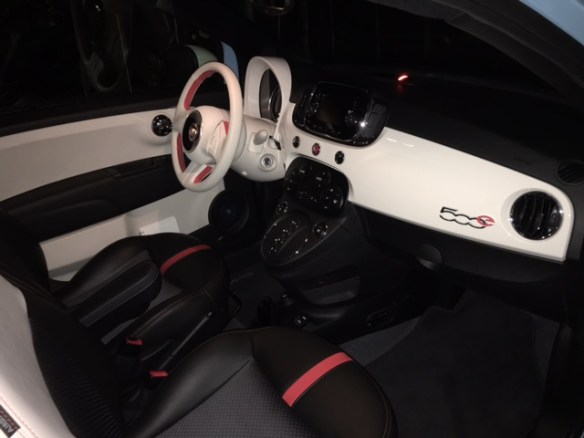
Fidelio’s interior is perfect for me, a slim 5-8 man. For being a little car, a Fiat 500e is a tall one, too, so headroom is generous for me–and would be for taller folks, too. The seats sit up high and firm, in a vinyl and sport cloth with jaunty red stripes.
IMG_5047

The dash features numerous chrome rings around pretty much everything from the instruments to the climate and radio controls to the gleaming door handles that lock when you push them towards the door.

IMG_4460

In an age of dull gray, plain tan, and somber black interior shades, my little Fiat enjoys a broad stroke of white. The dash panels mimic the painted ones of the original cars, and bring back a nostalgic pang for cars of my youth, with their expanses of painted metal and projecting light switches and radio knobs. All dangerous, but we’re talking about feelings here.

One thing about an electric car–especially, perhaps this one. It’s very very quiet in there when you’re rolling down the road–even at freeway velocities. Someone said recently something about double-insulated glass, but I can say that the nicer-than-I-expected audio system delivers crisp, clear, balanced sound on my favorite FM station–KCSM Jazz 91, as well as my favorite Sirius XM Satellite Radio selections.

Electric motors spin contentedly, and don’t vibrate like gas engines do. When you press the right-side pedal, Fidelio just moves out, quickly. The torque in the single-speed transmission is surprising and delightful, and the extra weight of hundreds of pounds of lithium-ion battery beneath you guarantees a low center of gravity. While most errands are in town and back and forth to work, I got out on to a few curving back roads now and again, and was once again amazed by the handling and just plain fun of this little beast.

Numbers come up in regular car stories for things like engine horsepower, cargo capacity, and fuel economy, along with Government efficiency ratings. In an electric car like Fidelio, it’s all about range. Sure, there’s a speedometer, but you really want to know how far you can go, all based on battery charge. Fidelio’s ingeniously simple center dial displays battery percentage off fullness both graphically with a green left parenthesis and with a number (85%, for example). At the bottom of the dial is the range display, big and bold.

What’s funny is, sometimes the range number grows while you’re using power. It means your average is improving based on your recent driving. Downhill, or stop-and-go? That means you’re generating new electricity and using little stored energy. Flying along at 65 on  the freeway, especially uphill, takes it away more quickly. There’s a little arrow that goes up or down (or is invisible) to indicate the trend.

To keep the range numbers good, I charged my car at work on a Level 2 charger in front of my building. Level 2 means 240 volts. I can fill up the battery from around half full, which it usually is by the time I’ve commuted home and back to work, before lunchtime. Then, with my EV driver courtesy, I move Fidelio aside for another company employee.

IMG_5015

Charging becomes a routine. You wave your little card in front of the ChargePoint bollard, it beeps, then you plug in the large handle which feels a bit like a gas filler, and then verify the machine is charging. Then, walk away. ChargePoint notifies me with a text message when it notices that Fidelio isn’t absorbing any more charge.

Sometimes, I’ll charge overnight at home at lowly 120–Level 1. It can take 12 hours to do what 4 hours does on 240. But it means I have a full battery to use on the weekends.

Over my two and a half months of driving, I’ve had to use our family gas burner a few times for trips to visit the grandchildren, or a bass lesson 50 miles away. But nearly always, Fidelio is available and steps up to the job.

My upright bass, which I play and also use to measure automotive cargo capacity, fits in the back when I flip down the second row seats. It just barely makes it, and only at a particular angle. But it works. I can also carry a bass guitar and a practice amplifier. If I need my big amplifier–it won’t fit. If it’s an electric only gig, everything slides right in. This is a small car, but a practical one.

IMG_4587

It’s hard to think of anything annoying about Fidelio, but there are a couple of nits. First of all, the flip-out “switchblade” key often opens in my pocket. Also, the sunvisors are pathetically slim and short, so you’re of luck if the sun is low in the sky as you drive north or west. The Bluetooth-connect, voice-activated telephone dialer works fine for calling numbers in your phone, but if you need to dictate the numbers, it suddenly becomes deaf. And that’s the end of my complaints.

Regarding efficiency, while gas and hybrid cars get fuel economy ratings in MPG (miles per gallon), the electrics get MPGe (miles per gallon equivalent). I’ll state my final numbers when my test is over, but at this point, I’m averaging around 135 MPGe–even better than the government ratings. I’ve seen as high as 178 MPGe, depending on the trip. I’d say that’s EXCELLENT.

I’d really like to just keep driving in the sunshine with Fidelio for years, but he has to go back to the press fleet and please some other folks. I got him with 79 miles on the clock–just break in time. It’s like he’s mine. I could go lease my own 500e, but I think I’ll wait to see if the new Chevrolet Bolt EV will deliver at least some of the zip and an honest 200 mile range. Then it would be perfect. But despite the Chevy’s attractive, up-to-date look and game-changing range number, the Bolt and the other EVs can’t touch Fidelio for driving experience and cuteness.

IMG_4504

The Electric Car Club

When I started testing my little blue Fiat 500e a couple of months ago, I thought, that as part of my EV awareness, I’d attend meetings of some electric car enthusiast organization.I pictured meeting in a place like an old Hof Brau, and standing in the parking lot before going inside for beers and roast beef, looking over each others’ cars in the fading sun.

night

What I was picturing was the car club of the past. I met the Corvair owners club years ago that way.

Today, the action is in three places, for me. The first is at work, where I’ve created the Electriccars channel on Slack–our company instant messenger application. We have 12 members–most of the electric car drivers in the company. We post photos, talk about range and what we want to buy someday, and we’re pretty well represented. We have drivers of Teslas, Leafs, Volts, A Ford Focus Electric and a Fusion Hybrid, BMW i3s, and a couple of us with Fiats. Here’s our charging array. Fidelio, my blue Fiat 500e, is at the top of the picture, because my battery is full, and I’ve moved aside to let another driver charge up. With 15 EVs and 6 spots, it’s the only way to make it work.

IMG_4475

I’ve had numerous conversations in the hallway and in our “Cantina” food and party area. One guy proudly showed me his Volt app, where he could get lots of stats on his mileage and driving efficiency. Another wanted to talk about the differences between the different EVs on the market–or the difference between living with a plug-in hybrid versus a pure electric. Another is eagerly awaiting his opportunity to put money down on a Tesla Model 3–that he’ll receive in two years. That’s patience.

The second way I meet EV drivers is at charging stations. While most of my charging happens at home or at my six-slot office charger, I had a fine conversation with two Leaf drivers in front of the Whole Foods recently. A fellow auto journalist drove to meet me for lunch in his EV test car, and showed me where he went to plug it in while we were eating.

There’s lots of EV action online. I belong to the Fiat 500e group on Facebook. For now, I have a car to show photos of, and stories to relate. So do they. There are proud new car photos, oddball charging shots, and interesting customizations. One guy installed new, more powerful, but less energy-consuming, headlamps. Another posted a shot of his little Fiat next to a giant Chevy Suburban. I had recently taken a very similar shot of my colleague’s orange 500e next to the same kind of behemoth, and posted it in reply. We have fun.

Of course there are numerous websites to visit, too. And on Twitter, I post links to this blog, and have picked up a bunch of folks to follow–and who follow me–by going there.

I was expecting more camaraderie between EV drivers on the road, but so far, no-one has waved to me from their car. I, of course notice all of them. Maybe they just like not buying or burning gas and aren’t the social type. More (electric) power to them.

Walgreens

I did look around for an actual car club, and found the Electric Auto Association. They have various chapters, but from what I can tell, they are the old-fashioned kind of organization. These are the techie guys who used to install dozens of regular car batteries in an old Honda Civic years ago. They are hands-on, and less of a purely consumer group–although I bet that’s changing.

If it were September, I could participate in National Drive Electric Week, but who knows what I’ll be driving by then? I may own my own EV by the time any local events start on September 10.

I love the social part of  being an EV driver. Perhaps it’s the excitement about doing something special that brings some folks together like this. When you drive an electric car, you fit right into the flow of traffic, and especially if you own a model that also has a gas version, you may be invisible to the other drivers. But YOU know you’re battery powered, and that it all makes a difference. Someday, it’ll be the norm.