Earth Day 2017 – Driving My Electric Car

IMG_8417This Earth Day comes at a time of significant concern for our home planet. Our new president, continuing in his belligerent, ill-advised way to work against the needs of our children and grandchildren, has appointed climate-denier Scott Pruitt as head of the EPA. He’s approving pipelines, reducing regulations, and we hear rumblings about backing out of the Paris accords. What can a concerned person do?

At times when the government isn’t cooperating, you need to act on your own. One of the things I do is to drive an electric car. On January 8, just weeks before the election of our frightening new leader, I took delivery of my  Kinetic Blue Chevrolet Bolt EV. As a journalist, I sometimes drive other cars to review them, but my goal for 2017 and forward is to test and promote cars with battery power–full electrics and also the many hybrid options for folks to drive electric part of the time.

Hybrid cars offer a way to slip into EV driving without risk, because you have a gas engine and an electric motor in the same car. Some come with a larger battery for storing some power to drive in a pure electric mode for a while. For example, the plug-in Chevrolet Volt has an EPA range of 53 miles in pure EV mode before a gasoline engine comes on to charge the battery. The hybrid Ford Fusion sedan delivers great fuel economy by blending its engine and motor to stretch out your fuel about twice as long. There’s a plug-in version that gives you about 27 petrol-free miles. Nearly every car manufacturer offers one or more hybrid today.

Until recently, driving a pure electric meant being constrained by battery range. Cars like the pioneering Nissan Leaf, despite their virtues, couldn’t make it past 80 or 90 miles before requiring a time-consuming recharge. Tesla turned that equation on its ear with its offerings, but they remain out of the affordability range for most people.

My Bolt EV, with its EPA-rated 238 miles of range, eliminates most, if not all, of that worry. Unless you’re planning a cross-country or California trans-state trip, you’re gold. I’ve proven that this winter by using my Bolt for commuting, visiting, and errands all over the San Francisco Bay Area–my home.

Now if I wanted a compact five-door hatchback and was OK with using gas, I may have selected a worthy car like the Honda Fit. It resembles the Bolt EV, but without the 964 pound battery and other amenities, it is a very modest investment, starting at under $17,000 including shipping. I also read yesterday that the new Alfa-Romeo Giulia sports sedan is the same price as the top-level Bolt EV–nearly $44,000. Which one would you pick?

There’s an element of sacrifice to spending that much on a compact (but roomy) hatchback from a mainstream manufacturer, but driving and living with the Bolt EV has been a real pleasure. It’s high enough to slide right in. The back seat is roomy for passengers, and it folds down to provide lots of space for the upright basses and Costco visits. The dashboard is friendly, colorful, and provides a wealth of the information you need. And I really like the interior and exterior styling, even if it attracts virtually no attention on the road.

But if you asked me, I’d say the best part remains the nearly silent, buttery smooth powertrain. I cruise down the freeway at 65 mph and listen to the Bose stereo on the way to work and the feeling is sheer bliss. Without the reciprocating pistons, you won’t feel vibration or hear any of the typical engine sounds. Slide the one-speed transmission into Low (L) and you can use your right foot to do “one pedal” driving that provides some of the feeling of control you used to get  from manual transmissions. Just touch the brake when you need it for sudden stops.

I like knowing that my car is contributing less to global warming than internal combustion engine-equipped cars, but doing it without sacrifice is even better. We Bolt EV drivers have an active Facebook page, too, with more than 2,500 members!

We have a long way to go–and not a lot of time to get there–but individual choices, regardless of what our temporarily derailed government says, can make all the difference. Today, I drove my EV on Earth Day. Driving it every day will help make every day Earth Day. Please join me.

Happy Earth Day.

Bill Mattos, One of the First Three Bolt Owners

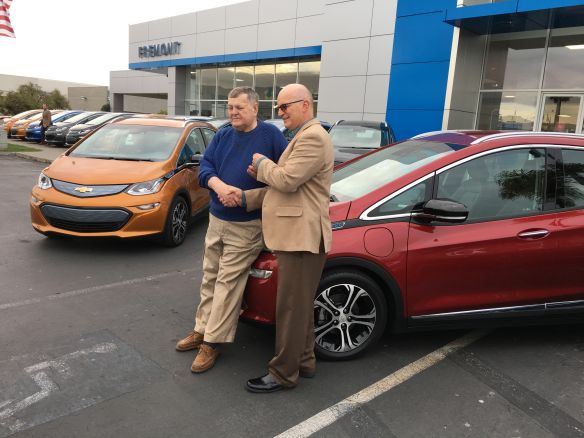
There’s a lot of excitement over Chevrolet’s award-winning new Bolt EV. Chevrolet promised to begin deliveries in December of 2016, and on December 13, in Fremont, California, three lucky customers drove their Bolts home. One of them was Bill Mattos, a retired law enforcement officer, who happens to live right there in town.

It turns out that Bill has been an EV enthusiast for a long time, since he got a rare opportunity to drive GM’s EV1 back in 1999.

“I was taking my Saturn to the dealership and saw this strange-looking car plugged in there,” said Bill. “It was the EV1. They let me drive it and we burned up a lot of electrons. I was blown away.”

gty_gm_ev1_mar_140904_16x9_992

Bill couldn’t buy or lease one—the waiting list was long, and GM notoriously cancelled the EV1 program—but he decided then that as soon as GM offered another EV, he’d be one of the first people to get one.

He got his chance when the diminutive Chevrolet Spark EV came out.

“I really liked the Spark’s acceleration, and it was easy to get in and out of,” Bill said. “But there was the 85-mile range, and while I enjoyed riding in the HOV lane, I sometimes felt a little intimidated by the big cars.”

Bill’s next EV was the larger Chevrolet Volt—a hybrid. He got the second-generation 2016 model. But not long after, he read about the upcoming all-electric Bolt and got excited.

“It sounded like a Spark on steroids,” he said. “I read everything I could find about it.”

And, Bill told the folks at Fremont Chevrolet to let him know immediately when they started taking orders so he could be the first one on the list. And that’s just what they did. On October 2, Bill drove down to Fremont Chevrolet and placed his order.

As it turns out, Fremont Chevrolet is the top EV seller in the Bay Area (and Fremont also happens to be where EV rival Tesla’s plant is located). So, when GM decided to deliver the first three Bolts there, Bill got a call to come on down and pick up his car. The dealership sent a car for him, since he would be driving his Bolt home.

“They had a whole lot of Bolts there, but most were going to other dealers for demo cars,” said Bill. “I originally ordered a silver one, but since I was getting to be first in line, I chose the red one, which included the fast charge port.”

The dignitaries presented Bill with his car, showed him how the features worked, and he was on his way. (Photo courtesy of Fremont Chevrolet. Bill Mattos, left, with Ron Meier, Chevrolet Western Regional Manager.)

bill-mattos-1

Bill really likes the car so far.

“It feels bigger inside than it looks on the outside, and it’s easy to get in and out of,” he says. “And the acceleration is great, although all EVs have that.”

Bill likes the ergonomics of the new Bolt, and how, with its 238-mile range, he doesn’t have to plug it in every night.

He’s had a few challenges using the new displays, but Bill knows it’s just an initial adjustment—and part of being an EV pioneer.

If you’re in the Fremont area and have a hankering for a new Bolt, contact Kurt Mietz, Fleet and Commercial Specialist, at Fremont Chevrolet. Call 650-766-7777 or email to: kurtm@cacargroup.com.

Kia Niro Hybrid Crossover Spotted at the Mall

kia-niro

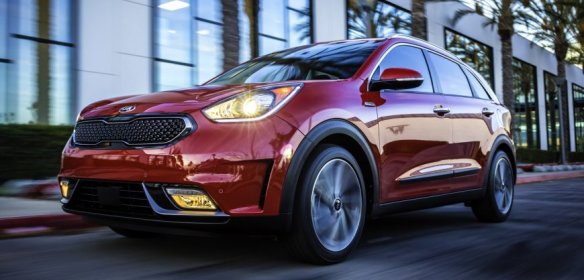
I was walking through the mall tonight with my wife, just after purchasing new sheets at Pottery Barn and look what I saw. It’s the new Kia Niro!

I’ve heard about this hybrid crossover for a while now, and expected to see one on the road or at a dealership soon. This one is here to show off.

Kia is smart to introduce a compact crossover, sized between the boxy Soul and the venerable Sportage, that has similar fuel economy to a Toyota Prius. The new Prius, the poster child for hybrids and the highest performing one, fuel economy wise, is an acquired taste visually. What folks seem to want now are crossovers, and the new smaller ones are hot hot hot. So Kia is in the catbird’s seat here.

I sat down in the car, and although I couldn’t get the seat to adjust (the battery, apparently was drained), I could tell that Kia is using the same clear, no-nonsense styling inside, with premium materials, to convey high competence, value for the money, and in the case of a crossover, that ride high feeling.

The Niro has a dual clutch six-speed automatic–not a CVT–so you can feel the gears shift normally and even move them manually. Of course, I didn’t sample that in the mall, but the Niro should at least emit a more sonorous sound than the moan of a CVT.

The 1.6-liter four-cylinder engine, mated to a 43 hp electric motor, contributes to the overall 146 horsepower. That motor will likely be as smooth and silent as motors are. My understanding is that there will be a hybrid and a plug-in hybrid version.

The young woman managing the display gave me a free Niro bag to carry things in, and took my information for future updates. Of course, I expect to hear from the automotive PR folks at some point soon, but this’ll tell me what interested car shoppers will get.

The thank-you email told me I could download the Niro app and configure a car on my iPad, so I did that. It took a while to download. It shows a musical video of the Niro zooming through a city – with no driver… Is this a look at their future autonomous vehicle?  Then–out to the country! A quick roll through a charging station (not stopping) and onward. You can click a button periodically to get details on the topic they’re presenting, such as Exterior Tour and Fuel Efficiency, all shown to a high-tech beat.

I’ll be looking forward to a real test of this car soon.

Chevrolet Volt – The Perfect Compromise

IMG_4787

The all-new Chevrolet Volt may be the best solution today for moving to greener driving to reduce CO2 emissions and mitigate the effects of climate change. It’s an electric vehicle (EV) without the drawbacks.

The many advantages of driving an EV include smooth, quiet motoring, minimal service requirements, and the feeling that you’re part of the solution and not the problem.

The downsides of EVs include limited range and the long time it takes to recharge the batteries.

Regular hybrid vehicles combine gas engines with electric motors to extend your fuel out over more miles, but you never plug in. Plug-in hybrids provide a small all-electric range before becoming regular hybrids.

The Chevrolet Volt, which debuted for 2011, was designed as an electric car with a range extender: The Voltec electric drive system. You could charge it up, drive about 35 miles, and then its small gasoline engine kicked in to generate electricity to keep the motor moving the car along.

The totally redesigned 2016 Volt continues on this path, with huge upgrades. Generation one owners gave GM plenty of feedback. Gone are the hard plastic panels with haptic touch controls. The styling is in line with current Chevy gasoline vehicles, like the midsize Malibu. The new car looks great inside and out, with colors and metallic trim befitting a fancier vehicle.

What’s most important, though, is that the new Volt offers an electric range of 53 miles. In a week with my Mosaic Black Metallic test car, I drove in silent, serene full-electric mode for all of my commuting (18 miles each way to work and home), and all of my normal errands. On only two occasions did I need the extended range. The combined range for gas and electric is 420 miles.

When my Volt switched over to gasoline, the instrument panel indicated I had moved from battery power. I could hardly hear the engine when it engaged, and even when the battery was depleted, the car sometimes used it with power generated from braking.

An electric car is rated for MPGe. MPGe assigns a comparative value to the efficiency of different EVs, but it also stands alongside MPG. My week with the Volt generated 118.1 MPGe. The EPA’s ratings are 106 MPGe for electric mode and 42 MPG for gasoline (combined city/highway numbers). Green scores are 8 for Smog and a perfect 10 for Greenhouse Gas.

Compare that to a standard Prius, which gets 52 combined MPG. The Chevrolet Cruze, the Volt’s gasoline cousin, earns 35 MPG combined, itself a laudable number.

The electric motor puts out 149 horsepower (111 kW), and a strong 294 lb.-ft. of torque. The gas engine generates only 75 horsepower, but it’s meant to charge the car rather than drive it. Chevy claims an 8.4-second 0-60 time. I felt confident in it driving uphill on a winding road in the rain.

The Volt comes in LT and Premier levels. My Premier tester flaunted attractive two-tone interior with tan inserts and silvery trim winding around the dash. The center screen is nicely rendered and there’s a jaunty blue plastic top on the “shift” knob. The rear seat now offers a center position, but there’s not a whole lot of legroom for that person. The hatchback is convenient, although it’s a high liftover.

IMG_4778.JPG

The Drive Mode switch lets you configure the Voltec system. Use Normal mode for maximum efficiency, Sport mode to take advantage of the bountiful electric motor torque, or Mountain mode for maximum power on steep upgrades. The fourth mode, Hold, lets you preserve your battery charge and use only gasoline.

Regenerative braking is crucial for hybrids and EVs, but the Volt lets you prime the pump with a paddle on the left side of the steering wheel for “Regen on Demand.” Use it like a brake, while banking charge. With practice, you can drive almost without using the brake pedal at all.

The Volt has its own personality, with a greeting sound and a “wind down” tone it makes when you turn it off. Because the electric motor is silent when you start the car, the blue Power button is more like turning on your iPhone than turning over your engine.

The LT starts at $34,820 and the Premier, with heated leather seats, a Bose stereo system, and more, starts at $39,270. My tester listed for $39,850. Various leasing options, plus some Federal and State rebates, can make these cars easier to drive home.

While an all-electric car may be the ideal way to go, it’s not practical for everyone today. But if you want a compact car that’ll do pretty much everything and let you drive electric most of the time, the Volt is a great solution.

New Flavors of Hybrid – Kia Niro

2017 Niro

2017 Niro

There are lots of ways to drive “greener,” and Kia is about to provide another. Already offering the Kia Soul EV all-electric hatchback and Sonata Hybrid, they now proudly present the Niro hybrid. About the size of the popular hybrid poster child Toyota Prius, it’s a crossover, so it’s taller, and looks like what folks increasingly are buying. Compact crossovers are hot hot hot. Great timing for Kia. We’ll find out more about this new entry as it hits the market later this year, but it looks like a winner so far.

Read the linked article above for details, but it looks like it’ll hit the 50 mpg target, competitive with the Prius. And like all Kias and Hyundais today, it has the creative eye of Peter Schreyer, former Audi design director, upon its fresh sheetmetal. Likely to be priced competitively, it just makes the choice harder (and better) this year.


The Electric Car Club

When I started testing my little blue Fiat 500e a couple of months ago, I thought, that as part of my EV awareness, I’d attend meetings of some electric car enthusiast organization.I pictured meeting in a place like an old Hof Brau, and standing in the parking lot before going inside for beers and roast beef, looking over each others’ cars in the fading sun.

night

What I was picturing was the car club of the past. I met the Corvair owners club years ago that way.

Today, the action is in three places, for me. The first is at work, where I’ve created the Electriccars channel on Slack–our company instant messenger application. We have 12 members–most of the electric car drivers in the company. We post photos, talk about range and what we want to buy someday, and we’re pretty well represented. We have drivers of Teslas, Leafs, Volts, A Ford Focus Electric and a Fusion Hybrid, BMW i3s, and a couple of us with Fiats. Here’s our charging array. Fidelio, my blue Fiat 500e, is at the top of the picture, because my battery is full, and I’ve moved aside to let another driver charge up. With 15 EVs and 6 spots, it’s the only way to make it work.

IMG_4475

I’ve had numerous conversations in the hallway and in our “Cantina” food and party area. One guy proudly showed me his Volt app, where he could get lots of stats on his mileage and driving efficiency. Another wanted to talk about the differences between the different EVs on the market–or the difference between living with a plug-in hybrid versus a pure electric. Another is eagerly awaiting his opportunity to put money down on a Tesla Model 3–that he’ll receive in two years. That’s patience.

The second way I meet EV drivers is at charging stations. While most of my charging happens at home or at my six-slot office charger, I had a fine conversation with two Leaf drivers in front of the Whole Foods recently. A fellow auto journalist drove to meet me for lunch in his EV test car, and showed me where he went to plug it in while we were eating.

There’s lots of EV action online. I belong to the Fiat 500e group on Facebook. For now, I have a car to show photos of, and stories to relate. So do they. There are proud new car photos, oddball charging shots, and interesting customizations. One guy installed new, more powerful, but less energy-consuming, headlamps. Another posted a shot of his little Fiat next to a giant Chevy Suburban. I had recently taken a very similar shot of my colleague’s orange 500e next to the same kind of behemoth, and posted it in reply. We have fun.

Of course there are numerous websites to visit, too. And on Twitter, I post links to this blog, and have picked up a bunch of folks to follow–and who follow me–by going there.

I was expecting more camaraderie between EV drivers on the road, but so far, no-one has waved to me from their car. I, of course notice all of them. Maybe they just like not buying or burning gas and aren’t the social type. More (electric) power to them.

Walgreens

I did look around for an actual car club, and found the Electric Auto Association. They have various chapters, but from what I can tell, they are the old-fashioned kind of organization. These are the techie guys who used to install dozens of regular car batteries in an old Honda Civic years ago. They are hands-on, and less of a purely consumer group–although I bet that’s changing.

If it were September, I could participate in National Drive Electric Week, but who knows what I’ll be driving by then? I may own my own EV by the time any local events start on September 10.

I love the social part of  being an EV driver. Perhaps it’s the excitement about doing something special that brings some folks together like this. When you drive an electric car, you fit right into the flow of traffic, and especially if you own a model that also has a gas version, you may be invisible to the other drivers. But YOU know you’re battery powered, and that it all makes a difference. Someday, it’ll be the norm.

Make the Right Choice – Drive Electric

Choices. It’s what everyone is thinking about now, as we plunge headlong into the 2016 Election season. No matter which side you’re on, you have to agree that the people who support each candidate are often vehement about it. People are deciding, and it’s early, but you could say that they are choosing with their hearts and not their heads. He or she is MY CANDIDATE, which means the other candidates are stupid or totally misguided.

At least it looks a lot like that to me.

Regardless, when people go out car shopping, they are bringing all their old habits of living and thinking along with them. They may have practical concerns, but car buying is still an emotional process. And that’s why most  people don’t go out shopping for electric cars.

The best reason to buy and drive electric is to protect the planet from the worst effects of climate change. Not burning as much carbon is better. There may be some arguments against this, but they are not coming from anyone who is informed about the situation we’re in.

Besides removing the combustion under the hood, electric cars are smooth and quiet. And, they deliver surprising torque from the get-go. The cars need next to no service, too. Forget oil changes or radiator flushes or hose or belt repairs. They cost less to run. Nice.

So, where’s the rub? Well, you can’t get some of the electrics everywhere. I live in California, and there are plenty here. And, the prices can look expensive. But with great leasing deals, that’s a non-issue.

Driving range can be seen as a concern, but if you have one internal combustion car in the family, it doesn’t have to be. My life of 36-mile-round-trip commuting and local errands perfectly suits Fidelio, my blue Fiat 500e.

What about charging? Do you need to look for chargers and doesn’t it take a long time.? Well, yes, it does take a long time, but if you use Level 2 (240-volt) chargers, it’s much less. But, as a long-time expert in EVs told me, you charge the car while it’s just sitting, doing nothing. It’s no big deal. I normally charge Fidelio at work, and he’s done by lunchtime. Then, I go park him elsewhere, freeing up the charger for the next person. The time to do that is the time I’d spend in a gas station. Granted, it may be more often, but it’s completely manageable.

So, what’s the deal? Maybe it’s just that many people don’t know how great it is to drive an electric car. So… If you have one, take out your friends and family! Give them a chance to see your EV in action. Joel Levin, of Plug-in America, says exactly that. Make it a viral experience. You show your neighbor, who then buys one. Then, the neighbor’s cousin visits and buys one. It takes knowledge and experience to recognize the benefits and pleasures of EVs. And if a pure EV is simply too much, say for a young couple in an apartment who need one all-purpose car, then look at the vast number of hybrid options.

It’s up to us to do something. Choose wisely.

What’s MPGe? Why Should I Care?

MPGe

When the United States Environmental Protection Agency (EPA) began measuring the fuel economy of cars decades ago, they created a miles-per-gallon (MPG) rating. It was designed to be posted on the Monroney (window) sticker, so consumers could compare different cars when they were shopping.

However, what happens when you have a car powered completely or partially by electricity? How do you measure a “gallon” of volts? The agency had to find a way to measure all energy, as a “measure of the average distance traveled per unit of energy consumed.”

So, in 2010, in response to the arrival of the new Chevrolet Volt plug-in hybrid and the Nissan Leaf all-electric vehicle, the EPA came up with the MPGe rating–miles-per-gallon-equivalent. See this Wikikpedia entry for more detailed information.

I went to my favorite comparison/information hangout online–fueleconomy.gov–and set up a comparison between four kinds of cars, including my Fiat 500e. The Fiat represented a pure electric vehicle, I listed the Chevrolet Volt as a plug-in hybrid, the Toyota Prius as a regular hybrid, and the popular Honda Civic sedan as an efficient “regular” internal combustion engine (ICE) car.

Here’s what I got. Check it out for yourself. There are lots of numbers there, but here’s what I take away from it all.

  1. Electric cars have only the MPGe/MPG score, and it’s much higher than the MPG scores. The Fiat was tops in this comparison, with the Volt just below, with the two non-plugin cars way below. Use this number to compare all-electric cars to each other (and check the range, too).
  2. Hybrids are much more fuel efficient than regular cars. Keep in mind that the Prius has the best fuel economy of any hybrid car, and the Civic is one of the most fuel-efficient ICE cars.
  3. Driving the Volt in electric mode–keeping your trips within the battery range and recharging regularly–delivers nearly as good a rating as the Fiat. Driving it long distances using only gasoline isn’t much better than the ICE Civic. But if you’re the typical driver, and make sure to charge up regularly, and you’ll get the best of both worlds.
  4. Hybrids, like the regular Prius, don’t plug in (there is a plug-in version too). They’re given an MPG number based on overall performance, because they switch back and forth between gasoline and electricity, depending on driving conditions. The numbers look pretty good, though.
  5. The Prius, in this four-car comparison, saves the most per year compared to the average car. Remember, there are lots of other factors, though. Still interesting.
  6. Notice there’s a “per 100 miles” measurement in the same box that contains the MPGe and MPG number? That’s where the “equivalent” comes in. The Fiat, for example, shows 30 kWh per 100 miles while the Honda shows 2.9 gallons per 100 miles. The question then comes–how much does it cost for 2.9 gallons of gas or 30 kWh of electricity? My experience, using a public charger at work, is that I can get around 15 kWh (about 50 miles worth) for a couple of bucks. Gas, in California now, is currently running about $2.25 a gallon. Doing the math, the Honda costs roughly $3.50 for gas for the $2.00 the Fiat runs. Charging my car at home, at night, would likely run a bit less.

Are you enjoying that comparison chart? Good. Now, click the Energy and Environment tab and you’ll see where electric cars come out on top for greenhouse gas emissions. The Fiat gets a lovely zero grams per mile. The Volt is mighty good at 51. The Prius more than triples that to 170, while the Civic gets 256. Many larger cars can emit 400 or 500 grams per mile. So even downsizing from a large to a smaller ICE car is an improvement.

Yes, it’s true that an electric car must use electricity that’s generated someplace using some method that could cause an environmental impact. And there’s the fuel that went into the tank of the transporter truck that delivered your EV to the dealership. Ideally, you generate power from solar panels on your roof, although remember, some energy was consumed to produce the panels. If your power is generated using hydroelectric, wind, or a giant solar farm, you’re good. Natural gas–not as good. Coal–not good at all. Here in California, there are no  coal-powered plants (as far as I know), but PG&E, the utility, could  buy power from another company that used coal to generate it. We have some nuclear power generation here, too.

Still, at this point, there are many fine reasons to drive an electric car, if it fits your lifestyle. But even driving a Prius cuts your carbon footprint down significantly. If you work it right, a plug-in hybrid, like the Volt, would be even better than the Prius (the more you use the electric and the less you burn fuel). And if all else fails, you can still drive a Civic instead of a Cadillac and reduce your environmental impact a bit.

Until we have affordable electric cars with a 300-mile range, these other options–plug-in hybrids, hybrids, and highly efficient regular gas-burners, will have a place in the automotive market.


EV Drivers – Pioneers and Tiny Minority

As I look over the pretty white dashboard with the silver rings in my Fiat 500e, I smile when I see another 500e on the road. Most of them have their stickers so they can ride in the car pool lane and skip tolls on the bridges. As a borrowed test car, mine doesn’t.

I enjoy seeing a BMW i3 whiz by. Nissan Leafs are common, distinguished from each other only by color. It’s nice to see the new 2016 Chevrolet Volt is taking off. I see them frequently, with their all-new look. Their unique taillamps flaunt a fresh signature on the way home at night.

But, we EV drivers are still a tiny minority on the highways and byways of America. For every one of us there are 100 Ford F150s or Toyota Camrys or Chevrolet Tahoes. Cheap gasoline has encouraged a boom in larger cars, so even intelligent choices like the Honda Fit or Hyundai Elantra languish.

Sergio Marchionne, head of Fiat Chrysler Automobiles, said he’s ramping up production of big Jeeps and reducing production of smaller, more efficient Dodge Darts and Chrysler 200s. Why? Because big Jeeps are the cars that people are buying, and he has to run his company at a profit. It’s a good–even necessary–business decision, but it’s not helping the environment. Marchionne has already stated that FCA loses thousands of dollars on every little Fiat 500e it sells (although the company gets credits towards its Federal clean air obligations).

The people are speaking, and most of them are not EV enthusiasts. They want what they want and like. You can’t blame them. Like the climate crisis in general, if you can’t see it, it’s hard to muster up the energy to do anything about it.

To my left, a giant, black Cadillac Escalade momentarily blocks out the sun. It’s going to be a long haul (but worth it).


It’s Time to Go Green

I’ve been testing cars for 23-1/2 years now, and there’s one thing that’s been bothering me for a long time. I love cars, or I wouldn’t be writing about them, but it feels like I’m supporting one of the main culprits of climate change. It feels like being a  smoker–I know it’s bad for me, but I’m hooked.

Well, my auto column has exposed me to lots of great highly efficient vehicles, including hybrids, plug-in hybrids, battery electric vehicles, and even some highly efficient regular old internal combustion cars.

This blog is about moving to the good guys. I’ll cover cars like the affordable all-electric Mitsubishi i-MiEV, the popular Toyota Prius, which gets a true 50 miles per gallon, and even the 2016 Hyundai Sonata Hybrid, a large, comfortable sedan that averaged 36 miles per gallon for the week I drove it.

I’ll talk about new technology, upcoming models, and ways to reduce driving without becoming housebound. There are plenty of fun-to-drive cars out there that have a much more minimal impact on the earth, and we’ll talk about them here.

Even if you switch from a 10-year-old Chevy Malibu to a 2016 Honda Fit, you’re doing something to help. Carpool with someone–even better. Or, if you’ve got a reasonable commute, use an electric.

Watch this space for a special feature coming soon–a long-term test of a pure electric vehicle. I’ll show it in all it’s glory, and show you the pain points, too.

It’s time to go green. Let’s do it together.