Regeneration Gives Extra Miles

When you’re driving an all-electric vehicle, you probably spend more time looking at the range number than the miles-per-hour indicator. If the number on it is close to the distance you’re planning to drive, it can be nerve wracking. Luckily, regenerative braking adds to that number.

For example, today, I drove 18.6 miles to work in stop-and-go traffic. I started out with 46 miles on my cute little Fiat 500e’s dashboard screen. Amazingly, halfway through the trip, it was at 45–just one mile down. At trip’s end, I pulled into my parking lot and saw 40 on the screen. I regenerated enough juice to take just 6 miles off the battery for an 18-mile ride. Nice!

Conversely, if I had gone the entire 18 miles at a steady 70 mph, it would probably read 28–or lower. It’s all a balance.

Electric cars use MPGe instead of MPG (miles per gallon). I earned 138.6 for this morning’s trip. 🙂

Electric Car Etiquette at Work

So, here I suddenly have an electric car, and I’m in the mood to top off its battery. Fidelio sits in the lot, waiting his turn. With a total range of about  82 miles, he’s reading 60, which is probably OK, but I want to minimize range anxiety.

I wait for the morning shift to move, but by 1:30 p.m., still nothing. So, I found out that there’s an emailing list at work for #EVDrivers. I sent out a plea, with a friendly announcement of my new, blue ride, and behold! Two EV owners almost immediately responded, and I saw two free spots from my third-floor window.

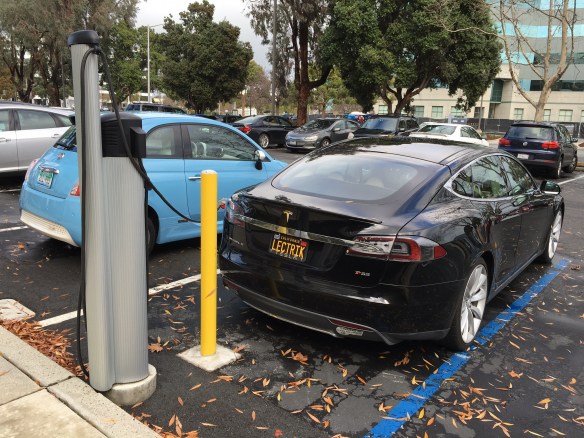
Down I flew, and drove Fidelio to the ChargePoint array. He tucked in right next to Tesla.

IMG_4466

After an hour and 49 minutes, I got a ChargePoint notification text.

IMG_4470

So, I went down and unplugged. I had spent $1.12, and had 84 miles on my instrument panel and a full green bar on the left. I was set.

IMG_4467

I’ve found out already about at least 10 people at work who have electric cars, and am looking forward to getting to know the ones I don’t know already. Maybe we can lobby for  a few more chargers. We can talk about new developments, and share any ideas or thoughts that could help.

The Fiat 500 is a very small car, but tonight, Fidelio carried my upright bass to orchestra rehearsal. The bass had to go in at a bit of an angle for the hatch to close, so the front passenger would be a little squeezed. But we made it. A successful first day for the little blue car.

Fidelio is Here

Fidelio-rainbow

And what a nice welcome, with a rainy day diminishing briefly, displaying a beautiful rainbow.

I drove him around the building to see if any charging stations were open. Nope! I have 60 miles of charge, so I’m OK, but I’m hoping to top him off this afternoon. With only 120 volts at home, it would take longer. So, I’m already “worrying” about charging. But it becomes routine, and with my normal early arrival time, I’ll surely get on one of the chargers without a hitch tomorrow morning.

Fidelio--arrival


200 Mile Electric Range Means Progress

Chevy Bolt

At the Consumer Electronics Show in Las Vegas, two important electric cars are making their debut now. One, the Chevrolet Bolt, has been teased for months, but now it’s slated for arrival at the end of this new year! The exciting thing? It boasts a 200-mile range–a game changer in the everything but Tesla electric car field. That could make the difference in choosing electric over gas.

160106-volkswagen-budd-e

The other intro was VW’s BUDD-e, which disappointed some by not being the next Microbus, but with its sleek boxiness, it could be trendy, and it’s supposed to get well over 200 miles per charge. It’s not a 2016 or 2017 model, though, sorry, but it demonstrates a platform that will underlie numerous other VW electric products. Great timing, with the “Dieselgate” crisis still on folks’ minds.

As eager as you may be to buy an electric now, there’s a real incentive to wait, if the Bolt is as good as it looks. With the new Volt beside it in the showroom, this is a strong set of green rides from a surprising source.


Paris Is Just the Beginning

I’m excited about the Paris Climate Agreement, and think it’s a great start. But that’s just it–a start. In itself, the agreement won’t solve the problem.

My personal focus on carbon reduction is car-related, so I’ve been thinking more about what we can do now to make an impact.

You can buy an electric car, if you want to. There are lots of choices, and lease rates are cheap. Unless you opt for the super-luxury-priced Tesla, though, you’ll be out of luck if you want to drive your e-car everywhere you take your current gas model. Range is less than 100 miles, except for the 2016 Leaf, which is claiming 107. Still, the point is made.

But I was wondering. What if we got, say, even half of the driving population to switch to electric? We still need to create the electricity. Where we get it would make a big difference. If it’s from a coal-powered plant, we’re still pushing out CO2.

And what happens to all of those old gas cars? Someone else would buy them and drive them. That just transfers the problem to a new owner.

Not too long ago, the Federal Government instituted a “Cash for Clunkers” program to buy up old superpolluters for more than they were worth and give the seller a few bucks to go buy a newer, cleaner car. What if there was a program for folks to turn in their old car and buy an electric (or hydrogen fuel cell vehicle, when available)? Then, the old car gets crushed and all the materials in it are recycled. That might help a little. The cars that don’t get crushed will have to be retired, too, as soon as possible.

It’s hard to see ahead 35 years to 2050, when we will need to have succeeded in our Paris commitments to limiting the temperature increase since pre-industrial times to 2 degrees Celsius (3.7 Fahrenheit). 1.5 degrees would be even better, scientists say, but it’s a really tough goal, according to what I read.

We need to start now, and not wait around. But I’m just like everyone else. I like my lifestyle and I don’t want to be limited or have to make changes. But, if I don’t, how can I expect anyone else to?  And if WE don’t, the temperature will just keep on rising.


Seeking Green at the San Francisco Auto Show

As always, I made time during the Thanksgiving long weekend this year to attend the San Francisco Auto Show. The 2015 version was no different than last year’s event. It’s essentially a huge showroom without pesky salespeople–where you can look at all the cars, sit in them, grab a little information, and get exhausted.

This year, I focused on electrics, hybrids, plug-ins, and alternative fuel vehicles, while looking at what’s new, too, and strolling nostalgically past some classic treasures.

The first thing I noticed in the far-ranging Moscone Center was that most cars are none of the above. If you’re lucky, there’s one per brand. Some, like Ford, offer multiple options, but you still have to seek out the environmentally friendly models, and the areas around them were generally not busy.

The big news this year comes from a new Chevrolet Volt and Toyota Prius. Both were there in multiples.

IMG_4324

The Volt (above) has been totally redesigned, and is both more attractive and more efficient. While the old model was loosely based on a radical concept car, this new Volt looks more like other new Chevys–which is better. It’s also has a bigger range in pure electric mode.

I first saw the Volt as part of the PG&E display, and wore its logo on the side. PG&E wants consumers to understand what buying and living with an electric car means, as the friendly utility that supplies their car-charging juice, and they featured some helpful displays and take-aways.

The company also got a chance to display their hybrid Ford work trucks. According to the PG&E spokesman, who actually works on one of the trucks, the guys just love them.

IMG_4322

Over in Toyota land, several Prii (Priuses) sat next to one Toyota Mirai, the company’s entry in the hydrogen fuel cell segment. The Mirai, for lease to a tiny group of early adopters willing to be beta testers for a car with virtually no places to fill it up, is one of the least attractive vehicles I’ve ever seen, but if and when hydrogen becomes a viable fuel to power automobiles, Toyota hopes to lay claim to the “Prius” of hydrogen cars by starting now.

The new Prius still looks something like the generation two and three models, but has gone wild, much as the latest Camry has, in an effort to refute any accusations of being boring.

IMG_4331

Mind you, the Prius is fabulous for getting there on minimal fuel (an honest 50 miles per gallon), but has never been a sporty ride. The new car, with floating roof, head- and tail lamps that are splattered across the corners of the car, and a dash panel that hides the information away from your eyes, will be polarizing. According to reports I’ve read before getting my hands on one, it is more fun to drive, intentionally. I can’t wait to find out.

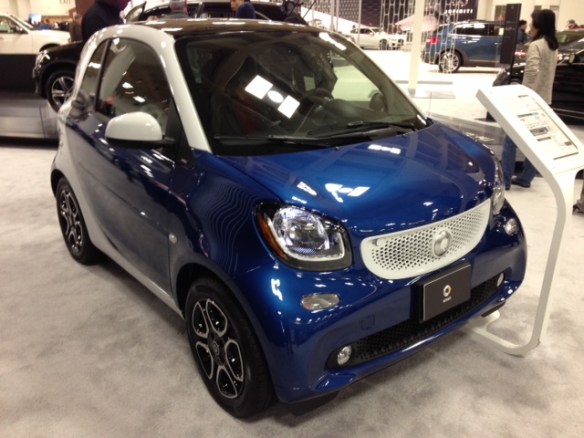
If you simply want to save fuel by driving a tiny car, the all-new Smart is here. Looking a bit more substantial, but still like half a car, it is not the highest in fuel economy (although an electric is offered). It is simply the best to park, and is still very cute.
IMG_4313

Where it gets more interesting is in places like Volvo, that now offers a hybrid version of its handsome, all-new XC90 crossover. Winning Motor Trend’s SUV of the Year competition places it more directly in front of potential buyers. The young woman showing it off told me that a pure electric is in the future, pending availability of more powerful batteries for longer range.

The Porsche 918 was there, as was the BMW i8, proving that you don’t have to drive a regular car to conserve fuel. The Porsche will set you back at least half a million dollars, while the BMW is a more “modest” $125K or so. Both surely occupy some teenage boys’ walls next to the Ferraris and Shelby Mustangs.

One note on regular cars. The new Honda Civic was there, and I was looking forward to seeing if it is as huge in person as in photos. The answer is Yes. The sweet little CVCC of 1973 has ballooned into a big sedan that looks like an Accord. Its styling is so bold and carefully rendered to not look cheap that it appears overblown and is hard to remember.

We need Honda to not just give us the Fit (pun avoided), but an even smaller model to compensate for this scary development. Of course, they’ll sell the usual 300,000 Civics to Americans in 2016, anyway. And, if it’s more efficient than an Accord, great! There isn’t a hybrid or electric model available yet.

With my family in tow, we wandered through other areas, including a huge ballroom full of customs, which included late-model BMWs and Subarus as well as a glorious low-riding 1959 Buick and some exquisitely customized muscle cars. Also, on the main floor, behind the Chryslers and Jeeps, the selection of new and historic Aston-Martins was dazzling. The Academy of Art University brought a fabulous assortment of fine classics, from a Stutz worthy of film royalty to a sweet Austin-Healey that looked exactly like one treasured by my dad in the 1960s.

And that is what makes it so challenging, and exciting, to be searching for an automotive answer to our climate problem while appreciating the beloved old internal combustion vehicles. When will a new car show include no more ICE models? Will we still love a 1941 Lincoln Coupe or a 1966 Porsche 911 25 years from now, even if they are part of what’s got us into this mess in the first place?

 

Europe’s Efficient Little Cars

I just returned last week from 12 days in London and Paris. The world’s eyes are on Paris now after the horrible terrorism that struck the French capital yesterday. I was walking those areas,– my hotel, and much of my wandering, were in the same part of town. It hurts me deeply to think of those beautiful streets being the scene of such an atrocity.

In this blog, though, it’s all about cars. When I was in Paris and London from October 27 to November 7, I saw lots and lots of small, fuel-efficient vehicles that never make it to American shores.

The argument for these smaller, more efficient vehicles across the pond has always been the high cost of fuel and also the old, narrow roads. Seems reasonable enough, but today, the world needs these cars, and some of them do find their way here. But a lot of them don’t.

Wouldn’t it be nice to be able to buy the VW Polo, or the cute little Audi A1 or BMW 1 Series hatchback that I saw on London streets? In Paris, it was nearly all French cars from Renault, Citroen and Peugeot. Seeing generations of these cute little cars zipping around was heartwarming.

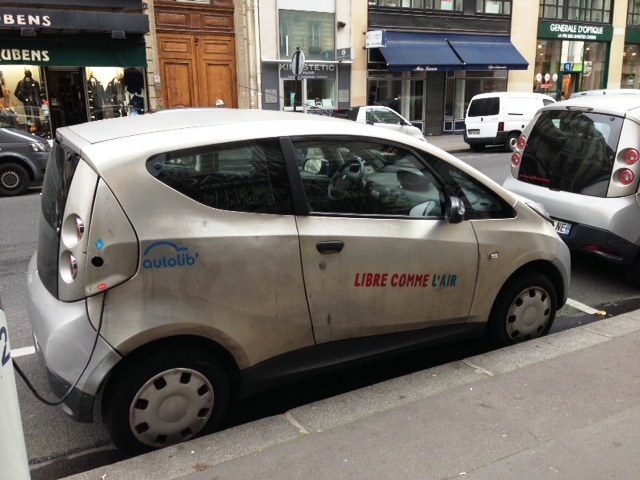
In Paris, I found numerous installations of the Autolib system.

Autolib1

Like Zipcar, the Autolib vehicles are part of a car sharing system for members, who can claim them at the street and then drop them off at another Autolib location. What’s different is that they are all identical tiny, silver electric hatchbacks.

Here’s a closer look. Made from aluminum, they have a flat surface appearance–and not all of them were especially clean. But I saw them all over the place–charging and in motion.

Autolib2

I recently read about an American city, I believe Indianapolis, that was instituting an Autolib system. Read more about Autolib and car sharing.

Of course, in both London and Paris, we used the highly efficient public transit system–London’s Underground and Paris’ Metro trains. San Francisco’s Muni system and the Bay Area’s BART network can only dream of this kind of efficiency. We also sampled intercity trains in France, visiting Versailles, and the international Eurostar, which took us from London to Paris in a brisk two and a half hours!

One other note. I captured this all-electric Renault Kangoo at the Grand Trianon, part of the surprisingly extensive grounds of Versailles. Cute, huh?

Renault Kangoo Electric

Mitsubishi i-MiEV – Entry-level Electric Motoring

In any shopping experience, there’s the fancy way, the regular way and the basic way to buy. You can grab the $3,000 bracelet at Tiffany’s, the $500 one at Macy’s, or the $29.95 one at Ross.

Same thing with electric cars. A super-duper Tesla can set you back $90,000, a Leaf is $35,000, and the little Mitsubishi i-MiEV? Just $22,995.

Mitsubishi_i-MiEV 2016

You do get more for your money, but if you truly want gas-free travel, the i-MiEV will do it. And there’s a certain charm to it, too, with its quirky bubble styling and basic (but quite functional) controls inside.

The downside is the range–about 62 miles–but that’s actually enough for most of your driving. I commuted 18 miles each way to work in the bright blue one I tested recently, and it was just fine. It helped that there are half a dozen ChargePoint charging stations in front of my office building, too, because charging at 240 volts is much faster than household 120.

You won’t have problems finding your i-MiEV in the parking lot–few are sold in the U.S., but they’re more popular in Europe.

See my recent story in the Tri-City Voice (Fremont, California) for more details.

Why the Price of Gas Is Too Low

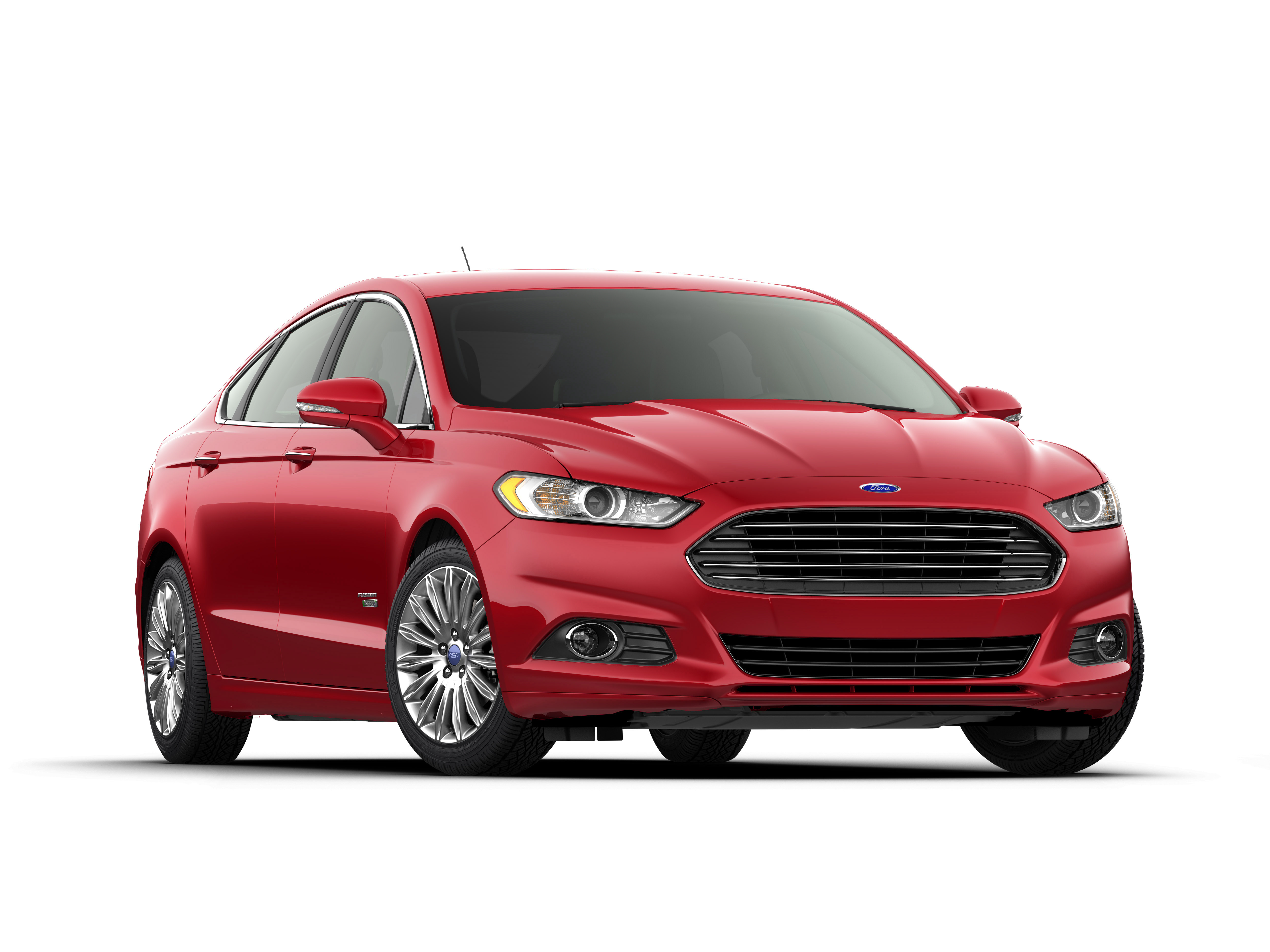
2014 Ford Fusion Energi sedan is Ford's newest plug-in hybrid; it has an EPA-estimated range of 620 miles when starting with a full tank of gas and fully charged battery.

Ford Fusion Energi

Everybody wants to save money. I hate paying a lot for gasoline, too. But, regular is just over $3 a gallon in California now, and I heard on the radio yesterday that somewhere in the continental U.S. it was below $2 a gallon. Hooray!

But wait a minute. The lower fuel prices go, the more people go out and buy large, gas-guzzling cars. Price is a big factor in those purchases, and the supply of Toyota Priuses piles up in the dealer lots.

Hybrid versions of cars that are also sold as gas models cost more. The idea is to save money, and they do–eventually. The real reason, though, to buy a hybrid, electric, or small, highly efficient vehicle is to save the planet!

Some folks do make that choice. I can think of three sets of them now. My neighbors traded in a thirsty, but beautifully maintained Lincoln Town Car for a midsize Ford Fusion Energi plug-in hybrid. That should triple or quadruple their mileage, and reduce their carbon footprint significantly.

Another couple I know, already Prius owners, leased a Nissan Leaf pure electric vehicle. The $99/month payment was a factor, but these folks, who have the solar panels on their roof to fuel the thing, are simply making the right choice.

I just found out today that another friend just got himself a brand new Volkswagen eGolf pure electric car. He already was planet friendly with his Honda Fit, but this makes a difference.

But, when I circumambulate the parking lot at my company, there are very few hybrids and electrics there. It’s going to take a while.

It’s Time to Go Green

I’ve been testing cars for 23-1/2 years now, and there’s one thing that’s been bothering me for a long time. I love cars, or I wouldn’t be writing about them, but it feels like I’m supporting one of the main culprits of climate change. It feels like being a  smoker–I know it’s bad for me, but I’m hooked.

Well, my auto column has exposed me to lots of great highly efficient vehicles, including hybrids, plug-in hybrids, battery electric vehicles, and even some highly efficient regular old internal combustion cars.

This blog is about moving to the good guys. I’ll cover cars like the affordable all-electric Mitsubishi i-MiEV, the popular Toyota Prius, which gets a true 50 miles per gallon, and even the 2016 Hyundai Sonata Hybrid, a large, comfortable sedan that averaged 36 miles per gallon for the week I drove it.

I’ll talk about new technology, upcoming models, and ways to reduce driving without becoming housebound. There are plenty of fun-to-drive cars out there that have a much more minimal impact on the earth, and we’ll talk about them here.

Even if you switch from a 10-year-old Chevy Malibu to a 2016 Honda Fit, you’re doing something to help. Carpool with someone–even better. Or, if you’ve got a reasonable commute, use an electric.

Watch this space for a special feature coming soon–a long-term test of a pure electric vehicle. I’ll show it in all it’s glory, and show you the pain points, too.

It’s time to go green. Let’s do it together.