The Electric Car Club

When I started testing my little blue Fiat 500e a couple of months ago, I thought, that as part of my EV awareness, I’d attend meetings of some electric car enthusiast organization.I pictured meeting in a place like an old Hof Brau, and standing in the parking lot before going inside for beers and roast beef, looking over each others’ cars in the fading sun.

night

What I was picturing was the car club of the past. I met the Corvair owners club years ago that way.

Today, the action is in three places, for me. The first is at work, where I’ve created the Electriccars channel on Slack–our company instant messenger application. We have 12 members–most of the electric car drivers in the company. We post photos, talk about range and what we want to buy someday, and we’re pretty well represented. We have drivers of Teslas, Leafs, Volts, A Ford Focus Electric and a Fusion Hybrid, BMW i3s, and a couple of us with Fiats. Here’s our charging array. Fidelio, my blue Fiat 500e, is at the top of the picture, because my battery is full, and I’ve moved aside to let another driver charge up. With 15 EVs and 6 spots, it’s the only way to make it work.

IMG_4475

I’ve had numerous conversations in the hallway and in our “Cantina” food and party area. One guy proudly showed me his Volt app, where he could get lots of stats on his mileage and driving efficiency. Another wanted to talk about the differences between the different EVs on the market–or the difference between living with a plug-in hybrid versus a pure electric. Another is eagerly awaiting his opportunity to put money down on a Tesla Model 3–that he’ll receive in two years. That’s patience.

The second way I meet EV drivers is at charging stations. While most of my charging happens at home or at my six-slot office charger, I had a fine conversation with two Leaf drivers in front of the Whole Foods recently. A fellow auto journalist drove to meet me for lunch in his EV test car, and showed me where he went to plug it in while we were eating.

There’s lots of EV action online. I belong to the Fiat 500e group on Facebook. For now, I have a car to show photos of, and stories to relate. So do they. There are proud new car photos, oddball charging shots, and interesting customizations. One guy installed new, more powerful, but less energy-consuming, headlamps. Another posted a shot of his little Fiat next to a giant Chevy Suburban. I had recently taken a very similar shot of my colleague’s orange 500e next to the same kind of behemoth, and posted it in reply. We have fun.

Of course there are numerous websites to visit, too. And on Twitter, I post links to this blog, and have picked up a bunch of folks to follow–and who follow me–by going there.

I was expecting more camaraderie between EV drivers on the road, but so far, no-one has waved to me from their car. I, of course notice all of them. Maybe they just like not buying or burning gas and aren’t the social type. More (electric) power to them.

Walgreens

I did look around for an actual car club, and found the Electric Auto Association. They have various chapters, but from what I can tell, they are the old-fashioned kind of organization. These are the techie guys who used to install dozens of regular car batteries in an old Honda Civic years ago. They are hands-on, and less of a purely consumer group–although I bet that’s changing.

If it were September, I could participate in National Drive Electric Week, but who knows what I’ll be driving by then? I may own my own EV by the time any local events start on September 10.

I love the social part of  being an EV driver. Perhaps it’s the excitement about doing something special that brings some folks together like this. When you drive an electric car, you fit right into the flow of traffic, and especially if you own a model that also has a gas version, you may be invisible to the other drivers. But YOU know you’re battery powered, and that it all makes a difference. Someday, it’ll be the norm.

Another Public Charging Adventure

Today, my wife and I took a trip about 11 miles away to a familiar shopping center. Her goal was eyebrow plucking. Mine was sitting and reading, and investigating a new charging station situated in front of the new Whole Foods grocery. I’d seen it before while shopping and felt it was a good use of my wait time.

I drove up to the nrg eVgo charger and stepped out to see what it wanted for me to use it.

IMG_4812

I’m most familiar with the ChargePoint charging stations, as they’re located at my office, and the Blink Network, which I’ve used occasionally. This new one had two boxes with charging cables hanging on them. The one I approached had two next to each other, one being a quick charge and the other looked like a level 2 charger. Based on that impression, I called the number posted there and tried to set up an account.

I gave the man my name and specifics, and he told me I could use a number he’d provide via email to log in to their website and finish the process. He also said he could give me access right away for today. Great.

I reached for the cable, and when I pulled it out, saw that it was the OTHER kind of quick charge plug–the SAE Combo (CCS) type. The other one was a CHAdeMO version. Because my car didn’t have a quick charger, I was out of luck.

Luckily, I was just doing research and didn’t need the charge to get home, but I never got that confirming email from eVgo, so I guess we’re not going to be doing any business for now.

I understand that a quick charger is great for visits to the grocery store, rather than a slower Level 2 style, but it pays to check carefully before parking and hoping. I did learn from the company’s website that they have other  locations nearby with (they say) Level 2 chargers available as  well. It’ll be interesting to see if this company grows and become handy quickly. The other two charging cables, by the way, were plugged into the noses of Nissan Leafs, which do have the CHAdeMO charger.


Make the Right Choice – Drive Electric

Choices. It’s what everyone is thinking about now, as we plunge headlong into the 2016 Election season. No matter which side you’re on, you have to agree that the people who support each candidate are often vehement about it. People are deciding, and it’s early, but you could say that they are choosing with their hearts and not their heads. He or she is MY CANDIDATE, which means the other candidates are stupid or totally misguided.

At least it looks a lot like that to me.

Regardless, when people go out car shopping, they are bringing all their old habits of living and thinking along with them. They may have practical concerns, but car buying is still an emotional process. And that’s why most  people don’t go out shopping for electric cars.

The best reason to buy and drive electric is to protect the planet from the worst effects of climate change. Not burning as much carbon is better. There may be some arguments against this, but they are not coming from anyone who is informed about the situation we’re in.

Besides removing the combustion under the hood, electric cars are smooth and quiet. And, they deliver surprising torque from the get-go. The cars need next to no service, too. Forget oil changes or radiator flushes or hose or belt repairs. They cost less to run. Nice.

So, where’s the rub? Well, you can’t get some of the electrics everywhere. I live in California, and there are plenty here. And, the prices can look expensive. But with great leasing deals, that’s a non-issue.

Driving range can be seen as a concern, but if you have one internal combustion car in the family, it doesn’t have to be. My life of 36-mile-round-trip commuting and local errands perfectly suits Fidelio, my blue Fiat 500e.

What about charging? Do you need to look for chargers and doesn’t it take a long time.? Well, yes, it does take a long time, but if you use Level 2 (240-volt) chargers, it’s much less. But, as a long-time expert in EVs told me, you charge the car while it’s just sitting, doing nothing. It’s no big deal. I normally charge Fidelio at work, and he’s done by lunchtime. Then, I go park him elsewhere, freeing up the charger for the next person. The time to do that is the time I’d spend in a gas station. Granted, it may be more often, but it’s completely manageable.

So, what’s the deal? Maybe it’s just that many people don’t know how great it is to drive an electric car. So… If you have one, take out your friends and family! Give them a chance to see your EV in action. Joel Levin, of Plug-in America, says exactly that. Make it a viral experience. You show your neighbor, who then buys one. Then, the neighbor’s cousin visits and buys one. It takes knowledge and experience to recognize the benefits and pleasures of EVs. And if a pure EV is simply too much, say for a young couple in an apartment who need one all-purpose car, then look at the vast number of hybrid options.

It’s up to us to do something. Choose wisely.

Charging Where You Find It

This weekend, I had an unusual schedule. I played short musical sets for two different events–one each day–in the same building at a local college! In fact, I stood not more than 10 feet away from my Saturday show when I did Sunday’s. I played different basses, too,for different kinds of music.

But this isn’t about music. It’s about a charging opportunity. Normally, I charge the car at work, or occasionally, at home. Home is slow, at Level 1 household current, but it helps top off the tank, so to speak.

However, when I pulled into my musical destination this Saturday, I was looking for a parking spot close to the door. I saw one, and when I got close, realized it was for electric charging! I could plug in to ChargePoint while I was playing. Hooray! As it turned out, I filled the battery to 100% while I was playing my 12 minutes with my band, Tablues, and listening to the other bands in the 53rd Annual Hayward Battle of the Bands.

Chabot-2-27-16

Today, Sunday, I performed with the Castro Valley Chamber Orchestra in a classical show featuring Bizet and Strauss. This time, I knew where to park, and snagged a spot. I even had a 500e companion! That’s 2 for 2. It’s lucky when you can use your car’s down time to charge up.

IMG_4762

Interesting side note. Today, as I drove to the college where the music was happening, a woman in a Lexus waved to me as we were stopped at a light. I rolled down the window. She asked me how I had driven my little electric Fiat 500e all the way from Michigan! You see, Fidelio, my test car, comes from there and wears a Michigan rear license plate. He was trucked here before being turned over to me. Of course, driving an electric car that’s not a Tesla across the country would be nearly impossible–or certainly very challenging. Funny.

Fidelio the Fiat 500e – The Bonding Begins

Part of the reason for borrowing an all-electric car for three months instead of a week was to not only evaluate the practicality of living with it, but also to see how my feelings would develop. And, as I kind of expected, with my daily driving of a little light-blue Fiat 500e named Fidelio, I am getting attached.

And why not? For driving to work, the car’s superb. Errands–excellent. I’ve traveled 15 miles to the vet, 20 to the hair stylist, 11 miles to the shopping center. My trip to work is 36 miles round trip. So, other than an occasional need to go further, I’m happy.

Here’s how the day works. Because I charged Fidelio at work the day before, when I start him up at 7 a.m., he’s got 45-55 miles of range on the clock, without on the home charger overnight. That means he’s normally facing in toward the garage. If he’d been on the home charger, I’d have backed him in to get the charging socket closer. It’s on the right rear fender, where the gas filler is if you have an engine instead of a motor.

I walk out my gate and there he is. What a cute little car. I’m glad I ordered the retro blue paint and white trim. I push the bottom button on the key fob and open the little hatchback. I place my briefcase back there on its side and close the lid. I pull out 5 dollars for the bridge toll, open the door, and slide in. He’s facing out below–must have been on the charger!

IMG_4638

Yes, I could use Fastrak and ride in the carpool lane, but this little test car isn’t mine and I don’t have the California stickers. It’s OK.

The way to work is pretty much all downhill or level, so the range gauge–a digital display at the bottom of the large circle speedometer–barely changes for the first few miles. In fact, it’s sometimes higher at the bottom of the hill to my house than at the top.

As always, the motor barely emits a sound–just a slight whine as you accelerate. That means that Sirius XM Satellite radio or FM–or Bluetooth streaming from my phone–is crisp and clear. The audio system in the Fiat 500e is pretty good, with woofers in the door and tweeters on the front windshield pillars.

Fidelio flies along through traffic. It does start to get congested as we get closer to the approach to the San Mateo Bridge. But, unless I have an early appointment, I just relax. The white, black and chrome dash is very pleasant to the eye. I especially like the little blue crescent of door trim that’s at the corner where the door and the dash meet. Of course, you can’t see any of the outside of the car from inside, with the short, sloping hood and white, rather than blue, mirrors.

Today, I noticed a dark gray 500e ahead of me. I hoped to catch the driver’s eye and wave to a fellow EV driver, but to no avail. I did get a dark gray Tesla launch itself into traffic a few minutes later, in front of me. He waved–probably to “thank” me for letting him cut in front of me.

We finally get on to the bridge approach, and it slows to a crawl again. No problem. It means I’m charging the battery every time I touch the brake pedal, and I’m using nothing while I’m sitting immobile. Traffic opens up again near the tolls. I drive up to pay my money and always hope the toll taker will say, “Nice car,” or “Is that an electric car?” They never do.In fact, today’s guy literally let out a big yawn! I think that job must be one of the worst.

Even the other electric drivers usually don’t seem to want to display the sense of shared coolness that I feel. I feel less like a journalist and more like a pioneer. There is a sense of being part of a secret society when you drive an all-electric car.

So few of us are driving them now, but we’re right in the heart of traffic, with everyone else. Our cars look normal, especially if there’s a standard gas version available, like with the Fiat 500. But under the hood, they’re really different, and drive with a smooth, quick, silence that’s enjoyable and environmentally cleaner. Some day, we’ll be the norm.

I feel a special sense of camaraderie with Fiat 500e drivers, and belong to a Fiat 500e Facebook group, but we really are more united by the kind of car we drive–and the decision that informed the acquisition–than by the brand. That doesn’t stop me from proudly wearing my FIAT cap, of course.

My exit is approaching and I slow down to take the curve. I can see my office building now ahead, with our company’s name at the top. The six chargers stand at attention along the side as I approach, and I smile when I notice that most of the spaces are free. I back into one, wave my little card in front of the ChargePoint charger, plug in, and I’m off to work. So pleasant, despite the traffic.

IMG_4466

The fueling pattern is different with an electric car. I plug in every morning at work, five days a week, to top off the battery. It normally takes a little over two hours to charge. I usually receive a text message from ChargePoint in late morning telling me Fidelio appears to be full, so I run down and move him out so another EV driver can use the charger. It’s EV etiquette–we have more than a dozen EV and plug-in drivers at my company sharing six spots.

The thing is, with a gas Fiat 500, I’d probably drive through the gas station once a week and spend five minutes filling up. So, the amount of time I need to do something with my EV is minimal, but it’s spread out over the week, and takes advantage of times the car is just sitting there. It’s the same with home charging, except that for me as an EV borrower, not owner, I still don’t have Level 2 240-volt charging at home. So, it takes more like 11 hours to do what 2-1/2 hours will do at work. But the car is just sitting in the driveway, so who cares?

I really like my blue baby. I may even love it. It’s cute, it’s comfortable, it’s nearly silent, and I feel good about cutting my emissions so much, so easily. I have carried my basses and my amplifier to gigs and rehearsals. The only issue that could come up is if I decide to play both kinds of bass at the same gig–or if the gig is 40 miles away. But I’ll work that one out. The other band members all have gas cars I can share. Meanwhile, it’s a pleasure to drive electric now.

What’s MPGe? Why Should I Care?

MPGe

When the United States Environmental Protection Agency (EPA) began measuring the fuel economy of cars decades ago, they created a miles-per-gallon (MPG) rating. It was designed to be posted on the Monroney (window) sticker, so consumers could compare different cars when they were shopping.

However, what happens when you have a car powered completely or partially by electricity? How do you measure a “gallon” of volts? The agency had to find a way to measure all energy, as a “measure of the average distance traveled per unit of energy consumed.”

So, in 2010, in response to the arrival of the new Chevrolet Volt plug-in hybrid and the Nissan Leaf all-electric vehicle, the EPA came up with the MPGe rating–miles-per-gallon-equivalent. See this Wikikpedia entry for more detailed information.

I went to my favorite comparison/information hangout online–fueleconomy.gov–and set up a comparison between four kinds of cars, including my Fiat 500e. The Fiat represented a pure electric vehicle, I listed the Chevrolet Volt as a plug-in hybrid, the Toyota Prius as a regular hybrid, and the popular Honda Civic sedan as an efficient “regular” internal combustion engine (ICE) car.

Here’s what I got. Check it out for yourself. There are lots of numbers there, but here’s what I take away from it all.

  1. Electric cars have only the MPGe/MPG score, and it’s much higher than the MPG scores. The Fiat was tops in this comparison, with the Volt just below, with the two non-plugin cars way below. Use this number to compare all-electric cars to each other (and check the range, too).
  2. Hybrids are much more fuel efficient than regular cars. Keep in mind that the Prius has the best fuel economy of any hybrid car, and the Civic is one of the most fuel-efficient ICE cars.
  3. Driving the Volt in electric mode–keeping your trips within the battery range and recharging regularly–delivers nearly as good a rating as the Fiat. Driving it long distances using only gasoline isn’t much better than the ICE Civic. But if you’re the typical driver, and make sure to charge up regularly, and you’ll get the best of both worlds.
  4. Hybrids, like the regular Prius, don’t plug in (there is a plug-in version too). They’re given an MPG number based on overall performance, because they switch back and forth between gasoline and electricity, depending on driving conditions. The numbers look pretty good, though.
  5. The Prius, in this four-car comparison, saves the most per year compared to the average car. Remember, there are lots of other factors, though. Still interesting.
  6. Notice there’s a “per 100 miles” measurement in the same box that contains the MPGe and MPG number? That’s where the “equivalent” comes in. The Fiat, for example, shows 30 kWh per 100 miles while the Honda shows 2.9 gallons per 100 miles. The question then comes–how much does it cost for 2.9 gallons of gas or 30 kWh of electricity? My experience, using a public charger at work, is that I can get around 15 kWh (about 50 miles worth) for a couple of bucks. Gas, in California now, is currently running about $2.25 a gallon. Doing the math, the Honda costs roughly $3.50 for gas for the $2.00 the Fiat runs. Charging my car at home, at night, would likely run a bit less.

Are you enjoying that comparison chart? Good. Now, click the Energy and Environment tab and you’ll see where electric cars come out on top for greenhouse gas emissions. The Fiat gets a lovely zero grams per mile. The Volt is mighty good at 51. The Prius more than triples that to 170, while the Civic gets 256. Many larger cars can emit 400 or 500 grams per mile. So even downsizing from a large to a smaller ICE car is an improvement.

Yes, it’s true that an electric car must use electricity that’s generated someplace using some method that could cause an environmental impact. And there’s the fuel that went into the tank of the transporter truck that delivered your EV to the dealership. Ideally, you generate power from solar panels on your roof, although remember, some energy was consumed to produce the panels. If your power is generated using hydroelectric, wind, or a giant solar farm, you’re good. Natural gas–not as good. Coal–not good at all. Here in California, there are no  coal-powered plants (as far as I know), but PG&E, the utility, could  buy power from another company that used coal to generate it. We have some nuclear power generation here, too.

Still, at this point, there are many fine reasons to drive an electric car, if it fits your lifestyle. But even driving a Prius cuts your carbon footprint down significantly. If you work it right, a plug-in hybrid, like the Volt, would be even better than the Prius (the more you use the electric and the less you burn fuel). And if all else fails, you can still drive a Civic instead of a Cadillac and reduce your environmental impact a bit.

Until we have affordable electric cars with a 300-mile range, these other options–plug-in hybrids, hybrids, and highly efficient regular gas-burners, will have a place in the automotive market.


Fidelio the Fiat 500e – One Month Report

I’ve now had my test Fiat 500e for a month. The quick review is–I love it!

2-19-16

This image tells the statistical side of the story. I’ve traveled 821.6 miles, in 37 hours and 52 minutes of commutes and short errands.. My average economy is 128.1 MPGe. The official numbers are 121 City, 103 Highway, for 112 Overall. So, I’ve beaten the numbers.

From the comfortable leatherette and cloth bucket seat, the car is everything I’d hoped it would be. It’s incredibly quiet, whether I’m on the freeway or side street, and seemingly regardless of surface. There is practically no tire hum or wind noise, and the car’s excellent insulation prevents most ambient noise from disturbing the serenity of the cabin.Of course, electric motors don’t make any significant noise other than a slight whine during acceleration, and are vibration free.

Inside, the audio system did a great job of entertaining me, with no-look fingertip controls on the back of the steering wheel making a shift of medium, volume, or station effortless. I used the hands-free dialing feature for a couple of phone calls, and it worked OK. Today, I had to nearly yell out a phone number to my local pizzeria, but the call went through.

The electric motor pulls the car along with surprising enthusiasm, although I’ve been careful to keep the color-coded curved bar on the right side of the central gauge in “Eco” territory (green) or Charge (blue). I think the hundreds of pounds of battery mounted low in the car increase its stability, because it corners flat, and there’s no noticeable dive or squat during braking or acceleration. It feels quick and light on its feet.

It may not seem very manly, but the bird’s egg blue paint and significant stretches of white in the interior make the car pretty and cute. That may not be for everyone, but I love it. It feels happy to me.

I’ve gotten into an easy routine with charging. I use one of the six Level 2 (240-volt) ChargePoint chargers in front of my building at work, and it takes two or three hours to top off the battery. I then pull the car away promptly, leaving room for another of the approximately 15 people at my office who drive electrics. There are three Fiat 500e’s, including another blue one (but he has black trim). The other one is a brilliant orange–probably my second choice. I share the six slots with Teslas, Ford Focuses, a Chevy Volt or two, and at least three Nissan Leafs.

I also charge at home, with a cable tucked under my garage door to the car, which I back into the driveway. Someday, my garage may be clean enough to accommodate the car–if I’m lucky, during this extended loan period. Even though it takes many hours to fill up, it’s normally time I spend in the house, relaxing with the family, writing, or playing music (or sleeping).

I’ve gotten more relaxed about charging as I’ve learned what my limits are and what to expect on my trips. So, if the car has 45 miles or range on it, or around half a charge, I’ll wait and not plug it in at home that night, planning to just charge it all up at work the next day. So I’m not bound by having to charge every time I park it.

I have had to use our gas car for a couple of longer trips, but otherwise, the 90-mile range of the Fiat is just right for everything else I want to do. The hatchback configuration means I can carry my big upright bass or my electric bass and amplifier. I can’t take both, though.

Groceries are no problem, and neither was a new amplifier or a TV. Normal size people will fit in back, but I wouldn’t put them there for a long trip. But, of course, the car isn’t meant for those anyway. 🙂

In the next two months, I expect more of the same. I plan to meet up with electric car enthusiasts as much as I can. So far nothing has materialized, though.

I got, and proudly wear, my FIAT hat!

IMG_4642

The little Fiat is happy in rain and in the dry weather. I haven’t felt like it was pushed around by storms, although I felt bad a few days ago when I opened the door and a blast of  rain wetted the dashboard, door panel and floors. It wasn’t too bad, but it sure felt like it.

My new friend at work, Moris, says Italian cars are the most beautiful. I will say that Fidelio is not the most dramatic or glamourous  car, but his details are well sorted out and he successfully evokes the original car.

IMG_4680

Here’s the morning dew on the silvery tail logo. Almost like an impressionist painting!


Electric Fiat 500e- a Smooth Operator

Now nearly four weeks in to my electric car adventure with  Fidelio, the blue Fiat 500e, I’m really enjoying the smooth, powerful performance I get from him. Whether I’m zipping around town, accelerating onto the freeway, or climbing up the significant hills in my neighborhood, the little electric motor is more than up to the task.

Fascinating also is the way I can actually gain charge on a trip. Yesterday, I drove about four miles into Hayward, the next town over. The trip being mostly downhill or level, I ended up with a net range gain. I started with 46  on the range indicator and pulled into my destination with 51! Of course, I gave it back on the way home, but that’s the kind of numbers game you play when you’re driving an electric car today.

I keep coming back to the smooth, quiet experience I have every day commuting 18 miles each  way to work. I think the reason is that electric motors are much quieter, because they are so much simpler than gas engines. With just one moving part, the shaft, an electric motor creates virtually no vibration.The pistons of a gas engine move up and down, turning the crankshaft, which generates a lot of vibration and noise. That’s why there are engine mounts and mufflers. But you won’t find them in an electric car.

IMG_4597

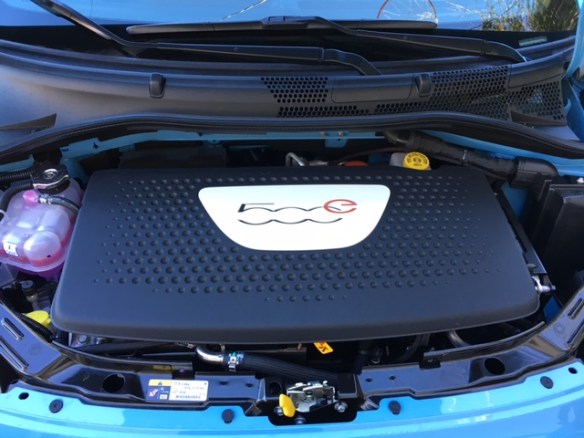
I’ll admit that with its shroud, wearing the same dot pattern you’ll find on the front, sides, and back of the 500e, you can’t see much in this photo, but notice that there’s no fan or radiator here!

I found a nice little comparison online that explains the differences between electric motors and gas engines, in brief. It also shows why electric cars are cheaper to operate and require much less maintenance. The real issue remains the range and charging time, and I believe that will be mitigated in the near future, with better batteries and quick charging.

The bottom line for today, though, is to plan, so you have enough charge available. Your car sits most of the time anyway, so just be sure it’s plugged in! According to the dash readout in Fidelio, recharging from yesterday’s jaunts was going to take about 11 hours using household 120 current. So what? I was in my house hanging out and sleeping.


Electric Cars: A Drop in the Bucket

Today, I read on the Clean Fleet Report website an interesting piece by Michael Coates about the Bestselling Electric Cars in the U.S. in 2015. Take a look and you’ll see the usual suspects.

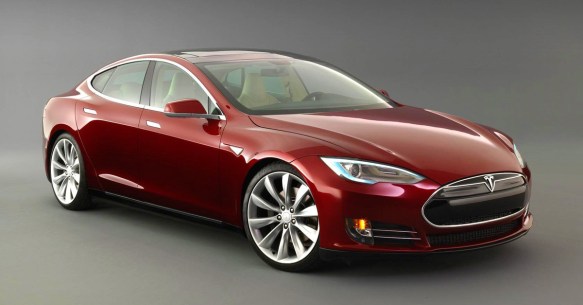
The top seller was, surprise surprise, the Tesla Model S, with 25,700 sold at $63,700 apiece after tax credits.

Tesla-Model-S

The Nissan Leaf, the previous leader, placed second, with 17,269, at a much more affordable $22,360 after tax credits. My baby, the Fiat 500e, came in at 7th place, with 6,194 sold at $25,700, after tax credits. Read all about them in the article.

The point, though, is that even though sales are increasing, this represents a minuscule portion of the car market. 2015 was a huge year, with around 17.5 million vehicles new vehicles sold. The industry has, by pretty much any standard, recovered, although not all companies are succeeding as well as others.

As I drive Fidelio to work and back I see a smattering of Volts and Leafs, an occasional “twin” 500e, and a Tesla or two, but we are a tiny minority. Mostly, we’re swimming in a sea of gas-burning cars and trucks of all shapes and sizes.

If we want to have an impact on the CO2 problem, there have to be LOTS more electric vehicles on the road as soon as possible.

Please join us. Even driving a new Chevrolet Volt, which features a gas engine along with its electric motor, has an all-electric range of up to 53 miles, which can make an impact.


Fiat 500e – Home Charging

Well, it’s been a great week of commuting and charging at work, but now that I’m home for the weekend, it’s time to plug in in my garage.

I wish my garage wasn’t so full of accumulated junk, but it is, so I have to use the method I’ve used with my other electric test cars–I plug in the charging unit inside the garage, attach the charging plug into the socket inside the “gas” door on the right rear corner of the car (backed in, of course), and then lower the garage door down to about an inch away from the concrete.

This is easy in clear weather, but is less pleasant when it’s raining. I did check, though, and the water doesn’t seem to want to drain into the garage. With Fidelio, my blue 500e, visiting into the springtime, I really need to clean out the garage so he can sit inside.

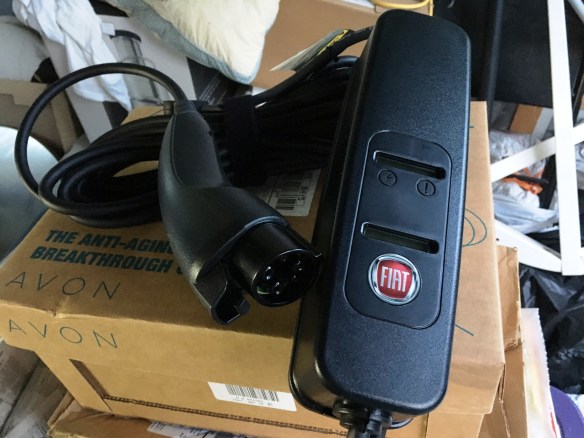
Since Fidelio came to me new, with just 79 miles on the odometer, I am the first journalist to drive him, so I got to take the charger out of its original plastic bag from the factory.

IMG_4493

It came with a slim User Guide, but I’m an old hand at home charging, so I left it in the bag for future journalists.

Fiat provides a sturdy, and long-enough, cord. You’re cautioned not to use any extension cords when charging. Most are probably not rugged enough to handle the job.

IMG_4494

When it’s plugged in, you can see it working by the movement of the green lights in the bar above the Fiat logo. There’s also a light inside the car, on the top of the dashboard, that shows an approximate level of charge in the car–kind of like the five dots on a Fitbit Flex.

So, I set it up and that was that. Sadly, home current, at 120 volts (known as Level 1 charging) is very slow. My level 2 ChargePoint chargers at work (240 volts) are much more efficient.

Here’s a record of my four visits to the chargers this week from the ChargePoint phone app. Fidelio had a partially full battery when I plugged in, but was topped off by lunchtime (on Wednesday through Friday).

IMG_4497

The first charge, on Jan 19, was in the afternoon, and the battery was 2/3 full. The others were typical, and show the amount of estimated range, time, and cost for the charge for each session. Interestingly, the addresses vary, although the six chargers are all right next to each other. 🙂