Flashback: Fiat 500e Video Review from Last Year

img_5143

On the eve of the arrival of my long-awaited Chevrolet Bolt EV, here’s the finished version of a video review I did on the Fiat 500e EV last April. Unlike my normal one-week test period, I got a three-month loan of this cute little all-electric car. Thanks again, Scott Brown of Fiat Chrysler Automobiles.

Little did I know when I got my Fiat test car on January 19, 2016 that a year later I’d be starting a new, longer-term EV adventure. But driving this car for three months gave me an appetite for gasoline-free motoring. I named the little blue hatchback Fidelio, and he was a faithful ride.

There are lots of posts on Fidelio on this blog from January through April 2016 to read. Enjoy my wrap-up in this video.


Bill Mattos, One of the First Three Bolt Owners

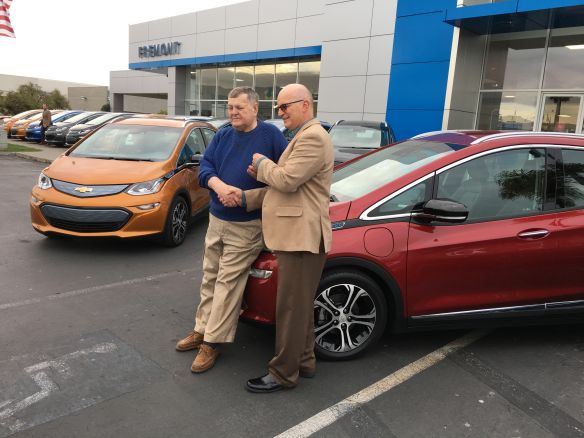
There’s a lot of excitement over Chevrolet’s award-winning new Bolt EV. Chevrolet promised to begin deliveries in December of 2016, and on December 13, in Fremont, California, three lucky customers drove their Bolts home. One of them was Bill Mattos, a retired law enforcement officer, who happens to live right there in town.

It turns out that Bill has been an EV enthusiast for a long time, since he got a rare opportunity to drive GM’s EV1 back in 1999.

“I was taking my Saturn to the dealership and saw this strange-looking car plugged in there,” said Bill. “It was the EV1. They let me drive it and we burned up a lot of electrons. I was blown away.”

gty_gm_ev1_mar_140904_16x9_992

Bill couldn’t buy or lease one—the waiting list was long, and GM notoriously cancelled the EV1 program—but he decided then that as soon as GM offered another EV, he’d be one of the first people to get one.

He got his chance when the diminutive Chevrolet Spark EV came out.

“I really liked the Spark’s acceleration, and it was easy to get in and out of,” Bill said. “But there was the 85-mile range, and while I enjoyed riding in the HOV lane, I sometimes felt a little intimidated by the big cars.”

Bill’s next EV was the larger Chevrolet Volt—a hybrid. He got the second-generation 2016 model. But not long after, he read about the upcoming all-electric Bolt and got excited.

“It sounded like a Spark on steroids,” he said. “I read everything I could find about it.”

And, Bill told the folks at Fremont Chevrolet to let him know immediately when they started taking orders so he could be the first one on the list. And that’s just what they did. On October 2, Bill drove down to Fremont Chevrolet and placed his order.

As it turns out, Fremont Chevrolet is the top EV seller in the Bay Area (and Fremont also happens to be where EV rival Tesla’s plant is located). So, when GM decided to deliver the first three Bolts there, Bill got a call to come on down and pick up his car. The dealership sent a car for him, since he would be driving his Bolt home.

“They had a whole lot of Bolts there, but most were going to other dealers for demo cars,” said Bill. “I originally ordered a silver one, but since I was getting to be first in line, I chose the red one, which included the fast charge port.”

The dignitaries presented Bill with his car, showed him how the features worked, and he was on his way. (Photo courtesy of Fremont Chevrolet. Bill Mattos, left, with Ron Meier, Chevrolet Western Regional Manager.)

bill-mattos-1

Bill really likes the car so far.

“It feels bigger inside than it looks on the outside, and it’s easy to get in and out of,” he says. “And the acceleration is great, although all EVs have that.”

Bill likes the ergonomics of the new Bolt, and how, with its 238-mile range, he doesn’t have to plug it in every night.

He’s had a few challenges using the new displays, but Bill knows it’s just an initial adjustment—and part of being an EV pioneer.

If you’re in the Fremont area and have a hankering for a new Bolt, contact Kurt Mietz, Fleet and Commercial Specialist, at Fremont Chevrolet. Call 650-766-7777 or email to: kurtm@cacargroup.com.

Chevy Bolt Anticipation

img_6908It’s two days before Christmas (and one before the first night of Chanukah). Anticipation is in the air. But I’ve been in a state of anticipation since October 11, when I ordered my Chevrolet Bolt.

As an auto writer, I’m always driving someone else’s car for an article, but I decided that this car is the one I want for me. I think it will be ideal for my needs–even if I’m only spending part of my time driving it.

What I’m trying to learn now is patience. It’s one thing to walk into a dealership, stroll around the lot, find a car you like, and then sit down and negotiate to drive it home. It’s another thing to order a car you’ve never actually seen or even driven and wait. You hope it’ll be as good as you’ve heard.

I did manage to get down to the San Francisco Auto Show in November and see a Bolt (see photo above). It was, amazingly, the same color I ordered, and I walked around it, talked with people about it, sat in it, got out, sat in it again, and hovered around it for a while.

I also visited a dealership and drove one. I was pleased that the experience behind the wheel (and in the back seat) was as good as I’d hoped. Having the car win awards right out of the chute was encouraging, too, making me feel like I was making the right choice.

The ordering process itself was simple. I went into the dealership and specified what I wanted–color, features, etc. Then, I waited to hear that the order was submitted. Then, I waited to be informed that the factory had received it. After that, it took a while to find out that the factory was preparing to build the car. Then, I learned that it was built but awaiting transport.

Today, I found out that my Bolt is on its way to California on a train. When it arrives here, it’ll go to a distribution center to be checked out before being trucked over the dealership. When it’ll arrive at Boardwalk Chevrolet in Redwood City is uncertain, but my great salesman emailed me today he may be able to track the progress of the train. That should be interesting.

I wish they could show you your car being built at the factory. I wish they put a little camera with a homing device on it, so you could follow its progress. We’re used to tracking our Amazon purchases from the moment it’s shipped to the minute it lands on your doorstep, so what do you say, Chevy?

Am I being obsessive? I still have a schedule of test cars into the middle of January, and am not giving up my column. But this is only the third time I’ve ordered a car–the second one for my own use–and it’s taking longer than I thought.

It’s definitely a team sport. The Chevy Bolt EV Owners Group on Facebook is approaching 1,000 members. I expect not every single person in that group will sign a purchase agreement or lease, but there’s a real groundswell of interest. As a journalist, I’m hoping to put a real public face on this car, and I plan to take it as far as it’ll go.

A few days ago, I ordered my home charger from ChargePoint. I’ll get it installed and ready for when I need it. I’m hoping to open up some space in my garage during the holiday break, but I’m getting a long enough cord that it’ll reach outside too, if necessary.

Meanwhile, on Sunday, my family will open gifts, and we’ll have a great time together. But my real gift is still on its way. The exquisite pain of waiting makes it all the more exciting.

Lucid Air – Enlightened Personal Transportation

lucid_air_2-25percentAs electric cars go, the Tesla, particularly the groundbreaking Model S, is the pinnacle of style and performance. But in its rear-view mirror, here comes some serious competition—the Lucid Air.

If you’ve never heard of Lucid, that’s not a surprise. Even those of us in the car writing business have heard little. The company renamed itself recently, and they’ve been working quietly to produce not just a concept and a plan, but a real car. I saw it yesterday, and rode in a test version, and it’s the real deal.

Per Zak Edson, Lucid’s Director of Marketing, the car world is stagnant today, with a wide variety of choices that don’t provide a complete experience. The Lucid, however, is designed from the start to combine the feel of a luxury car, the performance of a sports car, and the urban maneuverability of a midsize sedan—all in one vehicle.

The Air, Lucid’s sole car at this point, is meant to relate to you, and be a seamless, personal experience. It’s a new kind of car, a segment-breaker, that is Mercedes E-Class sized on the outside for easy maneuverability, S-Class sized inside, and low and sleek like a sports car. It’s a no-compromise proposition, designed to give you back your energy, space, and time.

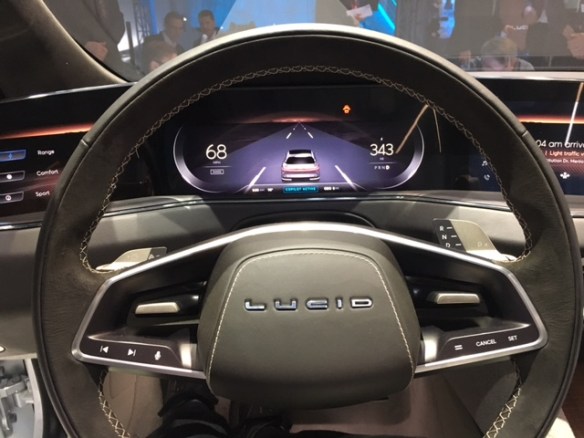
Inside, rather than presenting you with a large screen like in a Tesla, the Air gives you an update on the familiar instrument panel, but with more. It’s configurable, and it will know what to show you when you need it. So, for example, the left panel gives you controls for starting up, and once underway, displays your ongoing options.
wheel

The best way to communicate with the Air will be with your voice, just as you would with Siri. And as the car learns your routine, it can give you the best routing to your destination, remind you about stops you should make, and basically, act like the computers in Star Trek. The goal is to keep your phone in your pocket and your eyes on the road. The maximum capability with the minimum effort is the aim here—connected, natural, and adaptive.

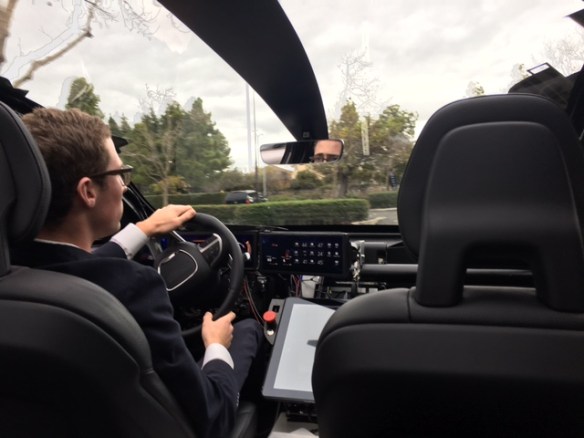
The Air will debut ready for autonomous driving, but you’ll have a manual mode and a co-pilot intermediate step, where the handsome center portion of the instrument panel will show you what’s happening so you can intervene if it’s necessary. I rode in a test vehicle on a closed track and saw how the car knows where it’s going, turns on its turn signal by itself, and shows you what’s going on.

The view in the instrument panel screen changes depending on whether you’re driving or it’s doing the work. As a driver, you’ll see supplementary information, like a bird’s eye view, but while it’s driving, you’ll see what the car sees.

You can change the look and feel of the screens too. And, there is a flat iPad style panel that angles out down low for detailed views and entering information, as needed. Push a button to retract it. Sweet.

The clean, subtle style of the interior is exemplified in the way the 29 speakers in the high-end audio system are incorporated in, subtly hidden in the panels, without garish or clashing grilles. And there’s active noise cancelling, so in this nearly silent EV, you’ll hear everything the music can provide.

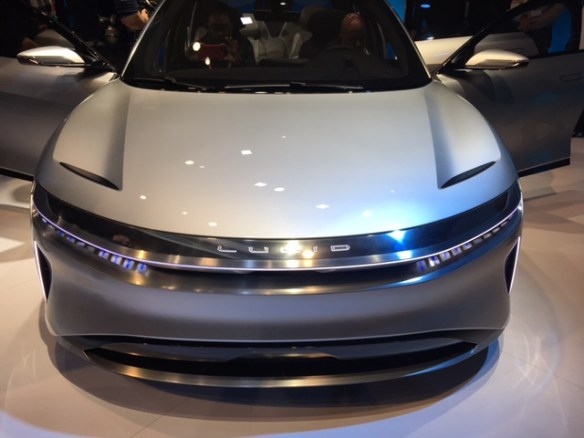
The car looks like a futuristic version of a full-size sedan. Derek Jenkins, the designer, used his talents before at Mazda, a small Japanese company known for its clean, expressive designs. In the Air, Jenkins has produced a vehicle with subtle surface transitions and some surprises.

The nose, for example, uses ten little headlamps on each side. Each tiny rectangle contains 4,820 individual lenses, like an insect’s eye, and each uses a gimbal to move with the car as it turns. They were going for a look different from the “two eyes” we’re accustomed to.
img_7236

Below the lighting strips, behind a cover, are the radar, lidar, and cameras needed to permit autonomous driving. And the shape creates a vortex of air to cool the motor components.

Lucid believes that California provides the perfect blend of technical innovation and the spirit and emotion of life there. So, the designers, led by Sue Magnusson, have chosen California-based interior themes, including Lake Tahoe (warm oranges) and Santa Monica (bright, sunny whites), Mojave at night (dark shades) and Santa Cruz.

I got to experience the four themes not only by touching material samples and conversing with friendly Lucid folks, but by sitting in a solitary seat and wearing Virtual Reality goggles. These themes will be knockouts in real life—I got to see Santa Cruz in the debut sample car. The nearly all-glass roof above each theme is astounding, too.
roof

Part of the vision for the Air is of air travel in an executive jet, blended with clean interior design, like a spacious, relaxing room. In opposition to today’s complex, busy lines, the exterior and interior of the car are elegant and refined. And the rear seat is configurable as a limo-like bench or as a pair of reclining chairs. The chairs lean way back, and from there you can look right up through the nearly all-glass roof. And with the ultra-spacious interior, the dash panel looks a half mile away.

view-from-back

How did they get S-Class accommodations inside an E-Class body? Super-efficient packaging.

In a fascinating discussion with David Mosely, Director, Powertrain, I learned about the extremely compact motors, one at each end of the car, that are small enough to fit under your arm (although I imagine they’re quite heavy). Positioning them carefully, along with a new compact type of differential and cooling system, allows for front and rear trunks.

img_7226

Damian Harty, the Director of Chassis Engineering, gave me a tour through the suspension’s various aluminum pieces, each of which fits carefully around the structural components near it. It’s ingenious, and beautiful, too.

How about performance? The two small motors, plus a carefully configured battery that fits beneath the car, deliver a hearty 600 horsepower, good for a 2.5-second zero-to-60 time. The standard 100 kWh battery should provide 300 miles of range while the optional 130 kWh battery is expected to deliver 400 miles. The battery is not a monolith but a carefully shaped essential element of the car. It’s shaped to allow extra legroom for the very comfortable rear-seat passengers.

Safety? I viewed a rugged looking body structure that uses top grade aluminum and is designed to deform perfectly in a crash. The advanced safety systems should ensure that that happens very rarely, though.

Lucid plans to produce its cars in a new, state-of-the-art factory in Casa Grande, Arizona, set to break ground in the middle of 2017. It’ll be a sprawling facility someday, but the plan is to roll it out in three phases. Then, as more capacity is needed, they’ll just expand to fill the space. That saves a lot of startup cost while leaving room to grow along with future volume. By 2022, it should employ 2,000 workers.

Peter Rawlinson, Lucid’s chief technical officer, designed the Tesla Model S and has worked with Lotus and Jaguar. Rawlinson told me the goal with the Air is to create one exquisite and high-priced model, at around $100,000. However, as costs go down and volume goes up, Lucid will be able to offer versions at closer to $65,000. That’s what Henry Ford with the Model T prices, although the two cars couldn’t be more dissimilar.

The employees I spoke with at Lucid all told me about the close collaboration they enjoyed with each other while developing the Air. Designers and engineers were collocated, for example, so styling and technical design could communicate throughout the process. The Lucid Air itself then, with it’s perfectly coordinated components, reflects the team of 300 people who created it.


Audi A3 E-Tron: Step One

news-2017-audi-a3-e-tron.jpg

The Audi A3 e-tron gives the premium German marque an entry point to electric motoring. Based on the previous generation Sportback wagon, it combines a 150-horsepower 1.4-liter gas engine with a 102-horsepower 75 kW electric motor to make a combined 204 horsepower drivetrain. With 258 lb.-ft. of torque, it pulls the compact wagon from 0-60 in 7.6 seconds.

Electric vehicles, even half-electric ones, use the MPGe rating, which offers an efficiency standard that you can use to compare competing vehicles. For example, you can measure the A3 against the plug-in Prius or the Chevrolet Volt. The A3 e-tron earns an 86 MPGe rating using electricity and gasoline, and a 39 MPG with gasoline only. I averaged 96.4 MPGe during my test week. The window sticker claims I’ll save $3,750 a year in fuel costs over the average new vehicle.

EPA fuel economy ratings are 8 for Smog and a perfect 10 for Greenhouse Gas. The 138 grams per mile of CO2 is lower than most cars, but, of course, higher than an all-electric car.

One way to compare plug-in hybrids is by the range they can drive on electricity alone. The A3 claims 17 miles, and in my 18-mile commute, I found that to be accurate. Just before I arrived at my office, the gauge indicated the switchover. So, I plugged in and had enough to get almost home, and so it went. By charging at both ends, I used very little gas for commuting.

Charging is simple. Plug in to standard 240-Volt (level 2) chargers at work or in other public places, or use your own household current, which is 120 Volts (level 1).  It’s an eight-hour process at home, comfortably overnight. On a level 2 charger, it’s just two and a quarter hours. You won’t be hogging the chargers while others wait. They’ll appreciate that.

The A3 is on the lower end of the range listing for plug-ins, but it still makes a big difference. The Chevy Volt offers an honest 53 miles of charge before switching over to its gas engine, which generates electricity to run the electric motor. The Audi is typical of a hybrid, using the gas engine and electric motor interchangeably as needed.

The A3 e-tron offers four driving modes, which you select on the dash. EV mode uses the electric motor only. In Hybrid mode the car’s computer picks the most efficient power source for the driving conditions—EV, gasoline, or both. In Hold Battery mode, the car is a hybrid only, saving the battery charge for driving all-electric later. The Charge Battery mode uses the engine to charge the battery while you’re driving at freeway speeds.

I ended up taking a six-hour round-trip to an exciting but farther away than I thought microbrewery, so for that trip, the A3 behaved like a normal hybrid car. And that’s what distinguishes a plug-in from an all-electric car. You can pretty much go wherever you want to, but drive hyper efficiently when you stay local.

The 8.8 kWh lithium-ion battery pack sits under the rear seat, and because it doesn’t take up any cargo space, the wagon is fully usable to carry your stuff. Other plug-ins like the Prius and Volt are hatchbacks, so the A3 has an advantage with a lower sill for easier placement of, say, a bass, in my case.

The A3 Sportback wears a new name: e-tron, which Audi will use to identify other, future electric and hybrid models, too. For now, it looks and feels like an A3, which is a good thing. The premium craftsmanship inside, simply presented at this level, is pleasant and feels substantial and carefully thought out. My Misano Red Pearl Effect test car greeted me with a sweet leather aroma when I opened the door for the first time. The switchgear works nicely, the eyeball vents swivel satisfyingly, and the it’s a pleasant place to be.

The A3 e-tron comes in three levels: Premium, Premium Plus, and Prestige. Base price is $37,900. My tester was a Premium Plus, which added $4,100 to the tab. That got me extras like 17-inch, 15-spoke alloy wheels, 3-D optic inlays, the Audi music interface, heated front seats, and aluminum window surrounds. The $2,600 Technology package added a navigation system, Audi Connect online services, and more. They charged $575 for the fancy red paint (a typical Audi upsell). The bottom line came to $46,100.

If you’re an Audiphile, this is your high-efficiency choice. An all-electric e-tron model should be here soon.

Chevy Bolt Gets a 238-mile Range!

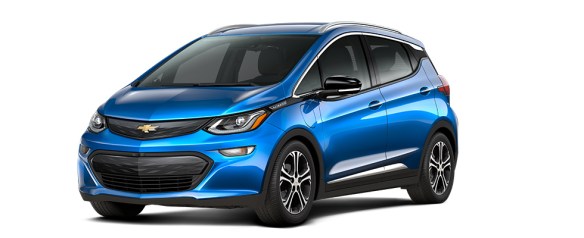
Today, Chevrolet released the official EPA range for the new Chevrolet Bolt all-electric vehicle. It’s 238 miles–more than what was advertised earlier, and enough to put all the other EVs in the dust! Yeah, you can spend three times that amount for a Tesla, but in the world of regular earth-loving folks, the Bolt is set to change the story. And, with the newly updated website, you can now see the models and colors available and a lot more information.

Price is still not official, but they’re talking about $37,500 before the Federal and California rebates, so it could be a $30K car.

I personally can’t wait to order mine in brilliant blue!

bolt-9-13-16-blue

Now, we also know that the Bolt, like the Volt, will come in two levels–LT and Premier. Want leather seats and shinier wheels? The Premier it is. You also get roof rails, heated front and rear seats, various life-saving alerts, and more. The website lists the differences.

Based on my experience with the Volt, the upper level car will look and feel better, but will cost several thousand dollars more. I just hope that I like the LT and that I can get it with DC fast charging. That method of charging lets you add about 90 miles to the battery in the time it takes to have a relaxing cup of coffee and a snack on the way somewhere.

In a related piece of good news, Volkswagen, BMW, and ChargePoint (the largest car charger company) have teamed up to build 95 Level 2 and DC charging stations as part of the  Express Charging Corridors Initiative along the East and West Coasts. For me in California, that means Highway 5 and 1 between Portland and San Diego. Back east, it’s between Boston and Washington, DC. That’ll go a long way to helping folks with EVs with 90 mile ranges get out and see the country. Of course, the Bolt, Teslas, and upcoming 200-mile cars like the next Leaf, will become even more worth owning.

Chevy now has a new EV-themed site, Chevyevlife.com, that explains about living with an electric car. After all, they are going to have three models to sell soon, including the Bolt, the fine new 2016/2017 Volt plug-in hybrid,and the Malibu Hybrid. The tiny Spark, having blazed the modern EV trail for the brand, has quietly exited the building.

Nissan Leaf – EV Pioneer

2016_nissan_leaf_02.JPG

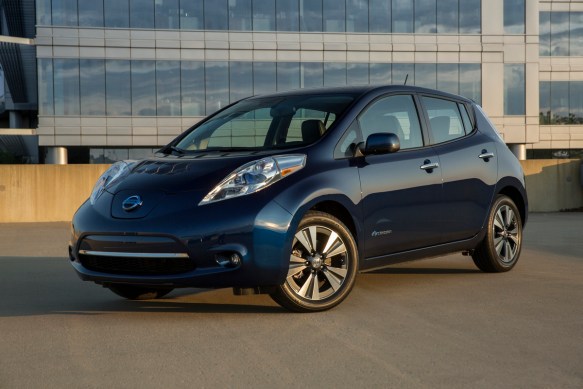
The Nissan Leaf was designed from scratch to be a gas-free all-electric model. They’ve sold more than 185,000 of them since its debut in 2010 as an ‘11, and a pioneer in mainstream EVs.

The Leaf hasn’t changed much over the years, though, until now. The 2016 model looks the same, but you now can get one with a 30 kWh lithium-ion battery. Adding just 46 pounds, it’s got higher power density, so it earns a 107-mile driving range from the EPA, versus 84 for the old 24 kWh battery, a 27 percent improvement.

For most driving, and many people, 107 miles is plenty. I drove my Deep Blue Pearl Leaf back and forth to work every day, in quiet comfort, the Bose audio system pouring out music from the standard Sirius XM radio and Bluetooth-connected selections from my Spotify stream.

The problem comes when you want to drive further. I got home one day with 85 miles on the range meter, and we had to take a quick trip that was about 70 miles. Because I wasn’t sure that was enough, we took our internal combustion engine car.

Although its design is aging, the Leaf feels smooth, solid, and friendly. With its virtually silent and vibration-free 80 kW motor, you fly along, almost by magic. Torque is available from the moment you step on the accelerator pedal, so there’s plenty of hustle from the 107 horsepower and 187 lb.-ft. of torque moving the 3,391-lb. car.

The EPA rates the Leaf at 124 MPGe City, 101 Highway, and 112 Overall. The Smog and Greenhouse Gas numbers are perfect 10s. The Leaf also gives you a miles-per-kWh rating, which was 4.1 for me. With 30 kWh, that looks like about 120 miles per charge.

2016_nissan_leaf_27

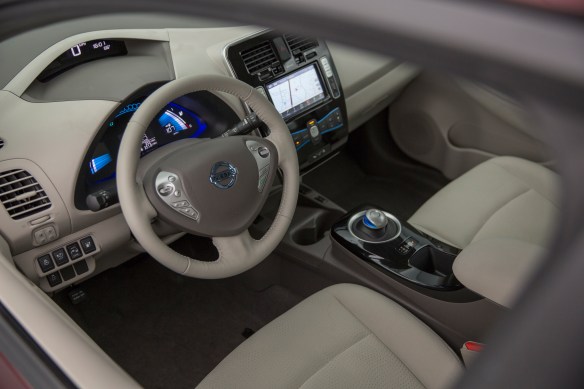
The one-speed transmission is controlled by a “palm shifter,” which, with its bright blue plastic front edge, reminded me of a Duncan Imperial yoyo. Just slip it back into Drive or forward into Reverse or push the Park button on the top.

The battery below the floor means a low center of gravity, so the Leaf is stable, and you feel secure darting around through traffic. But you are encouraged to drive gently to preserve charge. Nissan gives you a little Eco indicator at the top of the instrument panel, which assembles a little tree. The completed tree shrinks and moves to the lower right and you start on another one. I normally grew two on my 18-mile commute.

Unlike some other EVs, the Leaf is rated as a midsize car, and fits five adults, while providing 24 cubic feet of cargo space with the rear seat up. Drop the rear seat for an additional six cubic feet. I hauled my upright bass with ease, although the storage area isn’t flat—it’s deeper at the rear.

To charge the Leaf, a panel flips up on the car’s nose. In there, you’ll find the standard plug for using a Level 2 (240-volt) charger or a cable to charge (slowly) at home at 120 volts. A Level 2 charge takes about 6 hours. Upper level Leafs include a Quick Charge plug, which lets you refill the battery to 80 percent capacity in half an hour.

The Leaf is so quiet that Nissan provides an “Approaching Vehicle Sound for Pedestrians.” It’s a low-volume beep, which emanates from a speaker under the hood at speeds below 16 mph. I only heard it when backing out of my driveway.

The three models start with the S, the price leader, at $29,860. It comes with push-button start, electric windows, locks and mirrors, air conditioning, and a decent audio system, but gets only the 24 kW battery.

The mid-level SV starts at $35,050. It has the 30 kW battery and the Quick Charge plug. It also features the NissanConnect system with Navigation, a larger 7-inch display screen, two more audio speakers, and 17-inch alloys in place of 16-inch steel wheels.

The SL, at $36,790, is distinguished mainly by its comfortable leather seats. You also get a photovoltaic solar panel on the rear spoiler, heated rear seats, a cargo cover, and a couple other items. My SL tester came with the Premium Package, with an upgraded Bose 7-speaker audio system and the Around View monitor (it gives a bird’s eye view). It topped out at $39,390. All prices listed include the $850 delivery charge.

Retail prices are perhaps irrelevant, since many EVs are leased at bargain rates, and there are government tax credits that can significantly reduce your costs. Figure in that electricity is much cheaper than gasoline and EVs require much less maintenance, and it could be a real bargain.

2016_nissan_leaf_23

The Leaf, built in Smyrna, Tennessee, has been the most popular EV out there, and if you’re not budgeted for a Tesla, is still a good option.

Should I Get My EV Now or Wait?

Recently, with lease deals on EVs running at around $79/month (with a few thousand dollars down), I’ve been thinking about picking up one to use when I’m not testing other cars. After my three-month loan of a sweet little Fiat 500e earlier this year, I want to drive electric today, both because  it’s the right thing to do for the environment, but also to practice what I preach. Advocating for a move to carbon-free transportation is fine, but sometimes you have to walk the walk, too.

cq5dam.web.1280.1280

I believe that the upcoming Chevrolet Bolt, with its 200-mile range, vast dealer network, and attractive purpose-built EV design, will be a game changer for the non-wealthy like me. But I suspect that there will be no deals on Bolts, at least a first. There’s plenty of pent-up demand and they’ll have the only game in town–for a while, at least.

So, I’m focusing on the Volkswagen e-Golf again, as well as the Fiat 500e and maybe the Kia Soul EV.

eGOLF-LEAD-1940x1293

The process of elimination removed Tesla from consideration right off the top. It’s way out of my price range, and there are no cheap deals to be had anyway. Others cut from the list include the Ford Focus. It’s a regular car that’s been electrified, and has only a 76-mile range. There’s the worthy and pioneering Nissan Leaf, which was built as an EV from scratch, but is looking long in the tooth with minimal changes since its 2011 debut. The availability of a bigger battery with 107 miles of range in the 2016 model is a small consolation. The Chevrolet Spark EV is cute and has great torque, but it’s kind of tiny. The Mercedes-Benz B250e and BMW i3 are appealing, in different ways, but are not as affordable as the three vehicles I mentioned at the top of this paragraph, if low price of admission is the goal.

In any case, is it time to grab something now or to wait? I’m struggling with impatience but also with the knowledge that as with all things technological, the next improvement is right around the corner. You know that when you take home that new laptop, next week there’ll be one with a better screen or more memory or some amazing new feature.

Here’s what you get if you wait. The new Focus is going to jump to 107 miles of range with the ’17s. The all-new Hyundai Ioniq is arriving this fall with 110 miles of range. The Bolt looms ahead appealingly. The Kia Niro will offer a hybrid in a crossover shape–and perhaps a pure EV someday. What will the next Leaf be able to do? We’re on the edge of a whole new generation of attractive options.

To top it off, as I entertain a deal on the ’16 e-Golf with its 83-mile range, I just read that the ’17 is supposed to get about 125 miles of range with a new, larger battery. So, suddenly waiting a few months seems like a great idea, as long as I don’t need the car right now.

The only down side is that the cheap lease deals may dry up once the next gen cars are out. Who really believes that a $79/month lease is realistic in 2016, anyway? It’s just a way to sweeten the deal on a car that retails in the $30,000-plus vicinity and has limited range. The  companies are willing to move them out at a loss or minimal profit just to comply with regulations and maybe pick up some green cred for doing so.

Perhaps, if you’re really eager, you could take advantage of a deal now on the shortest lease term you can get (24 months?), and save up for the big transition two years from now, when you may be able to snag a Tesla Model 3 that someone ordered on spec or that fell through the cracks. Or, grab a second- or third-year Bolt with the all the bugs fixed. And the new Leaf will be out by then.

As an EV cheerleader, and soon-to-be participant, that may be the best way to get in now at minimal outlay and plan for a long, enjoyable electric car future.

But I remain perplexed. It does feel like sooner is better for the earth, but I want to have the best car for me, too.

Volvo XC90 T8 Hybrid – Unique

The all-new Volvo XC90

The all-new Volvo XC90 is a handsome, luxurious, comfortable, fuel efficient, and expensive large crossover. All all new, it’s a huge step forward for the Chinese-owned Swedish brand.

The regular gasoline versions are badged T6’s, but my car I tested was a Volvo XC90 T8, the world’s first seven-passenger plug-in hybrid SUV.

All XC90s share a potent 2.0-liter four-cylinder engine that uses both super- and turbo-charging to put out 313 horsepower and 295 lb.-ft. of torque. The T8 adds an electric motor and a battery pack to deliver limited electric-only motoring and a total of 400 horsepower and 472 lb.-ft.  of torque. I drove my 18-mile commute entirely on electricity once, but normally achieved just under that. The center screen shows graphical and digital statistics, and where the power is flowing.

Hybrid system settings are Hybrid, the default mode, which switches back and forth from fuel to charge. Pure mode means all-electric. Power mode combines the motor’s instant torque and the gas engine’s size to provide V8 level performance. Save mode lets you retain the battery charge for later use.

An EV range in the teens is typical for plug-in hybrids, and remarkable for a 5,059-lb. vehicle. The EPA gives it a 53 MPGe rating (compare that to other battery vehicles). In pure EV mode, it’s much better. Gas-only delivers 25 MPG. My tester averaged 22.7 mpg over 63 hours and 1,578 miles, including previous journalist loans.

Green scores are 7 for Smog and a split number for the Fuel Economy/Greenhouse Gas rating—7 for MPG and an 8 for CO2.

Pricing for the T8 starts at $69,050. My tester, with the $3,500 Inscription level upgrade, plus a raft of safety, convenience, and style packages and features, came to $84,005. That’s a big price tag, but this car is a great experience.It’s filled with luxury features, including an Orefors crystal shift knob and some beautiful food trim.

The all-new Volvo XC90

The XC90 T8 was named Green Car Journal’s Luxury Green Car of the Year, and is part of what is a welcome resurgence for Volvo, a brand with a historic commitment to safety, today’s latest technology, and now, a greener way to move a family of seven.

Yeah, it’s not a full-fledged EV, but it’s a move in the right direction. I’m look forward to Volvo offering a full EV before too long.

IMG_5801

Chevrolet Volt – The Perfect Compromise

IMG_4787

The all-new Chevrolet Volt may be the best solution today for moving to greener driving to reduce CO2 emissions and mitigate the effects of climate change. It’s an electric vehicle (EV) without the drawbacks.

The many advantages of driving an EV include smooth, quiet motoring, minimal service requirements, and the feeling that you’re part of the solution and not the problem.

The downsides of EVs include limited range and the long time it takes to recharge the batteries.

Regular hybrid vehicles combine gas engines with electric motors to extend your fuel out over more miles, but you never plug in. Plug-in hybrids provide a small all-electric range before becoming regular hybrids.

The Chevrolet Volt, which debuted for 2011, was designed as an electric car with a range extender: The Voltec electric drive system. You could charge it up, drive about 35 miles, and then its small gasoline engine kicked in to generate electricity to keep the motor moving the car along.

The totally redesigned 2016 Volt continues on this path, with huge upgrades. Generation one owners gave GM plenty of feedback. Gone are the hard plastic panels with haptic touch controls. The styling is in line with current Chevy gasoline vehicles, like the midsize Malibu. The new car looks great inside and out, with colors and metallic trim befitting a fancier vehicle.

What’s most important, though, is that the new Volt offers an electric range of 53 miles. In a week with my Mosaic Black Metallic test car, I drove in silent, serene full-electric mode for all of my commuting (18 miles each way to work and home), and all of my normal errands. On only two occasions did I need the extended range. The combined range for gas and electric is 420 miles.

When my Volt switched over to gasoline, the instrument panel indicated I had moved from battery power. I could hardly hear the engine when it engaged, and even when the battery was depleted, the car sometimes used it with power generated from braking.

An electric car is rated for MPGe. MPGe assigns a comparative value to the efficiency of different EVs, but it also stands alongside MPG. My week with the Volt generated 118.1 MPGe. The EPA’s ratings are 106 MPGe for electric mode and 42 MPG for gasoline (combined city/highway numbers). Green scores are 8 for Smog and a perfect 10 for Greenhouse Gas.

Compare that to a standard Prius, which gets 52 combined MPG. The Chevrolet Cruze, the Volt’s gasoline cousin, earns 35 MPG combined, itself a laudable number.

The electric motor puts out 149 horsepower (111 kW), and a strong 294 lb.-ft. of torque. The gas engine generates only 75 horsepower, but it’s meant to charge the car rather than drive it. Chevy claims an 8.4-second 0-60 time. I felt confident in it driving uphill on a winding road in the rain.

The Volt comes in LT and Premier levels. My Premier tester flaunted attractive two-tone interior with tan inserts and silvery trim winding around the dash. The center screen is nicely rendered and there’s a jaunty blue plastic top on the “shift” knob. The rear seat now offers a center position, but there’s not a whole lot of legroom for that person. The hatchback is convenient, although it’s a high liftover.

IMG_4778.JPG

The Drive Mode switch lets you configure the Voltec system. Use Normal mode for maximum efficiency, Sport mode to take advantage of the bountiful electric motor torque, or Mountain mode for maximum power on steep upgrades. The fourth mode, Hold, lets you preserve your battery charge and use only gasoline.

Regenerative braking is crucial for hybrids and EVs, but the Volt lets you prime the pump with a paddle on the left side of the steering wheel for “Regen on Demand.” Use it like a brake, while banking charge. With practice, you can drive almost without using the brake pedal at all.

The Volt has its own personality, with a greeting sound and a “wind down” tone it makes when you turn it off. Because the electric motor is silent when you start the car, the blue Power button is more like turning on your iPhone than turning over your engine.

The LT starts at $34,820 and the Premier, with heated leather seats, a Bose stereo system, and more, starts at $39,270. My tester listed for $39,850. Various leasing options, plus some Federal and State rebates, can make these cars easier to drive home.

While an all-electric car may be the ideal way to go, it’s not practical for everyone today. But if you want a compact car that’ll do pretty much everything and let you drive electric most of the time, the Volt is a great solution.