What’s MPGe? Why Should I Care?

MPGe

When the United States Environmental Protection Agency (EPA) began measuring the fuel economy of cars decades ago, they created a miles-per-gallon (MPG) rating. It was designed to be posted on the Monroney (window) sticker, so consumers could compare different cars when they were shopping.

However, what happens when you have a car powered completely or partially by electricity? How do you measure a “gallon” of volts? The agency had to find a way to measure all energy, as a “measure of the average distance traveled per unit of energy consumed.”

So, in 2010, in response to the arrival of the new Chevrolet Volt plug-in hybrid and the Nissan Leaf all-electric vehicle, the EPA came up with the MPGe rating–miles-per-gallon-equivalent. See this Wikikpedia entry for more detailed information.

I went to my favorite comparison/information hangout online–fueleconomy.gov–and set up a comparison between four kinds of cars, including my Fiat 500e. The Fiat represented a pure electric vehicle, I listed the Chevrolet Volt as a plug-in hybrid, the Toyota Prius as a regular hybrid, and the popular Honda Civic sedan as an efficient “regular” internal combustion engine (ICE) car.

Here’s what I got. Check it out for yourself. There are lots of numbers there, but here’s what I take away from it all.

  1. Electric cars have only the MPGe/MPG score, and it’s much higher than the MPG scores. The Fiat was tops in this comparison, with the Volt just below, with the two non-plugin cars way below. Use this number to compare all-electric cars to each other (and check the range, too).
  2. Hybrids are much more fuel efficient than regular cars. Keep in mind that the Prius has the best fuel economy of any hybrid car, and the Civic is one of the most fuel-efficient ICE cars.
  3. Driving the Volt in electric mode–keeping your trips within the battery range and recharging regularly–delivers nearly as good a rating as the Fiat. Driving it long distances using only gasoline isn’t much better than the ICE Civic. But if you’re the typical driver, and make sure to charge up regularly, and you’ll get the best of both worlds.
  4. Hybrids, like the regular Prius, don’t plug in (there is a plug-in version too). They’re given an MPG number based on overall performance, because they switch back and forth between gasoline and electricity, depending on driving conditions. The numbers look pretty good, though.
  5. The Prius, in this four-car comparison, saves the most per year compared to the average car. Remember, there are lots of other factors, though. Still interesting.
  6. Notice there’s a “per 100 miles” measurement in the same box that contains the MPGe and MPG number? That’s where the “equivalent” comes in. The Fiat, for example, shows 30 kWh per 100 miles while the Honda shows 2.9 gallons per 100 miles. The question then comes–how much does it cost for 2.9 gallons of gas or 30 kWh of electricity? My experience, using a public charger at work, is that I can get around 15 kWh (about 50 miles worth) for a couple of bucks. Gas, in California now, is currently running about $2.25 a gallon. Doing the math, the Honda costs roughly $3.50 for gas for the $2.00 the Fiat runs. Charging my car at home, at night, would likely run a bit less.

Are you enjoying that comparison chart? Good. Now, click the Energy and Environment tab and you’ll see where electric cars come out on top for greenhouse gas emissions. The Fiat gets a lovely zero grams per mile. The Volt is mighty good at 51. The Prius more than triples that to 170, while the Civic gets 256. Many larger cars can emit 400 or 500 grams per mile. So even downsizing from a large to a smaller ICE car is an improvement.

Yes, it’s true that an electric car must use electricity that’s generated someplace using some method that could cause an environmental impact. And there’s the fuel that went into the tank of the transporter truck that delivered your EV to the dealership. Ideally, you generate power from solar panels on your roof, although remember, some energy was consumed to produce the panels. If your power is generated using hydroelectric, wind, or a giant solar farm, you’re good. Natural gas–not as good. Coal–not good at all. Here in California, there are no  coal-powered plants (as far as I know), but PG&E, the utility, could  buy power from another company that used coal to generate it. We have some nuclear power generation here, too.

Still, at this point, there are many fine reasons to drive an electric car, if it fits your lifestyle. But even driving a Prius cuts your carbon footprint down significantly. If you work it right, a plug-in hybrid, like the Volt, would be even better than the Prius (the more you use the electric and the less you burn fuel). And if all else fails, you can still drive a Civic instead of a Cadillac and reduce your environmental impact a bit.

Until we have affordable electric cars with a 300-mile range, these other options–plug-in hybrids, hybrids, and highly efficient regular gas-burners, will have a place in the automotive market.




Fidelio the Fiat 500e – One Month Report

I’ve now had my test Fiat 500e for a month. The quick review is–I love it!

2-19-16

This image tells the statistical side of the story. I’ve traveled 821.6 miles, in 37 hours and 52 minutes of commutes and short errands.. My average economy is 128.1 MPGe. The official numbers are 121 City, 103 Highway, for 112 Overall. So, I’ve beaten the numbers.

From the comfortable leatherette and cloth bucket seat, the car is everything I’d hoped it would be. It’s incredibly quiet, whether I’m on the freeway or side street, and seemingly regardless of surface. There is practically no tire hum or wind noise, and the car’s excellent insulation prevents most ambient noise from disturbing the serenity of the cabin.Of course, electric motors don’t make any significant noise other than a slight whine during acceleration, and are vibration free.

Inside, the audio system did a great job of entertaining me, with no-look fingertip controls on the back of the steering wheel making a shift of medium, volume, or station effortless. I used the hands-free dialing feature for a couple of phone calls, and it worked OK. Today, I had to nearly yell out a phone number to my local pizzeria, but the call went through.

The electric motor pulls the car along with surprising enthusiasm, although I’ve been careful to keep the color-coded curved bar on the right side of the central gauge in “Eco” territory (green) or Charge (blue). I think the hundreds of pounds of battery mounted low in the car increase its stability, because it corners flat, and there’s no noticeable dive or squat during braking or acceleration. It feels quick and light on its feet.

It may not seem very manly, but the bird’s egg blue paint and significant stretches of white in the interior make the car pretty and cute. That may not be for everyone, but I love it. It feels happy to me.

I’ve gotten into an easy routine with charging. I use one of the six Level 2 (240-volt) ChargePoint chargers in front of my building at work, and it takes two or three hours to top off the battery. I then pull the car away promptly, leaving room for another of the approximately 15 people at my office who drive electrics. There are three Fiat 500e’s, including another blue one (but he has black trim). The other one is a brilliant orange–probably my second choice. I share the six slots with Teslas, Ford Focuses, a Chevy Volt or two, and at least three Nissan Leafs.

I also charge at home, with a cable tucked under my garage door to the car, which I back into the driveway. Someday, my garage may be clean enough to accommodate the car–if I’m lucky, during this extended loan period. Even though it takes many hours to fill up, it’s normally time I spend in the house, relaxing with the family, writing, or playing music (or sleeping).

I’ve gotten more relaxed about charging as I’ve learned what my limits are and what to expect on my trips. So, if the car has 45 miles or range on it, or around half a charge, I’ll wait and not plug it in at home that night, planning to just charge it all up at work the next day. So I’m not bound by having to charge every time I park it.

I have had to use our gas car for a couple of longer trips, but otherwise, the 90-mile range of the Fiat is just right for everything else I want to do. The hatchback configuration means I can carry my big upright bass or my electric bass and amplifier. I can’t take both, though.

Groceries are no problem, and neither was a new amplifier or a TV. Normal size people will fit in back, but I wouldn’t put them there for a long trip. But, of course, the car isn’t meant for those anyway. 🙂

In the next two months, I expect more of the same. I plan to meet up with electric car enthusiasts as much as I can. So far nothing has materialized, though.

I got, and proudly wear, my FIAT hat!

IMG_4642

The little Fiat is happy in rain and in the dry weather. I haven’t felt like it was pushed around by storms, although I felt bad a few days ago when I opened the door and a blast of  rain wetted the dashboard, door panel and floors. It wasn’t too bad, but it sure felt like it.

My new friend at work, Moris, says Italian cars are the most beautiful. I will say that Fidelio is not the most dramatic or glamourous  car, but his details are well sorted out and he successfully evokes the original car.

IMG_4680

Here’s the morning dew on the silvery tail logo. Almost like an impressionist painting!


Electric Fiat 500e- a Smooth Operator

Now nearly four weeks in to my electric car adventure with  Fidelio, the blue Fiat 500e, I’m really enjoying the smooth, powerful performance I get from him. Whether I’m zipping around town, accelerating onto the freeway, or climbing up the significant hills in my neighborhood, the little electric motor is more than up to the task.

Fascinating also is the way I can actually gain charge on a trip. Yesterday, I drove about four miles into Hayward, the next town over. The trip being mostly downhill or level, I ended up with a net range gain. I started with 46  on the range indicator and pulled into my destination with 51! Of course, I gave it back on the way home, but that’s the kind of numbers game you play when you’re driving an electric car today.

I keep coming back to the smooth, quiet experience I have every day commuting 18 miles each  way to work. I think the reason is that electric motors are much quieter, because they are so much simpler than gas engines. With just one moving part, the shaft, an electric motor creates virtually no vibration.The pistons of a gas engine move up and down, turning the crankshaft, which generates a lot of vibration and noise. That’s why there are engine mounts and mufflers. But you won’t find them in an electric car.

IMG_4597

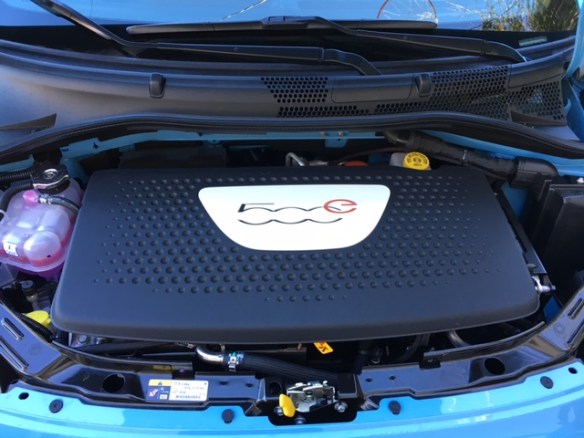
I’ll admit that with its shroud, wearing the same dot pattern you’ll find on the front, sides, and back of the 500e, you can’t see much in this photo, but notice that there’s no fan or radiator here!

I found a nice little comparison online that explains the differences between electric motors and gas engines, in brief. It also shows why electric cars are cheaper to operate and require much less maintenance. The real issue remains the range and charging time, and I believe that will be mitigated in the near future, with better batteries and quick charging.

The bottom line for today, though, is to plan, so you have enough charge available. Your car sits most of the time anyway, so just be sure it’s plugged in! According to the dash readout in Fidelio, recharging from yesterday’s jaunts was going to take about 11 hours using household 120 current. So what? I was in my house hanging out and sleeping.


Typical Weekend with My Electric Car

After a week of easy, pleasant commuting, Fidelio, my little blue Fiat 500e, proved excellent at taking me on some weekend errands.

On Saturday, I started out at Safeway, for some groceries and household items.

IMG_4583

The rear area is great for small trips, without having to drop the back seat. I hope those 12 rolls of paper towels last a while. 🙂

IMG_4584

Next, we drove a couple blocks to the Post Office.

IMG_4585

I got a good place in the lot in front, between two hulking SUVs–a Ford Explorer and a Chevrolet Tahoe.

IMG_4586

That was easy. Next, I drove home and picked up my bass and amps for a band practice at Ed’s place. Ed has lots of room for cars in his yard.

IMG_4588

All my gear fits into the back, as long as I drop the rear seats.

IMG_4587

I’d say that was a successful Saturday of schlepping around without using an ounce of gasoline.

On Sunday, I took Fidelio down to Pete’s Hardware to buy a few screws to fix my amplifier head. That was easy.

IMG_4595

Ha ha – looks like my little car is getting sawed!

Sadly, when it came time to go to San Jose, 40 miles away, I had to leave him home and take my wife’s regular old gasoline car. The errands had used up just enough range to make an 80-mile round trip, mostly high-speed freeway driving, a little too close for comfort.

Electric Cars: A Drop in the Bucket

Today, I read on the Clean Fleet Report website an interesting piece by Michael Coates about the Bestselling Electric Cars in the U.S. in 2015. Take a look and you’ll see the usual suspects.

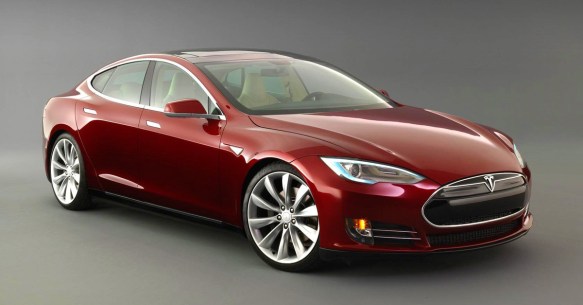
The top seller was, surprise surprise, the Tesla Model S, with 25,700 sold at $63,700 apiece after tax credits.

Tesla-Model-S

The Nissan Leaf, the previous leader, placed second, with 17,269, at a much more affordable $22,360 after tax credits. My baby, the Fiat 500e, came in at 7th place, with 6,194 sold at $25,700, after tax credits. Read all about them in the article.

The point, though, is that even though sales are increasing, this represents a minuscule portion of the car market. 2015 was a huge year, with around 17.5 million vehicles new vehicles sold. The industry has, by pretty much any standard, recovered, although not all companies are succeeding as well as others.

As I drive Fidelio to work and back I see a smattering of Volts and Leafs, an occasional “twin” 500e, and a Tesla or two, but we are a tiny minority. Mostly, we’re swimming in a sea of gas-burning cars and trucks of all shapes and sizes.

If we want to have an impact on the CO2 problem, there have to be LOTS more electric vehicles on the road as soon as possible.

Please join us. Even driving a new Chevrolet Volt, which features a gas engine along with its electric motor, has an all-electric range of up to 53 miles, which can make an impact.


Fidelio – Features I Like

When you settle in and start driving a car regularly, you find the features that stand out, or make you smile. It might even be a little smile. Of course, what I like best about my little Fiat 500e is its all-electric drivetrain, which means smooth, nearly silent operation and no gasoline–ever! But here are three small things I’ve enjoyed so far.

  1. Audio controls on the back of the steering wheel

IMG_4528

You can get these in any car sold by Fiat Chrysler Automobiles, including Jeeps, Dodges, and now, even Fiats. One of the safest and easiest ways to control your sound, the controls, one on each side of the steering wheel, do what dials and buttons used to do on the dash. Some cars have them on the front of the wheel, but these are better because you don’t even have to look at them (or even can look at them) and take your eyes off the road. Each pad has a round center button and a top and bottom section that you also push.

On the left, the center button skips from one preset to the next. The other two move you through the radio tuner, or tracks of a CD or Bluetooth stream. On the right, the center button changes mode, from AM/FM radio to CD, SiriusXM, or Bluetooth streaming. The other two adjust the volume. Once you get it, it’s so easy.

2. Push to lock

IMG_4535

To keep it simple and clean, to lock the door, just push the handle in towards the door. I think this may replicate the way the original 1950s and 60s models did it. See the little red bar? It means it’s locked.

3. World’s easiest push-button transmission controls

IMG_4536

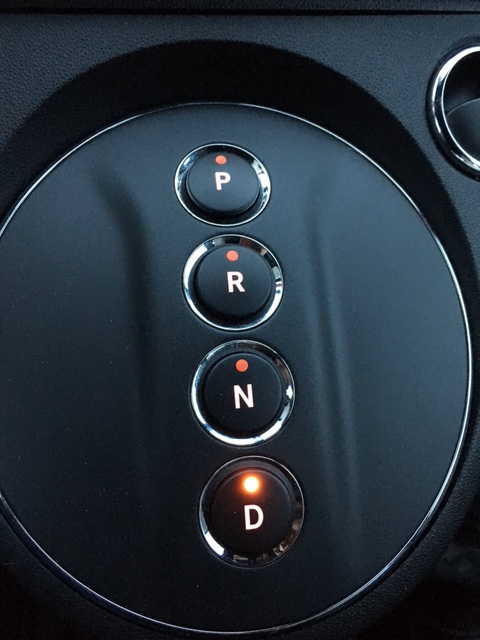
With only one speed (electric cars don’t need or use gears), it’s just a D for drive and you’re off. Simple, and takes up no space. Of course, it’s great fun to shift gears manually in a gasoline car, but this is the future, and I’m OK with that. Notice there’s no “L” for Low–you don’t need it. And the shaping of the panel keeps it  from looking flat and cheap.


EV Drivers – Pioneers and Tiny Minority

As I look over the pretty white dashboard with the silver rings in my Fiat 500e, I smile when I see another 500e on the road. Most of them have their stickers so they can ride in the car pool lane and skip tolls on the bridges. As a borrowed test car, mine doesn’t.

I enjoy seeing a BMW i3 whiz by. Nissan Leafs are common, distinguished from each other only by color. It’s nice to see the new 2016 Chevrolet Volt is taking off. I see them frequently, with their all-new look. Their unique taillamps flaunt a fresh signature on the way home at night.

But, we EV drivers are still a tiny minority on the highways and byways of America. For every one of us there are 100 Ford F150s or Toyota Camrys or Chevrolet Tahoes. Cheap gasoline has encouraged a boom in larger cars, so even intelligent choices like the Honda Fit or Hyundai Elantra languish.

Sergio Marchionne, head of Fiat Chrysler Automobiles, said he’s ramping up production of big Jeeps and reducing production of smaller, more efficient Dodge Darts and Chrysler 200s. Why? Because big Jeeps are the cars that people are buying, and he has to run his company at a profit. It’s a good–even necessary–business decision, but it’s not helping the environment. Marchionne has already stated that FCA loses thousands of dollars on every little Fiat 500e it sells (although the company gets credits towards its Federal clean air obligations).

The people are speaking, and most of them are not EV enthusiasts. They want what they want and like. You can’t blame them. Like the climate crisis in general, if you can’t see it, it’s hard to muster up the energy to do anything about it.

To my left, a giant, black Cadillac Escalade momentarily blocks out the sun. It’s going to be a long haul (but worth it).


Fiat 500e – Range Budgeting

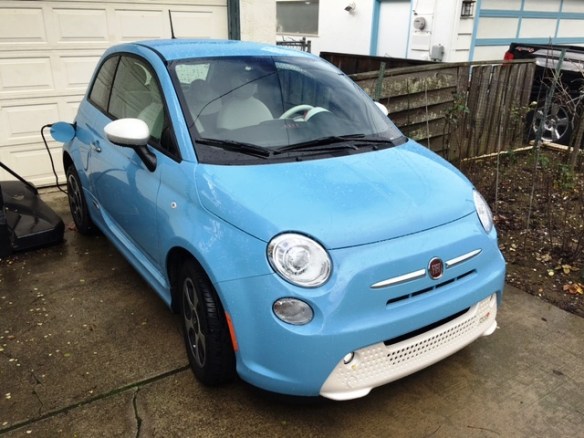
When you’ve got an electric car and lots of things to do, you need to plan accordingly. Yesterday, I would have taken Fidelio, the little blue Fiat 500e, on my errands around town, but I had to top off his battery so he’d be ready for a 30-mile trip today. Also yesterday, while my wife, son and I drove to a family dinner 80 miles from home, he remained here in the driveway, tethered to the charger. I think he looks a little sad, but it could just be the camera angle and the rainy weather.

IMG_4500

Today, he gets a nice freeway cruise into Oakland. I’m expecting little traffic, so there won’t be much chance to regenerate power. With a full battery, this should be no problem.

I’m sure this range business will be part of my life as long as my three-month test lasts, and it takes thinking and planning–something you don’t do with a normal gas-powered car. But I’m already finding that it helps you reduce driving in general, and cleverly combine trips to maximize economy. As long as you have a petroleum-drinking second car around, it’s all possible.


Fiat 500e – Home Charging

Well, it’s been a great week of commuting and charging at work, but now that I’m home for the weekend, it’s time to plug in in my garage.

I wish my garage wasn’t so full of accumulated junk, but it is, so I have to use the method I’ve used with my other electric test cars–I plug in the charging unit inside the garage, attach the charging plug into the socket inside the “gas” door on the right rear corner of the car (backed in, of course), and then lower the garage door down to about an inch away from the concrete.

This is easy in clear weather, but is less pleasant when it’s raining. I did check, though, and the water doesn’t seem to want to drain into the garage. With Fidelio, my blue 500e, visiting into the springtime, I really need to clean out the garage so he can sit inside.

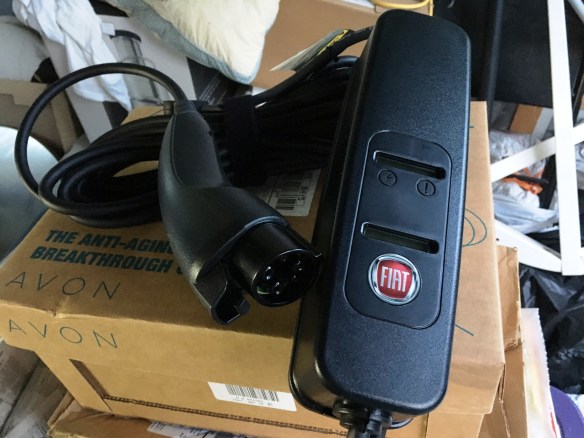
Since Fidelio came to me new, with just 79 miles on the odometer, I am the first journalist to drive him, so I got to take the charger out of its original plastic bag from the factory.

IMG_4493

It came with a slim User Guide, but I’m an old hand at home charging, so I left it in the bag for future journalists.

Fiat provides a sturdy, and long-enough, cord. You’re cautioned not to use any extension cords when charging. Most are probably not rugged enough to handle the job.

IMG_4494

When it’s plugged in, you can see it working by the movement of the green lights in the bar above the Fiat logo. There’s also a light inside the car, on the top of the dashboard, that shows an approximate level of charge in the car–kind of like the five dots on a Fitbit Flex.

So, I set it up and that was that. Sadly, home current, at 120 volts (known as Level 1 charging) is very slow. My level 2 ChargePoint chargers at work (240 volts) are much more efficient.

Here’s a record of my four visits to the chargers this week from the ChargePoint phone app. Fidelio had a partially full battery when I plugged in, but was topped off by lunchtime (on Wednesday through Friday).

IMG_4497

The first charge, on Jan 19, was in the afternoon, and the battery was 2/3 full. The others were typical, and show the amount of estimated range, time, and cost for the charge for each session. Interestingly, the addresses vary, although the six chargers are all right next to each other. 🙂


Fiat 500e – Small Doesn’t Mean Cheap

The Fiat 500, in any form, is a very small car. Granted, the 500X crossover and 500L are a little larger, but still, the regular 500 is dinky. But don’t assume that being diminutive means being Spartan or uncomfortable.

Nope, my little 500e, Fidelio, is a very pleasant place to be. Granted, the rear seats aren’t spacious, but I did fit my 5-11 son back there last night (for a short trip). It’s the other things that lift the 500e up.

One thing is the leatherette seats, which are soft and stand up tall. The two-tone black/white look is chic, blended with the overall black/white theme of the entire car (a $395 option, and worth it). Cheap cars are all black or gray. White is a fancy color. The plastic panels on the dash evoke the painted metal of the 500’s 1950’s ancestor, as do the chrome rings around the gauges and round control buttons. Nice.

IMG_4460

From a modern point of view, there’s SiriusXM Satellite radio, and it’s easy to manage from the steering wheel controls. They’re on the BACK of the wheel, as in all Fiat Chrysler Automobiles products. I love that feature–you never have to look away from the road. Also, the white leather (with red trim) on the steering wheel itself is upscale. Oh–the sound from the audio system is surprisingly good, too.

A real luxury is how you hear that audio. With no vibration or noise from an engine, the 500e is blissfully quiet. On the freeway, you may get a little noise from rougher road surfaces, but in town, it’s almost eerily silent, and the music comes in sharp and clear.

The 500e has climate control–set it and forget it style. Without a radiator or a hot engine to generate the heat, I’m not sure where it comes from, but it’s a hearty blast when you start out in a 42-degree morning. Heated seats (one level only, though) are common these days, but are often lacking in a “cheap” car. You get ’em here.

Having a display on the instrument panel for each individual tire’s pressure is nice. The Audi A3 I drove recently didn’t even have that.

The 500e may be narrow, but it’s tall, so you don’t feel claustrophobic. The colorful. friendly instrument panel and small but effective center screen convey lots of useful information, and keep the black-and-white environment cheery.

With an electric motor, your car feels more like it’s rolling down the road rather than being dragged along. Stepping on the accelerator (don’t call it “the gas”) generates an immediate push forward. With 111 horsepower and 147 lb.-ft. of torque, the 500e is never poky, even going up the steep hills in my neighborhood.

Here’s to many more great (short) trips in Fidelio, the little blue EV.