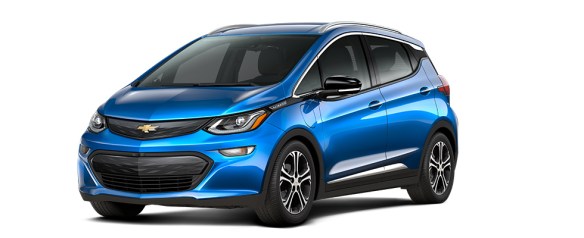
Chevy Bolt Anticipation

img_6908It’s two days before Christmas (and one before the first night of Chanukah). Anticipation is in the air. But I’ve been in a state of anticipation since October 11, when I ordered my Chevrolet Bolt.

As an auto writer, I’m always driving someone else’s car for an article, but I decided that this car is the one I want for me. I think it will be ideal for my needs–even if I’m only spending part of my time driving it.

What I’m trying to learn now is patience. It’s one thing to walk into a dealership, stroll around the lot, find a car you like, and then sit down and negotiate to drive it home. It’s another thing to order a car you’ve never actually seen or even driven and wait. You hope it’ll be as good as you’ve heard.

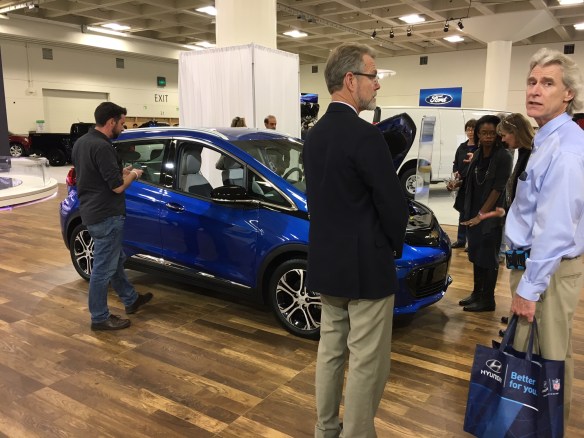
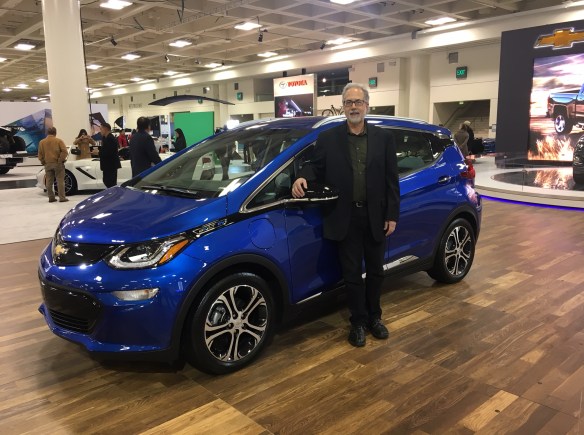
I did manage to get down to the San Francisco Auto Show in November and see a Bolt (see photo above). It was, amazingly, the same color I ordered, and I walked around it, talked with people about it, sat in it, got out, sat in it again, and hovered around it for a while.

I also visited a dealership and drove one. I was pleased that the experience behind the wheel (and in the back seat) was as good as I’d hoped. Having the car win awards right out of the chute was encouraging, too, making me feel like I was making the right choice.

The ordering process itself was simple. I went into the dealership and specified what I wanted–color, features, etc. Then, I waited to hear that the order was submitted. Then, I waited to be informed that the factory had received it. After that, it took a while to find out that the factory was preparing to build the car. Then, I learned that it was built but awaiting transport.

Today, I found out that my Bolt is on its way to California on a train. When it arrives here, it’ll go to a distribution center to be checked out before being trucked over the dealership. When it’ll arrive at Boardwalk Chevrolet in Redwood City is uncertain, but my great salesman emailed me today he may be able to track the progress of the train. That should be interesting.

I wish they could show you your car being built at the factory. I wish they put a little camera with a homing device on it, so you could follow its progress. We’re used to tracking our Amazon purchases from the moment it’s shipped to the minute it lands on your doorstep, so what do you say, Chevy?

Am I being obsessive? I still have a schedule of test cars into the middle of January, and am not giving up my column. But this is only the third time I’ve ordered a car–the second one for my own use–and it’s taking longer than I thought.

It’s definitely a team sport. The Chevy Bolt EV Owners Group on Facebook is approaching 1,000 members. I expect not every single person in that group will sign a purchase agreement or lease, but there’s a real groundswell of interest. As a journalist, I’m hoping to put a real public face on this car, and I plan to take it as far as it’ll go.

A few days ago, I ordered my home charger from ChargePoint. I’ll get it installed and ready for when I need it. I’m hoping to open up some space in my garage during the holiday break, but I’m getting a long enough cord that it’ll reach outside too, if necessary.

Meanwhile, on Sunday, my family will open gifts, and we’ll have a great time together. But my real gift is still on its way. The exquisite pain of waiting makes it all the more exciting.
Chevrolet Bolt in the Flesh!

img_6934

Finally, I’ve seen and touched a real Chevrolet Bolt! I got my chance at the San Francisco Auto Show, where they had a single car. And–it was the same Kinetic Blue that I’ve ordered mine in! And, as a Premier level model, it was essentially identical to my long anticipated new ride.

I approached it from the front, and it looked, well, like it was supposed to look. It’s not large, but it’s not small either, and stands tall–nearly as high as a crossover, but not as chunky. The smiling face had the fill panel with energetic lines on it and a big gold Chevy logo and gleamed in the show lights.

img_6909

The paint looked lustrous and I ran my hands over the car, “petting” it, to get a true feel of the body. The chrome trim is not skimpy, and the roof rails are a gleaming silver.

img_6927

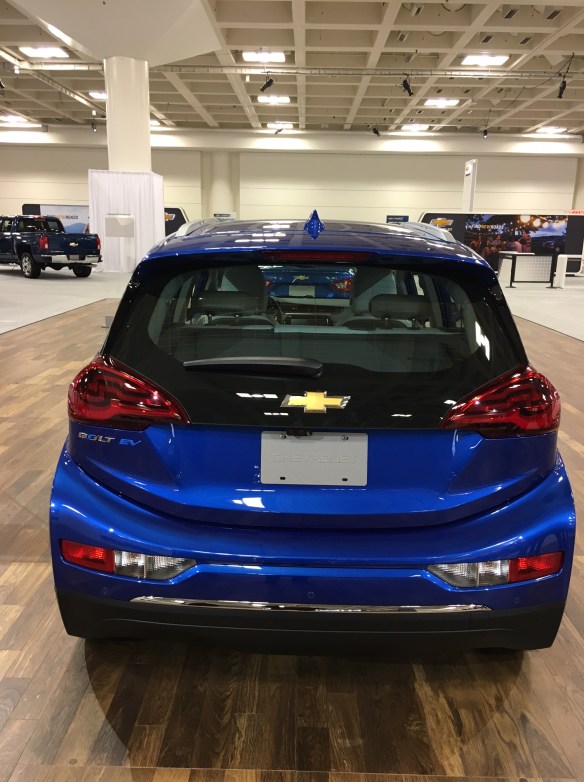
The taillamps are bold, with a sharp edge along their tops and the “electronic” theme pattern in them. The new logo is different from the Volt’s.

img_6914

I popped the hood, which proved to be very lightweight, and used a prop rod. The flat, silvery motor is tucked in there, minus the usual radiator, water pump, and other internal-combustion-engine accouterments. There is still a container up front, but it looks like folks are being warned NOT to put radiator fluid in there.

img_6901

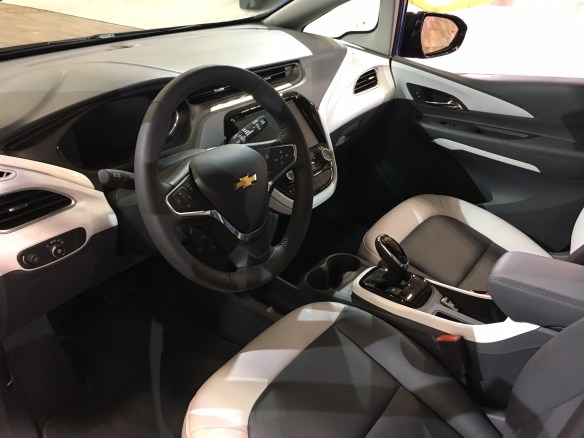
I stepped inside. It looked like the photos, but I also got the sense of height and the gray/white contrasts. I think this is the lighter interior scheme–the one I ordered–with partial white on the seats and a white lower half of the dash. The doors are dark, with just a little white extending into the top.

img_6904

Plastics are good GM grade, but not Audi level luxury. We all understand that the premium pricing of the Bolt, for its size, is for the 900-pound battery, but the fittings seemed well done and similar to the all-new 2016 Volt, its plug-in hybrid sibling.

The instrument panel was totally blank, as today’s screens are, so I couldn’t evaluate it, or see anything on the center display either. The thick, leather-wrapped wheel feels good in your hands, and has the requisite redundant buttons for audio, info, phone, cruise control, and even a heated steering wheel. The rearview mirror is thick, as it also functions as a backup camera (when the car’s on).

img_6917

The seats are narrow but nice and firm–perfect for 167-pound me. A large person might not take to them as well. The back bench sits higher than the front buckets, for good visibility but also leaving plenty of battery space below.

img_6912

I tried sitting behind the driver’s seat that was set for me and had a couple of inches of legroom, so a Bolt should accommodate full sized folks back there.

IMG_6926.JPG

The rear hatch wasn’t operational (they turn off all EV functions for these cars at shows, apparently), but we were able to drop the rear seats and see the space in back, including the sturdy “false floor” that provides a smooth surface and also hidden storage.

The car was just sitting there, without signage or hoopla, but two nice young women were there to answer questions, and we had a pleasant conversation. One of them took a few really nice photos of me with my beloved car. I also spoke with numerous other show goers who were interested, and that provided a sense of camaraderie. I expect I’ll be having more of these when I get mine, and I welcome that as a chance to sound the rallying cry of Go Green!

img_6936

I should have some help in that, since the Bolt, this week, won three important awards. First, it’s the 2017 Motor Trend Car of the Year. It’s also named to the Car and Driver 10Best list, and is the Green Car of the Year, from Green Car Journal, announced at the Los Angeles Auto Show. An auspicious start.

img_6907

Now, I’ll await word from Don Mays, my salesman at Boardwalk Chevrolet in Redwood City, California, that my car is built and on its way. He told me that delivery is expected before Christmas, so that’s about a month away. I’m eager to put it on the road to see what it can do.

img_6930


Kia Niro Hybrid Crossover Spotted at the Mall

kia-niro

I was walking through the mall tonight with my wife, just after purchasing new sheets at Pottery Barn and look what I saw. It’s the new Kia Niro!

I’ve heard about this hybrid crossover for a while now, and expected to see one on the road or at a dealership soon. This one is here to show off.

Kia is smart to introduce a compact crossover, sized between the boxy Soul and the venerable Sportage, that has similar fuel economy to a Toyota Prius. The new Prius, the poster child for hybrids and the highest performing one, fuel economy wise, is an acquired taste visually. What folks seem to want now are crossovers, and the new smaller ones are hot hot hot. So Kia is in the catbird’s seat here.

I sat down in the car, and although I couldn’t get the seat to adjust (the battery, apparently was drained), I could tell that Kia is using the same clear, no-nonsense styling inside, with premium materials, to convey high competence, value for the money, and in the case of a crossover, that ride high feeling.

The Niro has a dual clutch six-speed automatic–not a CVT–so you can feel the gears shift normally and even move them manually. Of course, I didn’t sample that in the mall, but the Niro should at least emit a more sonorous sound than the moan of a CVT.

The 1.6-liter four-cylinder engine, mated to a 43 hp electric motor, contributes to the overall 146 horsepower. That motor will likely be as smooth and silent as motors are. My understanding is that there will be a hybrid and a plug-in hybrid version.

The young woman managing the display gave me a free Niro bag to carry things in, and took my information for future updates. Of course, I expect to hear from the automotive PR folks at some point soon, but this’ll tell me what interested car shoppers will get.

The thank-you email told me I could download the Niro app and configure a car on my iPad, so I did that. It took a while to download. It shows a musical video of the Niro zooming through a city – with no driver… Is this a look at their future autonomous vehicle?  Then–out to the country! A quick roll through a charging station (not stopping) and onward. You can click a button periodically to get details on the topic they’re presenting, such as Exterior Tour and Fuel Efficiency, all shown to a high-tech beat.

I’ll be looking forward to a real test of this car soon.

Chevy Bolt – Clean Car from a Green Factory

bolt-orion-1280-1280

I’m waiting  for my Chevrolet Bolt to be built. As of October 24, the order is submitted to the factory and accepted by production control, according to my salesman, Don Mays.

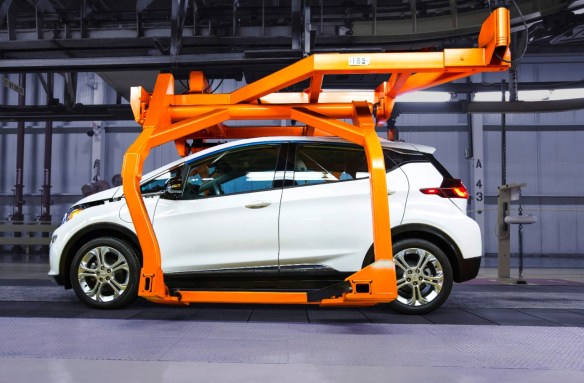
So–what kind of factory does GM have in Orion, Michigan? Well, the General Motors Orion Assembly Plant gets more than half its energy from methane from decomposing trash, and has a 350-watt solar array. That’s pretty impressive!

One of the arguments is, why not just use your old car–it’s already built? Why spend all the energy to make new ones? If the factory runs efficiently, there’s less cost to driving a new electric car. It’s a complicated story, and we’ll keep following it.

Meanwhile, I’ll be waiting for the next installment from Chevy.


My Chevy Bolt – The Story Begins

slack-for-ios-upload-1

On Tuesday, October 11, 2016, I stepped into Boardwalk  Chevrolet and sat down with Don Mays to order my own Chevrolet Bolt. This very specific step is the beginning of my second electric car adventure, one that I expect to change the way I write about cars.

Ever since I heard about the Bolt–GM’s 200+ mile all-electric car–I’ve been fascinated with it, and followed all the news reports on it closely. Also, over time, I’ve become convinced that electric cars are a major part of our future transportation solution for working to limit the effects of climate change.

From January to April of this year, I spent a delightful three months with a darling baby blue Fiat 500e, which I named Fidelio. He and I commuted and dashed about town together without using a drop of gas, and it was a very happy experience. However, Fidelio’s 90-mile range was the one down side. So, when I learned that the Bolt would offer more than 200 miles, I was sold.

Don tells me that the order will be placed, and that, as production moves along, he’ll be able to tell me when my car is made and track its progress from the Orion, Michigan plant to Milpitas, CA. Then, it will go onto a truck and be sent to the dealership in Redwood City, CA. Expected arrival? Around Christmas time, if I’m lucky. But it sounds like the West Coast gets the first allocations, and that’s where I live.

I’ve ordered cars before, but never without test driving one. I was one of the first Saturn owners, back in November of 1990. My family also bought one of the first Corvairs, in 1960. So I guess it’s a family tradition to try out new GM experiments.

By the way, I ordered my car as the upper level Premier, in extra-cost Kinetic Blue, with the  lighter of two interior colors (gray/white), with the premium audio package (I’ll spend a lot of time commuting in it), and the safety feature package as well. I got the quick charge plug, too. May as well have it the way I want it, and I expect to be showing it off a lot–especially when it’s the first one in town.

Stay tuned!

bolt-9-13-16-blue


Audi A3 E-Tron: Step One

news-2017-audi-a3-e-tron.jpg

The Audi A3 e-tron gives the premium German marque an entry point to electric motoring. Based on the previous generation Sportback wagon, it combines a 150-horsepower 1.4-liter gas engine with a 102-horsepower 75 kW electric motor to make a combined 204 horsepower drivetrain. With 258 lb.-ft. of torque, it pulls the compact wagon from 0-60 in 7.6 seconds.

Electric vehicles, even half-electric ones, use the MPGe rating, which offers an efficiency standard that you can use to compare competing vehicles. For example, you can measure the A3 against the plug-in Prius or the Chevrolet Volt. The A3 e-tron earns an 86 MPGe rating using electricity and gasoline, and a 39 MPG with gasoline only. I averaged 96.4 MPGe during my test week. The window sticker claims I’ll save $3,750 a year in fuel costs over the average new vehicle.

EPA fuel economy ratings are 8 for Smog and a perfect 10 for Greenhouse Gas. The 138 grams per mile of CO2 is lower than most cars, but, of course, higher than an all-electric car.

One way to compare plug-in hybrids is by the range they can drive on electricity alone. The A3 claims 17 miles, and in my 18-mile commute, I found that to be accurate. Just before I arrived at my office, the gauge indicated the switchover. So, I plugged in and had enough to get almost home, and so it went. By charging at both ends, I used very little gas for commuting.

Charging is simple. Plug in to standard 240-Volt (level 2) chargers at work or in other public places, or use your own household current, which is 120 Volts (level 1).  It’s an eight-hour process at home, comfortably overnight. On a level 2 charger, it’s just two and a quarter hours. You won’t be hogging the chargers while others wait. They’ll appreciate that.

The A3 is on the lower end of the range listing for plug-ins, but it still makes a big difference. The Chevy Volt offers an honest 53 miles of charge before switching over to its gas engine, which generates electricity to run the electric motor. The Audi is typical of a hybrid, using the gas engine and electric motor interchangeably as needed.

The A3 e-tron offers four driving modes, which you select on the dash. EV mode uses the electric motor only. In Hybrid mode the car’s computer picks the most efficient power source for the driving conditions—EV, gasoline, or both. In Hold Battery mode, the car is a hybrid only, saving the battery charge for driving all-electric later. The Charge Battery mode uses the engine to charge the battery while you’re driving at freeway speeds.

I ended up taking a six-hour round-trip to an exciting but farther away than I thought microbrewery, so for that trip, the A3 behaved like a normal hybrid car. And that’s what distinguishes a plug-in from an all-electric car. You can pretty much go wherever you want to, but drive hyper efficiently when you stay local.

The 8.8 kWh lithium-ion battery pack sits under the rear seat, and because it doesn’t take up any cargo space, the wagon is fully usable to carry your stuff. Other plug-ins like the Prius and Volt are hatchbacks, so the A3 has an advantage with a lower sill for easier placement of, say, a bass, in my case.

The A3 Sportback wears a new name: e-tron, which Audi will use to identify other, future electric and hybrid models, too. For now, it looks and feels like an A3, which is a good thing. The premium craftsmanship inside, simply presented at this level, is pleasant and feels substantial and carefully thought out. My Misano Red Pearl Effect test car greeted me with a sweet leather aroma when I opened the door for the first time. The switchgear works nicely, the eyeball vents swivel satisfyingly, and the it’s a pleasant place to be.

The A3 e-tron comes in three levels: Premium, Premium Plus, and Prestige. Base price is $37,900. My tester was a Premium Plus, which added $4,100 to the tab. That got me extras like 17-inch, 15-spoke alloy wheels, 3-D optic inlays, the Audi music interface, heated front seats, and aluminum window surrounds. The $2,600 Technology package added a navigation system, Audi Connect online services, and more. They charged $575 for the fancy red paint (a typical Audi upsell). The bottom line came to $46,100.

If you’re an Audiphile, this is your high-efficiency choice. An all-electric e-tron model should be here soon.

Chevy Bolt Gets a 238-mile Range!

Today, Chevrolet released the official EPA range for the new Chevrolet Bolt all-electric vehicle. It’s 238 miles–more than what was advertised earlier, and enough to put all the other EVs in the dust! Yeah, you can spend three times that amount for a Tesla, but in the world of regular earth-loving folks, the Bolt is set to change the story. And, with the newly updated website, you can now see the models and colors available and a lot more information.

Price is still not official, but they’re talking about $37,500 before the Federal and California rebates, so it could be a $30K car.

I personally can’t wait to order mine in brilliant blue!

bolt-9-13-16-blue

Now, we also know that the Bolt, like the Volt, will come in two levels–LT and Premier. Want leather seats and shinier wheels? The Premier it is. You also get roof rails, heated front and rear seats, various life-saving alerts, and more. The website lists the differences.

Based on my experience with the Volt, the upper level car will look and feel better, but will cost several thousand dollars more. I just hope that I like the LT and that I can get it with DC fast charging. That method of charging lets you add about 90 miles to the battery in the time it takes to have a relaxing cup of coffee and a snack on the way somewhere.

In a related piece of good news, Volkswagen, BMW, and ChargePoint (the largest car charger company) have teamed up to build 95 Level 2 and DC charging stations as part of the  Express Charging Corridors Initiative along the East and West Coasts. For me in California, that means Highway 5 and 1 between Portland and San Diego. Back east, it’s between Boston and Washington, DC. That’ll go a long way to helping folks with EVs with 90 mile ranges get out and see the country. Of course, the Bolt, Teslas, and upcoming 200-mile cars like the next Leaf, will become even more worth owning.

Chevy now has a new EV-themed site, Chevyevlife.com, that explains about living with an electric car. After all, they are going to have three models to sell soon, including the Bolt, the fine new 2016/2017 Volt plug-in hybrid,and the Malibu Hybrid. The tiny Spark, having blazed the modern EV trail for the brand, has quietly exited the building.

Nissan Leaf – EV Pioneer

2016_nissan_leaf_02.JPG

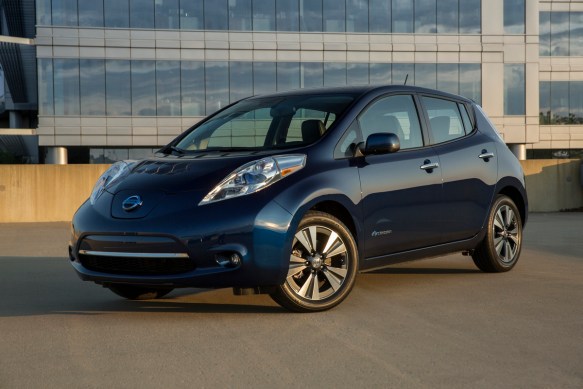
The Nissan Leaf was designed from scratch to be a gas-free all-electric model. They’ve sold more than 185,000 of them since its debut in 2010 as an ‘11, and a pioneer in mainstream EVs.

The Leaf hasn’t changed much over the years, though, until now. The 2016 model looks the same, but you now can get one with a 30 kWh lithium-ion battery. Adding just 46 pounds, it’s got higher power density, so it earns a 107-mile driving range from the EPA, versus 84 for the old 24 kWh battery, a 27 percent improvement.

For most driving, and many people, 107 miles is plenty. I drove my Deep Blue Pearl Leaf back and forth to work every day, in quiet comfort, the Bose audio system pouring out music from the standard Sirius XM radio and Bluetooth-connected selections from my Spotify stream.

The problem comes when you want to drive further. I got home one day with 85 miles on the range meter, and we had to take a quick trip that was about 70 miles. Because I wasn’t sure that was enough, we took our internal combustion engine car.

Although its design is aging, the Leaf feels smooth, solid, and friendly. With its virtually silent and vibration-free 80 kW motor, you fly along, almost by magic. Torque is available from the moment you step on the accelerator pedal, so there’s plenty of hustle from the 107 horsepower and 187 lb.-ft. of torque moving the 3,391-lb. car.

The EPA rates the Leaf at 124 MPGe City, 101 Highway, and 112 Overall. The Smog and Greenhouse Gas numbers are perfect 10s. The Leaf also gives you a miles-per-kWh rating, which was 4.1 for me. With 30 kWh, that looks like about 120 miles per charge.

2016_nissan_leaf_27

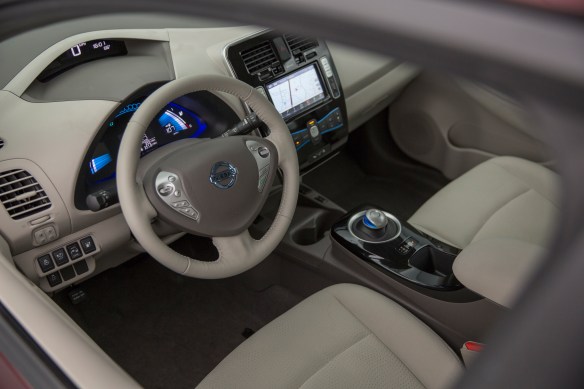
The one-speed transmission is controlled by a “palm shifter,” which, with its bright blue plastic front edge, reminded me of a Duncan Imperial yoyo. Just slip it back into Drive or forward into Reverse or push the Park button on the top.

The battery below the floor means a low center of gravity, so the Leaf is stable, and you feel secure darting around through traffic. But you are encouraged to drive gently to preserve charge. Nissan gives you a little Eco indicator at the top of the instrument panel, which assembles a little tree. The completed tree shrinks and moves to the lower right and you start on another one. I normally grew two on my 18-mile commute.

Unlike some other EVs, the Leaf is rated as a midsize car, and fits five adults, while providing 24 cubic feet of cargo space with the rear seat up. Drop the rear seat for an additional six cubic feet. I hauled my upright bass with ease, although the storage area isn’t flat—it’s deeper at the rear.

To charge the Leaf, a panel flips up on the car’s nose. In there, you’ll find the standard plug for using a Level 2 (240-volt) charger or a cable to charge (slowly) at home at 120 volts. A Level 2 charge takes about 6 hours. Upper level Leafs include a Quick Charge plug, which lets you refill the battery to 80 percent capacity in half an hour.

The Leaf is so quiet that Nissan provides an “Approaching Vehicle Sound for Pedestrians.” It’s a low-volume beep, which emanates from a speaker under the hood at speeds below 16 mph. I only heard it when backing out of my driveway.

The three models start with the S, the price leader, at $29,860. It comes with push-button start, electric windows, locks and mirrors, air conditioning, and a decent audio system, but gets only the 24 kW battery.

The mid-level SV starts at $35,050. It has the 30 kW battery and the Quick Charge plug. It also features the NissanConnect system with Navigation, a larger 7-inch display screen, two more audio speakers, and 17-inch alloys in place of 16-inch steel wheels.

The SL, at $36,790, is distinguished mainly by its comfortable leather seats. You also get a photovoltaic solar panel on the rear spoiler, heated rear seats, a cargo cover, and a couple other items. My SL tester came with the Premium Package, with an upgraded Bose 7-speaker audio system and the Around View monitor (it gives a bird’s eye view). It topped out at $39,390. All prices listed include the $850 delivery charge.

Retail prices are perhaps irrelevant, since many EVs are leased at bargain rates, and there are government tax credits that can significantly reduce your costs. Figure in that electricity is much cheaper than gasoline and EVs require much less maintenance, and it could be a real bargain.

2016_nissan_leaf_23

The Leaf, built in Smyrna, Tennessee, has been the most popular EV out there, and if you’re not budgeted for a Tesla, is still a good option.

Saving Antarctica to Save the Earth

antarctica-map

Today, at work, as part of a series of talks on leadership, I heard a talk by a polar adventurer and environmentalist. Sir Robert Swan, OBE, is the only person to walk to both the North and the South Poles. And what enormous adventures these were for Sir Robert in his youth. His great adventures helped pave the way for his love of Antarctica, and led to his great work–2041 (2041.com). And he’s still going to Antarctica regularly.

The goal of 2041 is to protect the last great wilderness on earth now, and to prepare for the year 2041, when the agreement ends that declared that the southern continent was the property of everyone on earth. At that point, the continent could start being exploited by private individuals and nations. Sir Robert wants us to be done with mining and oil drilling for energy by 2041 so there’ll be no reason for anyone to come down to the south pole and ruin the pristine wilderness.

Sir Robert Swan

Why would it matter what happens to Antarctica? Well, because of the effects of global warming, more and more of the vast area of ice is warming. As chunks melt and slide into the ocean, it raises the sea level. As warned about from scientists, this will submerge coastal cities and lead to disastrous conditions around the world.

My goal with stevegoesgreen.com is to encourage people to move from fossil-fuel-powered vehicles to electric ones as part of the overall effort of slowing global warming and protecting the earth. So I was all ears when Sir Robert told of his 70-day ordeal hiking 900 miles from the coast to one tiny, lonely outpost at the exact South Pole.

During the adventure, Sir Robert worked closely with four others, two of whom accompanied him on his trek while the other two stayed at the original coastal landing. It all worked in the end because everyone did what they needed to do, and were all leaders in their own area. The goal was clearly stated, all the details were worked out, and then followed meticulously. It took determination, cooperation, and focus to make it happen. There are many great lessons for teams working under much easier circumstances, which is why our company brought Sir Robert in to inspire us.

Sir Robert’s trip to the North pole began similarly,  with a larger, international group, but they ran into patches of melting ice that forced them to change their route and still try to get to the North pole in time, before their supplies ran out. They made it, but it was disheartening to see the destruction of the North Pole ice.

When Sir Robert witnessed for himself the problems at the poles, he became convinced that we must do everything we can to save the earth, and has been dedicated to raising awareness and money ever since. See the 2041.com website for much more about this amazing enterprise.

His parting words, which I don’t have written down, sadly, were about how we must all take leadership responsibility and not wait for others to do what must be done. If we don’t act, maybe no one will. Then, we’re really in trouble.

All I want is for us to give up our gas burners and move to clean energy in our cars. But we can do it for our entire world–and in our own way, make a big difference.


Should I Get My EV Now or Wait?

Recently, with lease deals on EVs running at around $79/month (with a few thousand dollars down), I’ve been thinking about picking up one to use when I’m not testing other cars. After my three-month loan of a sweet little Fiat 500e earlier this year, I want to drive electric today, both because  it’s the right thing to do for the environment, but also to practice what I preach. Advocating for a move to carbon-free transportation is fine, but sometimes you have to walk the walk, too.

cq5dam.web.1280.1280

I believe that the upcoming Chevrolet Bolt, with its 200-mile range, vast dealer network, and attractive purpose-built EV design, will be a game changer for the non-wealthy like me. But I suspect that there will be no deals on Bolts, at least a first. There’s plenty of pent-up demand and they’ll have the only game in town–for a while, at least.

So, I’m focusing on the Volkswagen e-Golf again, as well as the Fiat 500e and maybe the Kia Soul EV.

eGOLF-LEAD-1940x1293

The process of elimination removed Tesla from consideration right off the top. It’s way out of my price range, and there are no cheap deals to be had anyway. Others cut from the list include the Ford Focus. It’s a regular car that’s been electrified, and has only a 76-mile range. There’s the worthy and pioneering Nissan Leaf, which was built as an EV from scratch, but is looking long in the tooth with minimal changes since its 2011 debut. The availability of a bigger battery with 107 miles of range in the 2016 model is a small consolation. The Chevrolet Spark EV is cute and has great torque, but it’s kind of tiny. The Mercedes-Benz B250e and BMW i3 are appealing, in different ways, but are not as affordable as the three vehicles I mentioned at the top of this paragraph, if low price of admission is the goal.

In any case, is it time to grab something now or to wait? I’m struggling with impatience but also with the knowledge that as with all things technological, the next improvement is right around the corner. You know that when you take home that new laptop, next week there’ll be one with a better screen or more memory or some amazing new feature.

Here’s what you get if you wait. The new Focus is going to jump to 107 miles of range with the ’17s. The all-new Hyundai Ioniq is arriving this fall with 110 miles of range. The Bolt looms ahead appealingly. The Kia Niro will offer a hybrid in a crossover shape–and perhaps a pure EV someday. What will the next Leaf be able to do? We’re on the edge of a whole new generation of attractive options.

To top it off, as I entertain a deal on the ’16 e-Golf with its 83-mile range, I just read that the ’17 is supposed to get about 125 miles of range with a new, larger battery. So, suddenly waiting a few months seems like a great idea, as long as I don’t need the car right now.

The only down side is that the cheap lease deals may dry up once the next gen cars are out. Who really believes that a $79/month lease is realistic in 2016, anyway? It’s just a way to sweeten the deal on a car that retails in the $30,000-plus vicinity and has limited range. The  companies are willing to move them out at a loss or minimal profit just to comply with regulations and maybe pick up some green cred for doing so.

Perhaps, if you’re really eager, you could take advantage of a deal now on the shortest lease term you can get (24 months?), and save up for the big transition two years from now, when you may be able to snag a Tesla Model 3 that someone ordered on spec or that fell through the cracks. Or, grab a second- or third-year Bolt with the all the bugs fixed. And the new Leaf will be out by then.

As an EV cheerleader, and soon-to-be participant, that may be the best way to get in now at minimal outlay and plan for a long, enjoyable electric car future.

But I remain perplexed. It does feel like sooner is better for the earth, but I want to have the best car for me, too.