Chevrolet Bolt Wins Another Award

img_6902

While anxiously reading every possible piece of news about the Chevrolet Bolt as I await mine, I learned that another award happened–Time magazine named the Bolt one of the 25  Best Inventions of 2016!

It does seem to be in between the too-expensive but long-range Tesla and the limited-range other guys in the Bolt’s price range.

Thanks, Time magazine.

I’ve been reading posts on Facebook from my Chevrolet Bolt EV Owners Group, and folks have a variety of things on their minds–some of which hadn’t crossed mine. I don’t really care how the heater works, for example, although it’s a question for EVs, which don’t have the radiator fluid to use as a source of heat. Some are waxing positive on the styling–others less so. The seats fit some but not all. People in states other than California and Oregon are grousing about having to wait for their dealers to have any in stock.

I’m expecting my car before January 1st, and every day I wait to hear if it’s built yet. But soon, this space will be where you can get the skinny on what it’s like to live with one of these groundbreaking cars.


Chevrolet Bolt in the Flesh!

img_6934

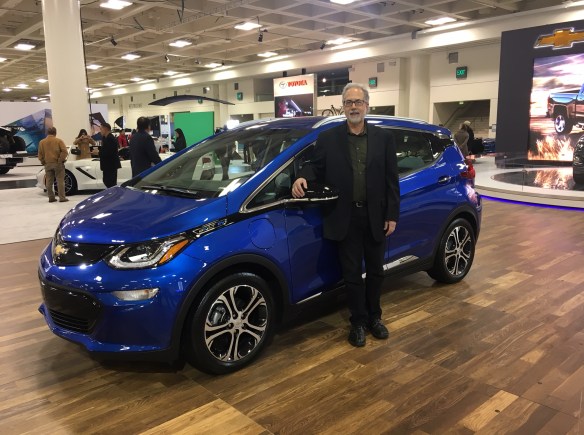
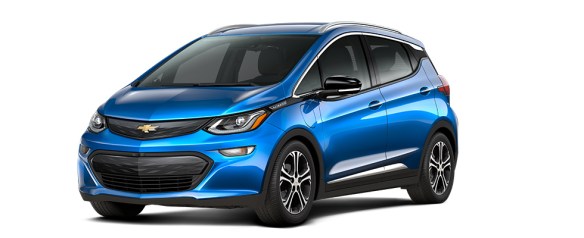
Finally, I’ve seen and touched a real Chevrolet Bolt! I got my chance at the San Francisco Auto Show, where they had a single car. And–it was the same Kinetic Blue that I’ve ordered mine in! And, as a Premier level model, it was essentially identical to my long anticipated new ride.

I approached it from the front, and it looked, well, like it was supposed to look. It’s not large, but it’s not small either, and stands tall–nearly as high as a crossover, but not as chunky. The smiling face had the fill panel with energetic lines on it and a big gold Chevy logo and gleamed in the show lights.

img_6909

The paint looked lustrous and I ran my hands over the car, “petting” it, to get a true feel of the body. The chrome trim is not skimpy, and the roof rails are a gleaming silver.

img_6927

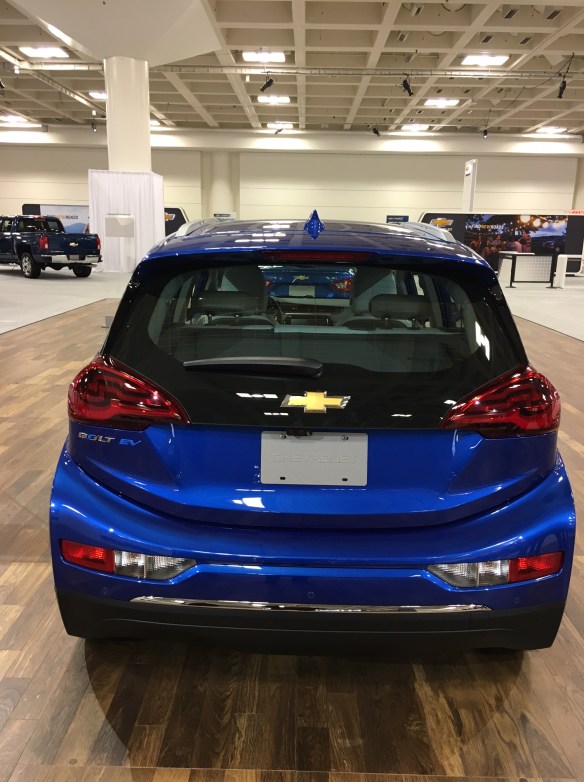
The taillamps are bold, with a sharp edge along their tops and the “electronic” theme pattern in them. The new logo is different from the Volt’s.

img_6914

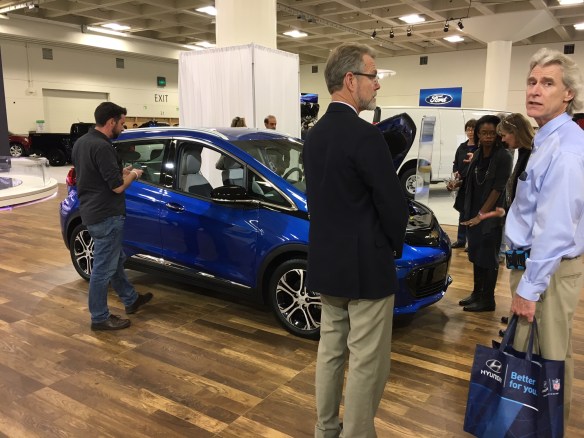
I popped the hood, which proved to be very lightweight, and used a prop rod. The flat, silvery motor is tucked in there, minus the usual radiator, water pump, and other internal-combustion-engine accouterments. There is still a container up front, but it looks like folks are being warned NOT to put radiator fluid in there.

img_6901

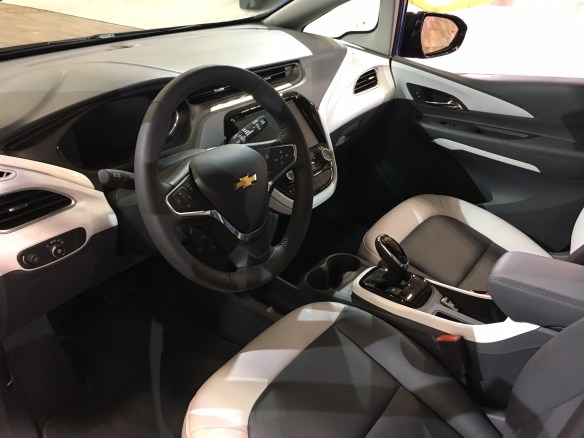
I stepped inside. It looked like the photos, but I also got the sense of height and the gray/white contrasts. I think this is the lighter interior scheme–the one I ordered–with partial white on the seats and a white lower half of the dash. The doors are dark, with just a little white extending into the top.

img_6904

Plastics are good GM grade, but not Audi level luxury. We all understand that the premium pricing of the Bolt, for its size, is for the 900-pound battery, but the fittings seemed well done and similar to the all-new 2016 Volt, its plug-in hybrid sibling.

The instrument panel was totally blank, as today’s screens are, so I couldn’t evaluate it, or see anything on the center display either. The thick, leather-wrapped wheel feels good in your hands, and has the requisite redundant buttons for audio, info, phone, cruise control, and even a heated steering wheel. The rearview mirror is thick, as it also functions as a backup camera (when the car’s on).

img_6917

The seats are narrow but nice and firm–perfect for 167-pound me. A large person might not take to them as well. The back bench sits higher than the front buckets, for good visibility but also leaving plenty of battery space below.

img_6912

I tried sitting behind the driver’s seat that was set for me and had a couple of inches of legroom, so a Bolt should accommodate full sized folks back there.

IMG_6926.JPG

The rear hatch wasn’t operational (they turn off all EV functions for these cars at shows, apparently), but we were able to drop the rear seats and see the space in back, including the sturdy “false floor” that provides a smooth surface and also hidden storage.

The car was just sitting there, without signage or hoopla, but two nice young women were there to answer questions, and we had a pleasant conversation. One of them took a few really nice photos of me with my beloved car. I also spoke with numerous other show goers who were interested, and that provided a sense of camaraderie. I expect I’ll be having more of these when I get mine, and I welcome that as a chance to sound the rallying cry of Go Green!

img_6936

I should have some help in that, since the Bolt, this week, won three important awards. First, it’s the 2017 Motor Trend Car of the Year. It’s also named to the Car and Driver 10Best list, and is the Green Car of the Year, from Green Car Journal, announced at the Los Angeles Auto Show. An auspicious start.

img_6907

Now, I’ll await word from Don Mays, my salesman at Boardwalk Chevrolet in Redwood City, California, that my car is built and on its way. He told me that delivery is expected before Christmas, so that’s about a month away. I’m eager to put it on the road to see what it can do.

img_6930


Kia Niro Hybrid Crossover Spotted at the Mall

kia-niro

I was walking through the mall tonight with my wife, just after purchasing new sheets at Pottery Barn and look what I saw. It’s the new Kia Niro!

I’ve heard about this hybrid crossover for a while now, and expected to see one on the road or at a dealership soon. This one is here to show off.

Kia is smart to introduce a compact crossover, sized between the boxy Soul and the venerable Sportage, that has similar fuel economy to a Toyota Prius. The new Prius, the poster child for hybrids and the highest performing one, fuel economy wise, is an acquired taste visually. What folks seem to want now are crossovers, and the new smaller ones are hot hot hot. So Kia is in the catbird’s seat here.

I sat down in the car, and although I couldn’t get the seat to adjust (the battery, apparently was drained), I could tell that Kia is using the same clear, no-nonsense styling inside, with premium materials, to convey high competence, value for the money, and in the case of a crossover, that ride high feeling.

The Niro has a dual clutch six-speed automatic–not a CVT–so you can feel the gears shift normally and even move them manually. Of course, I didn’t sample that in the mall, but the Niro should at least emit a more sonorous sound than the moan of a CVT.

The 1.6-liter four-cylinder engine, mated to a 43 hp electric motor, contributes to the overall 146 horsepower. That motor will likely be as smooth and silent as motors are. My understanding is that there will be a hybrid and a plug-in hybrid version.

The young woman managing the display gave me a free Niro bag to carry things in, and took my information for future updates. Of course, I expect to hear from the automotive PR folks at some point soon, but this’ll tell me what interested car shoppers will get.

The thank-you email told me I could download the Niro app and configure a car on my iPad, so I did that. It took a while to download. It shows a musical video of the Niro zooming through a city – with no driver… Is this a look at their future autonomous vehicle?  Then–out to the country! A quick roll through a charging station (not stopping) and onward. You can click a button periodically to get details on the topic they’re presenting, such as Exterior Tour and Fuel Efficiency, all shown to a high-tech beat.

I’ll be looking forward to a real test of this car soon.

Chevrolet Bolts are In Production!

gm_starts_bolt_production

Finally, the assembly line is running at the General Motors Orion Assembly Plant in Orion, Michigan, and Bolts are moving slowly down the line.

The news story I found mentions the sad news that only California and Oregon will get cars before the end of the year, but luckily for me, I’m in California, and my order is in, so I am hoping to see my car something before the end of the year.

It’s an interesting experience in 2016, when instant gratification is the norm, to have to wait for anything. I knew that I wanted an EV, and I knew that the Bolt was the only realistic choice, since it’s (relatively) affordable and has a great range, with its big 60 kWh battery. So, I dashed down to place my order.

But nearly a month in, waiting feels as interminable as the conclusion of the 2016 election. While the latter event is literally right around the corner, I’m not sure when I’ll see my Bolt. And, I’m not sure exactly how much it’s going to cost me on a monthly basis.

Figuring that my car would be with me at least 30 months, I went for the nicer Premier model, with a few upgrades, like leather seats, and upgraded the stereo and safety features, so it’s $43,000 or so before they take the $7,500 off for the Federal tax credit. Then, there’s California money coming to me too, $2,500 worth, as I understand it. But I’ll have to decide how much to put down to keep those payments reasonable.

I’m also turning in my ancient 1993 Plymouth Voyager minivan, my occasional car that will now go to gas car heaven. I plan to put it out to pasture when I’m assured of my Bolt delivery date.

I haven’t bought myself a new car since November of 1990, when I got my Saturn. It was exciting to sell my Honda and buy a new car that was a brand new brand, too. I was the first guy on my block to have one, and I got some attention. I even got noticed by Hal Riney and Partners, who had the Saturn account, so I ended up on the cover of the 1994 Saturn brochures!

img_6728

Look at all that nice dark hair. And I’m posing with my first son, who’s now a grownup father of two. 🙂

My Chevy salesman says he’ll keep me posted on the progress, so I will, at some point, know the status of the build and when it gets put onto a transporter truck for its western trip. Watch this space for updates.

And, visit my new venue, Clean Fleet Report, for my EV and hybrid writings.


My Chevy Bolt – The Story Begins

slack-for-ios-upload-1

On Tuesday, October 11, 2016, I stepped into Boardwalk  Chevrolet and sat down with Don Mays to order my own Chevrolet Bolt. This very specific step is the beginning of my second electric car adventure, one that I expect to change the way I write about cars.

Ever since I heard about the Bolt–GM’s 200+ mile all-electric car–I’ve been fascinated with it, and followed all the news reports on it closely. Also, over time, I’ve become convinced that electric cars are a major part of our future transportation solution for working to limit the effects of climate change.

From January to April of this year, I spent a delightful three months with a darling baby blue Fiat 500e, which I named Fidelio. He and I commuted and dashed about town together without using a drop of gas, and it was a very happy experience. However, Fidelio’s 90-mile range was the one down side. So, when I learned that the Bolt would offer more than 200 miles, I was sold.

Don tells me that the order will be placed, and that, as production moves along, he’ll be able to tell me when my car is made and track its progress from the Orion, Michigan plant to Milpitas, CA. Then, it will go onto a truck and be sent to the dealership in Redwood City, CA. Expected arrival? Around Christmas time, if I’m lucky. But it sounds like the West Coast gets the first allocations, and that’s where I live.

I’ve ordered cars before, but never without test driving one. I was one of the first Saturn owners, back in November of 1990. My family also bought one of the first Corvairs, in 1960. So I guess it’s a family tradition to try out new GM experiments.

By the way, I ordered my car as the upper level Premier, in extra-cost Kinetic Blue, with the  lighter of two interior colors (gray/white), with the premium audio package (I’ll spend a lot of time commuting in it), and the safety feature package as well. I got the quick charge plug, too. May as well have it the way I want it, and I expect to be showing it off a lot–especially when it’s the first one in town.

Stay tuned!

bolt-9-13-16-blue


Audi A3 E-Tron: Step One

news-2017-audi-a3-e-tron.jpg

The Audi A3 e-tron gives the premium German marque an entry point to electric motoring. Based on the previous generation Sportback wagon, it combines a 150-horsepower 1.4-liter gas engine with a 102-horsepower 75 kW electric motor to make a combined 204 horsepower drivetrain. With 258 lb.-ft. of torque, it pulls the compact wagon from 0-60 in 7.6 seconds.

Electric vehicles, even half-electric ones, use the MPGe rating, which offers an efficiency standard that you can use to compare competing vehicles. For example, you can measure the A3 against the plug-in Prius or the Chevrolet Volt. The A3 e-tron earns an 86 MPGe rating using electricity and gasoline, and a 39 MPG with gasoline only. I averaged 96.4 MPGe during my test week. The window sticker claims I’ll save $3,750 a year in fuel costs over the average new vehicle.

EPA fuel economy ratings are 8 for Smog and a perfect 10 for Greenhouse Gas. The 138 grams per mile of CO2 is lower than most cars, but, of course, higher than an all-electric car.

One way to compare plug-in hybrids is by the range they can drive on electricity alone. The A3 claims 17 miles, and in my 18-mile commute, I found that to be accurate. Just before I arrived at my office, the gauge indicated the switchover. So, I plugged in and had enough to get almost home, and so it went. By charging at both ends, I used very little gas for commuting.

Charging is simple. Plug in to standard 240-Volt (level 2) chargers at work or in other public places, or use your own household current, which is 120 Volts (level 1).  It’s an eight-hour process at home, comfortably overnight. On a level 2 charger, it’s just two and a quarter hours. You won’t be hogging the chargers while others wait. They’ll appreciate that.

The A3 is on the lower end of the range listing for plug-ins, but it still makes a big difference. The Chevy Volt offers an honest 53 miles of charge before switching over to its gas engine, which generates electricity to run the electric motor. The Audi is typical of a hybrid, using the gas engine and electric motor interchangeably as needed.

The A3 e-tron offers four driving modes, which you select on the dash. EV mode uses the electric motor only. In Hybrid mode the car’s computer picks the most efficient power source for the driving conditions—EV, gasoline, or both. In Hold Battery mode, the car is a hybrid only, saving the battery charge for driving all-electric later. The Charge Battery mode uses the engine to charge the battery while you’re driving at freeway speeds.

I ended up taking a six-hour round-trip to an exciting but farther away than I thought microbrewery, so for that trip, the A3 behaved like a normal hybrid car. And that’s what distinguishes a plug-in from an all-electric car. You can pretty much go wherever you want to, but drive hyper efficiently when you stay local.

The 8.8 kWh lithium-ion battery pack sits under the rear seat, and because it doesn’t take up any cargo space, the wagon is fully usable to carry your stuff. Other plug-ins like the Prius and Volt are hatchbacks, so the A3 has an advantage with a lower sill for easier placement of, say, a bass, in my case.

The A3 Sportback wears a new name: e-tron, which Audi will use to identify other, future electric and hybrid models, too. For now, it looks and feels like an A3, which is a good thing. The premium craftsmanship inside, simply presented at this level, is pleasant and feels substantial and carefully thought out. My Misano Red Pearl Effect test car greeted me with a sweet leather aroma when I opened the door for the first time. The switchgear works nicely, the eyeball vents swivel satisfyingly, and the it’s a pleasant place to be.

The A3 e-tron comes in three levels: Premium, Premium Plus, and Prestige. Base price is $37,900. My tester was a Premium Plus, which added $4,100 to the tab. That got me extras like 17-inch, 15-spoke alloy wheels, 3-D optic inlays, the Audi music interface, heated front seats, and aluminum window surrounds. The $2,600 Technology package added a navigation system, Audi Connect online services, and more. They charged $575 for the fancy red paint (a typical Audi upsell). The bottom line came to $46,100.

If you’re an Audiphile, this is your high-efficiency choice. An all-electric e-tron model should be here soon.

Should I Get My EV Now or Wait?

Recently, with lease deals on EVs running at around $79/month (with a few thousand dollars down), I’ve been thinking about picking up one to use when I’m not testing other cars. After my three-month loan of a sweet little Fiat 500e earlier this year, I want to drive electric today, both because  it’s the right thing to do for the environment, but also to practice what I preach. Advocating for a move to carbon-free transportation is fine, but sometimes you have to walk the walk, too.

cq5dam.web.1280.1280

I believe that the upcoming Chevrolet Bolt, with its 200-mile range, vast dealer network, and attractive purpose-built EV design, will be a game changer for the non-wealthy like me. But I suspect that there will be no deals on Bolts, at least a first. There’s plenty of pent-up demand and they’ll have the only game in town–for a while, at least.

So, I’m focusing on the Volkswagen e-Golf again, as well as the Fiat 500e and maybe the Kia Soul EV.

eGOLF-LEAD-1940x1293

The process of elimination removed Tesla from consideration right off the top. It’s way out of my price range, and there are no cheap deals to be had anyway. Others cut from the list include the Ford Focus. It’s a regular car that’s been electrified, and has only a 76-mile range. There’s the worthy and pioneering Nissan Leaf, which was built as an EV from scratch, but is looking long in the tooth with minimal changes since its 2011 debut. The availability of a bigger battery with 107 miles of range in the 2016 model is a small consolation. The Chevrolet Spark EV is cute and has great torque, but it’s kind of tiny. The Mercedes-Benz B250e and BMW i3 are appealing, in different ways, but are not as affordable as the three vehicles I mentioned at the top of this paragraph, if low price of admission is the goal.

In any case, is it time to grab something now or to wait? I’m struggling with impatience but also with the knowledge that as with all things technological, the next improvement is right around the corner. You know that when you take home that new laptop, next week there’ll be one with a better screen or more memory or some amazing new feature.

Here’s what you get if you wait. The new Focus is going to jump to 107 miles of range with the ’17s. The all-new Hyundai Ioniq is arriving this fall with 110 miles of range. The Bolt looms ahead appealingly. The Kia Niro will offer a hybrid in a crossover shape–and perhaps a pure EV someday. What will the next Leaf be able to do? We’re on the edge of a whole new generation of attractive options.

To top it off, as I entertain a deal on the ’16 e-Golf with its 83-mile range, I just read that the ’17 is supposed to get about 125 miles of range with a new, larger battery. So, suddenly waiting a few months seems like a great idea, as long as I don’t need the car right now.

The only down side is that the cheap lease deals may dry up once the next gen cars are out. Who really believes that a $79/month lease is realistic in 2016, anyway? It’s just a way to sweeten the deal on a car that retails in the $30,000-plus vicinity and has limited range. The  companies are willing to move them out at a loss or minimal profit just to comply with regulations and maybe pick up some green cred for doing so.

Perhaps, if you’re really eager, you could take advantage of a deal now on the shortest lease term you can get (24 months?), and save up for the big transition two years from now, when you may be able to snag a Tesla Model 3 that someone ordered on spec or that fell through the cracks. Or, grab a second- or third-year Bolt with the all the bugs fixed. And the new Leaf will be out by then.

As an EV cheerleader, and soon-to-be participant, that may be the best way to get in now at minimal outlay and plan for a long, enjoyable electric car future.

But I remain perplexed. It does feel like sooner is better for the earth, but I want to have the best car for me, too.

Mercedes-Benz’s Electric Option–B250e

IMG_5849

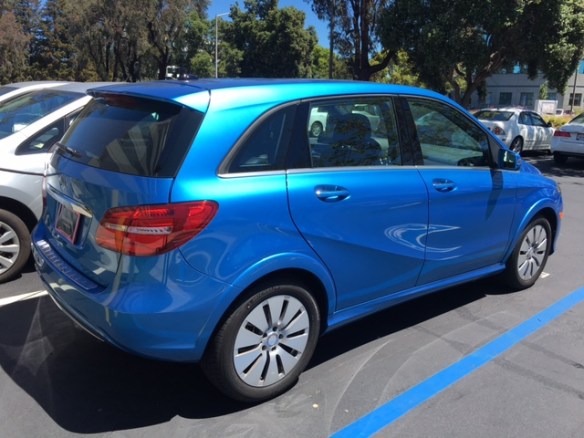
There’s an electric-powered Mercedes-Benz out there, but you can be forgiven if you haven’t noticed. Quietly, the B250e is rolling around town, if you happen to be in California or other EV friendly locales.

The B is a five-door hatchback–not the shape you expect from Mercedes. The B-Class is sold in other parts of the world, including Canada, as a small, utility-minded gasoline-powered car, but in the U.S., B-Class cars are EVs only (labeled Electric Drive). There’s a tiny A-Class sold overseas, too, but you won’t see one here.

It makes sense for the German giant to put an all-electric powertrain in a small vehicle. Roughly the size of a Nissan Leaf, it has less weight to labor the battery pack with. With a folding rear seat, it’s spacious in the back. In the bright blue of my colleague Pam’s new commuter car, it has a friendly aspect to it.

I’ve been eager to test Mercedes’ baby EV, so when I saw one attached to the chargers at my building, I slipped my card under the driver’s side wiper and waited for the owner to respond. Pam did, and offered to show me around the car–and even let me drive it for a few minutes.

The B may look like a generic hatchback (despite it’s dramatic character line that rises up the side), but inside, it feels like a Mercedes-Benz. While not furnished in rare woods, and rich leather, it has dignity and mass, and an instrument panel that looks like a Mercedes-Benz’ should. It feels more upscale than other EVs I’ve tested. It can’t match a Tesla, of course, but it’s not priced as one, either.

Driving the car is, judging from my brief test, pleasant and, of course, silent. There are settings for S (sport), E (eco) and E+ (eco plus), and, I think, a “normal” setting. If you set it to S, you get the full benefit of an electric motor’s instant torque and rocket ahead with a snap. In E or especially E+, the drivetrain feels anaesthetized, but that’s so you use less juice.

Stats: 132 kW electric motor, 177 horsepower, 251 lb.-ft. of torque, 0-60 in 7.9 seconds.

Pam, who stepped out of a reliable Mercedes-Benz M Class SUV, has been getting about 83 miles per charge in her new B, which puts it in the realm of the original Leaf and other cars like the Ford Focus EV and Fiat 500e. Mercedes claims 87 miles. But the future is looming, with 200+ mile range EVs on their way, so I’m guessing that the Tesla-sourced engine/battery will be getting an upgrade before too long. Meanwhile, for a commute from southern San Jose to San Mateo, California, the little Mercedes-Benz EV is just the ticket. Pam has level 2 (240 volt) charging at home and here at work, so she never has to run out, as long as she doesn’t stray too far from the normal path.

Pricing is officially $41,450, but as you might expect, leasing drops costs considerably. Pam leased hers for a little bit more than $300 a month with some money down. The Federal rebate was applied directly to the lease, and her California state rebate is on its way. She relishes her white carpool-lane stickers, too.

The B is a natural competitor to the BMW i3, and, as these two German competitors go, it’s the more sober, elegant one, versus the radical BMW. But by all means, you should cross-shop.

I’m eagerly awaiting my chance to spend a week with this car, but for now, it looks like a winner to me–for the right driver and purpose.

IMG_5850


4th Generation Prius–Wacky and Vastly Improved

IMG_5614.JPGThe Toyota Prius has been a green car icon for 20 years now (17 in the U.S.).  It’s substantially redone this year for its fourth generation.

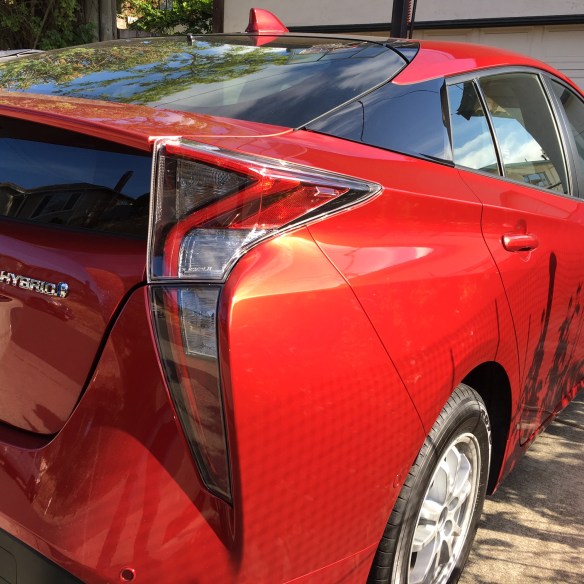
The most obvious change is the startling styling. The new Prius is longer, lower, and wider, but not like the mammoth late 1950’s American cars. It’s a radical interpretation of the now classic Prius proportions, with a squinting face and a finned tail. Thanks partially to that shape, the new car has one of the lowest cds (coefficient of drag) in the industry – 0.24.

PRS_MY16_0014_V002

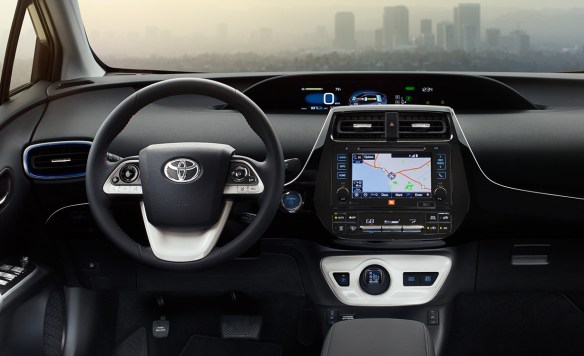
Since the second generation 2004 Prius, the interior has been space-age and swoopy, but the 2016 model is vastly improved. The sweep of the soft-touch panels from dash to doors is dramatic, and with a lower cowl and side windows, visibility is better too. The center-mounted instruments sit on a dramatically layered and in piano black panel. My tester’s only odd item was a white plastic center console (and on the steering wheel and dash), which reminded me of a porcelain bathroom sink.

The Prius has always provided an energy flow display, but the new one offers two. The center console houses the big, colorful one, but the little one in the slim band below the windshield helps you monitor when the engine is on. With awareness, you can lift off the accelerator slightly to move from gasoline to electricity. Being always informed lets you drive at the highest efficiency.

As a hybrid, the Prius uses both its 1.8-liter gas engine and two electric motors to move. For 2016, the engine is set to be on less, so the car runs as an EV more. Some components, such as the continuously variable transaxle and power unit, are smaller and lighter, and some body panels, like the hood, are made of lightweight aluminum.

The new Prius dumps the old nickel-metal hydride battery technology for modern lithium-ion. The battery pack is smaller and flatter, so it fits under the rear seat instead of beneath the cargo area, leaving more cargo space.

The EPA economy numbers are improved, at 54 City, 50 Highway, and 52 Combined. I averaged a splendid 57.2 mpg over a busy week. After you turn off the car, the instrument panel briefly displays a rating of your driving efficiency for that trip. I averaged as much as 80.1 mpg a ride. The screen displays a score, say 74/100, and suggests other measures of efficiency, such as lowering the climate control temperature or accelerating more gently. The Green numbers are 7 for Smog and a perfect 10 for Greenhouse Gas.

Unlike a pure electric, the Prius lets you drive as far as you like with great mpg. However, previous models weren’t a great joy to drive, feeling a bit removed from the road. The new model is greatly improved. Built on the Toyota New Global Architecture, it features a high-strength body structure and a double-wishbone independent rear suspension. This, along with a lower center of gravity, makes day-to-day driving much more engaging.

The new Prius is much quieter inside, thanks to numerous improvements in sound reduction. That benefits music listening, a necessity for the daily commute grind. My tester featured a JBL system with 10 GreenEdge speakers. I played music from a variety of sources, including an easy Bluetooth hookup with my iPhone. There’s a charging spot on the console, but it didn’t work on my iPhone. I think it’s better with Androids.

The Prius comes with the new Toyota Safety Sense technology. This includes a Pre-collision system with Pedestrian Detection, Lane Departure Alert, Automatic High-beam, and Full-Speed Dynamic Radar Cruise Control. There’s also an Intelligent Parking Assist system available. As you’d expect, the high-tech hybrid is a showcase for Toyota’s other technological breakthroughs.

You can get your Prius in six flavors. The entry point is the Two, at $25,035. The Three model adds more convenience and technology features, and the Four is the top-of-the-line model. The Two and Three are also available in Eco versions, which use weight-saving and technological tweaks to up the fuel economy a bit. At the top is the Four Touring—the ultimate Prius, at $30,835. All prices shown include the “delivery and handling fee.”

My tester came in a bright new color—Hypersonic Red. A $395 option, it makes the car stand out in traffic. My tester, with the Premium Convenience Package ($1,705) and Advanced Technology Package ($1,935), as well as a Four Season Floor Mat Package ($364) totaled up to $33,884.

The Prius Prime, a plug-in version of the Prius, arrives soon, for even great efficiency.

Today, hybrids have an important role in minimizing carbon emissions into the atmosphere. Driving a Prius is now more efficient and fun. And the extreme styling does grow on you.

Prius face.jpg

Toyota Mirai – EV Powered by Hydrogen

Electric cars are becoming commonplace, but if you really want to sample the latest technology, drive a hydrogen-powered electric car. That’s what the Toyota Mirai is. Mirai, by the way, means “future” in Japanese.

IMG_5652.JPG

I had a chance to spend an hour with a shiny white Mirai yesterday, and it was a very pleasant drive. In fact, it felt pretty much like a nicely turned out midsize luxury sedan.

But this is no ordinary car. It runs solely on electricity, but you don’t get the power by plugging it in. No–the power control unit, tucked under the prominent hood, controls energy from the fuel stack, which is located under the vehicle and manufactures electricity  chemically, like a battery.

IMG_5647.JPG

Fuel cells are an interesting and complicated subject I won’t delve into here, but in essence, you put in hydrogen and generate electricity to run a motor. The only byproduct is water–H2O. There’s a button on the dash where you can release the accumulated water, which accumulates at about 1/3 cup per mile. Somehow, in my test, we forgot to use this feature, but the experts who guided me told me that the water is so pure you could drink it (but it’s not recommended).

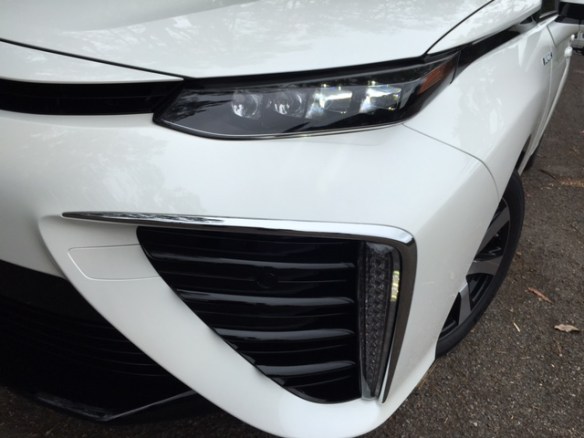
The Mirai looks a bit ungainly in photographs, but in person it stands strong and proud, wearing Toyota’s latest styling, also seen on the all-new 2016 Prius. No one can accuse Toyota of being plain vanilla anymore. The most noticeable feature from the front is the large “gills,” which I’m told allow more air into the motor area for the fuel cell to stay cool. They are also a different look, and believe me, are more compelling in person.
IMG_5656.JPG

The roof has a pillarless, floating look, seen also on the Prius and on a few other cars today, so it’s definitely the latest style. The proportions are masculine in their mass but feminine in their roundness (forgive the stereotypes), but I think the car could appeal to a wide range of folks.

Inside, the Mirai is curves and edges intertwined, with a luxurious feel. The door slams with an authoritative thunk. I learned that the Mirai is assembled in the same plant as the extremely limited and expensive LFA supercar, in Japan, by craftsmen who sweat every detail. The seats feature a complex, compelling stitch pattern, likened to aliens by my guide. They’re covered in SofTex, an artificial but pleasantly pliable leatherlike material.

IMG_5649

The instrument panel features the normal buttons and switches. The climate control uses the touch-sensitive sliders seen in a few other vehicles. Once you get used to them you can just tap to make adjustments. The steering wheel has the usual controls for accessories and speed control. The dash gives you lots of interesting information about how your Mirai is doing.

I peeked in the trunk. It’s tall and wide, but not as deep as a non-electric, since the hydrogen tank takes up a little room back there. No big deal, but you won’t pack any surfboards in there.

My ride was in the western area of San Francisco. I started up on 2nd Avenue and the car accelerated heartily, emitting just a slight whine. The sound is what you’d expect from an EV. I didn’t hear anything that sounded like a fuel cell, as it does its crucial work in silence, apparently. Brakes are nicely modulated, steering has a well weighted feel, and the car feels a lot like a Lexus, appropriate since it shares its platform with one. This is definitely much more car than a Camry or a Prius.

I wound through the San Francisco Presidio and down past Crissy Field, then climbed the steep Divisadero Street hill quietly and effortlessly. Then, I headed west again, returning to where I started, all too soon.

Hydrogen cars are likely to be part of the future automotive solution. If plug-in electric vehicles have a range problem, needing a recharge every 80-100 miles today (excepting Tesla), hydrogen cars have an infrastructure problem. They don’t have a range problem per se, with an EPA rating of 312 miles per tankful, but fueling stations are extremely scarce.

Toyota is investing in building up a network, working with companies such as First Element to set up stations throughout California. In the San Francisco Bay Area, there are a few, including one in Hayward, just a couple of miles from my home. I heard yesterday that there’s a station in Harris Ranch (near the Tesla supercharger) that allows San Francisco-to-Los Angeles trips, complete with a rest stop and a tasty meal. Toyota has 20 certified stations in California today.

An issue could arise if you took your Mirai out of state, away from hydrogen fuel and Mirai-certified service locations. Like driving a compressed natural gas (CNG) vehicle, fueling will be the issue. Take your other car to see Mount Rushmore.

How about if you have a mechanical issue with your Mirai? You must take it to a Mirai-certified Toyota dealership, which has the proper tools, service bays, and training to take care of the fuel cell. For ordinary things like brakes, you can go to any Toyota shop. There are eight certified Mirai dealerships in California–four in the north and four in the south.

So, what’s the price on this baby? I didn’t see an actual window sticker, but the retail is $57,500. However, consider this. You can buy or lease this car now. The current lease deal is $499/month for 36 months, 12,000 miles a year. Not only do you get California and Federal rebates, but Toyota is offering one of its own. And, as more than icing on the cake, Toyota will issue you a card good for up to $15,000 worth of fuel for the first three years. Service is included for that period too. So, lease the car and you essentially pay nothing but your lease payment for three years. Considering the competitors in the $57,000 range, such as Mercedes-Benz, BMW, and so on, it’s almost a steal.

Yes, as a Mirai driver you’ll have to think about refueling, and you may have to go out of your way. You can’t just pick up and drive to South Dakota on a whim. But, if you do have travel in mind, Toyota offers seven days a year of free rental of another vehicle. So, drop off your Mirai and take, say, a Highlander for a trip.

There are some questions. What will hydrogen cost when you DO have to start paying for it? Currently, it’s made primarily using natural gas, and costs $13-16 a kilogram. The tank holds 5.1 kg, so that’s $65-80 per fill-up. In three years, the cost could drop substantially.

Another issue is, just how environmentally friendly is hydrogen fuel if you need to use natural gas to make it? For now, natural gas is the easiest way, but there are numerous alternatives, including using waste to generate it. See the numerous videos on Youtube for much more information.

When Toyota introduced the Prius in 1996 in Japan (and 1999 in the U.S.), it was a bold venture, and the initial buyers were pioneers. Of course, those cars used regular gasoline, but still, it was a little bit of a risk. Now, in its fourth generation, on an all-new platform, the Prius leads the way in hybrids. Are you ready to be a pioneer, too? The Mirai is at the forefront. And, Toyota has opened its thousands of patents, so other manufacturers will be offering their own hydrogen fuel cell vehicles, helping to make the case for more fueling stations. It’s an  exciting time.