My Chevrolet Bolt – Pending Production

IMG_6896.JPG

As wait for my Chevrolet Bolt to arrive, I’ve joined two Facebook Chevrolet Bolt groups and other forums. I’m learning more about how cars are built.

I’ve ordered two cars before. The first was my Saturn, back in 1990, and I heard nothing until it was there to pick up. I think I may have simply received a car that matched my request, rather than having it custom assembled for me at the factory. Another time, I ordered a car for my wife. They said it would be two months and it ended up being six weeks. But I never had any idea of the flow.

So, in this day of instant information, I was expecting to hear from my salesman that my car was getting loaded on the truck and was on its way. But so far, no news.

Then, I read on a forum about the Chevrolet Live Chat line, and tried that. Presto! In a few seconds I found out that my car, with its six-digit alphanumeric ID number, was in the Broadcast status–meaning they have set up the computer at the plant to build it. The Targeted Production Week (TPW) is next week–12/12/16. I signed up to get weekly updates, too.

I’m a little disappointed, because that means the car could arrive in January, but there’s really nothing I can do about it. I didn’t put the absolute first order in (my salesman said he had a bunch of them already), so I’ll just wait. There’s not really any rush, is there?

There’s a lot of talk about the Bolt, with it winning awards and all. I’ve even see the electric billboard on my commute showing it as the Motor Trend Car of the Year winner! But I’m personally feeling anxious for it to get here. I sure don’t want them to rush it, though. And what if they build it tomorrow? Isn’t “made on a Monday” bad luck? (just kidding).

More as it happens.

img_6910

Chevrolet Bolt in the Flesh!

img_6934

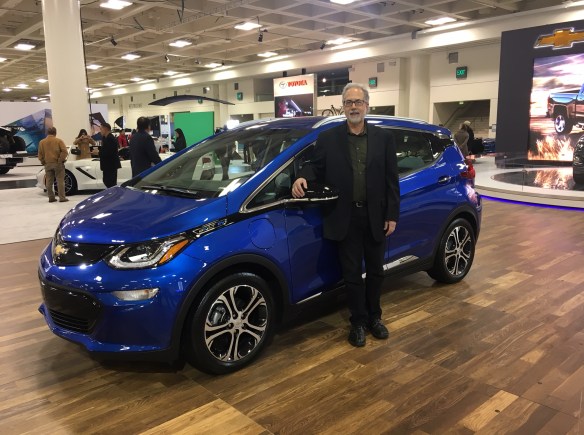
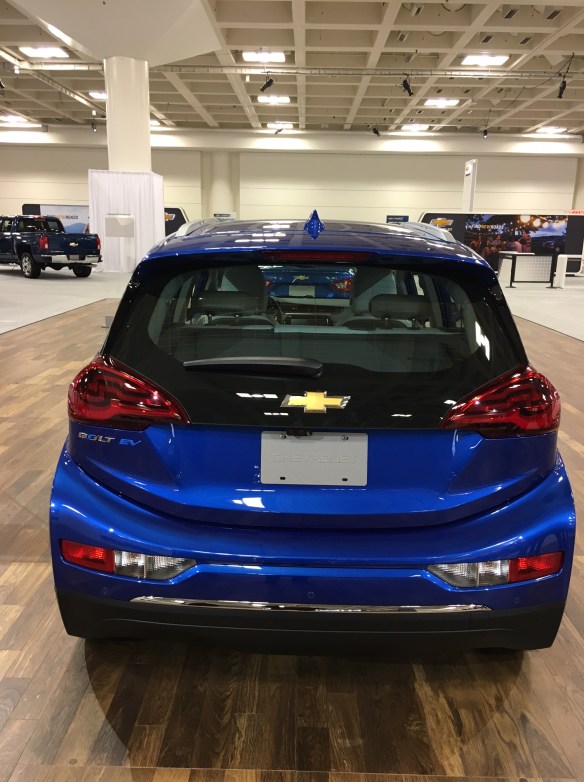
Finally, I’ve seen and touched a real Chevrolet Bolt! I got my chance at the San Francisco Auto Show, where they had a single car. And–it was the same Kinetic Blue that I’ve ordered mine in! And, as a Premier level model, it was essentially identical to my long anticipated new ride.

I approached it from the front, and it looked, well, like it was supposed to look. It’s not large, but it’s not small either, and stands tall–nearly as high as a crossover, but not as chunky. The smiling face had the fill panel with energetic lines on it and a big gold Chevy logo and gleamed in the show lights.

img_6909

The paint looked lustrous and I ran my hands over the car, “petting” it, to get a true feel of the body. The chrome trim is not skimpy, and the roof rails are a gleaming silver.

img_6927

The taillamps are bold, with a sharp edge along their tops and the “electronic” theme pattern in them. The new logo is different from the Volt’s.

img_6914

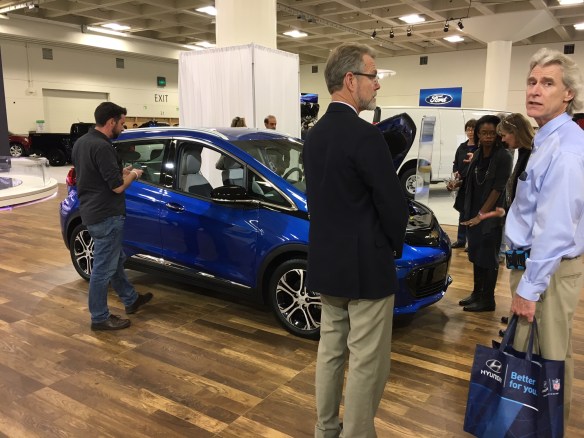
I popped the hood, which proved to be very lightweight, and used a prop rod. The flat, silvery motor is tucked in there, minus the usual radiator, water pump, and other internal-combustion-engine accouterments. There is still a container up front, but it looks like folks are being warned NOT to put radiator fluid in there.

img_6901

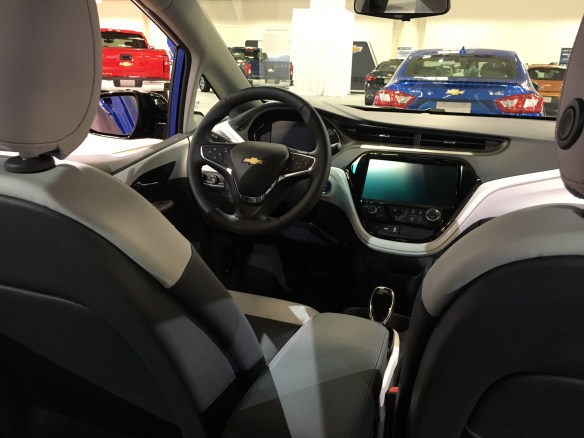
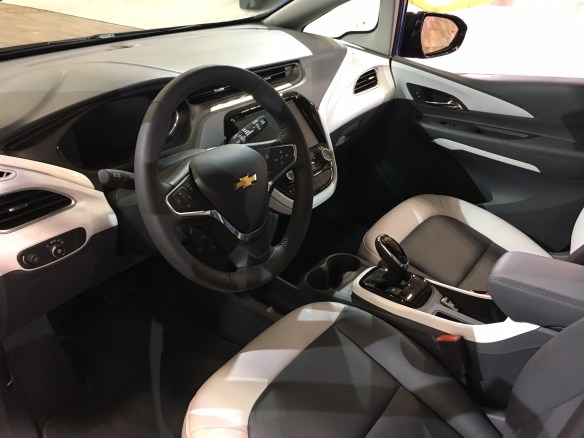
I stepped inside. It looked like the photos, but I also got the sense of height and the gray/white contrasts. I think this is the lighter interior scheme–the one I ordered–with partial white on the seats and a white lower half of the dash. The doors are dark, with just a little white extending into the top.

img_6904

Plastics are good GM grade, but not Audi level luxury. We all understand that the premium pricing of the Bolt, for its size, is for the 900-pound battery, but the fittings seemed well done and similar to the all-new 2016 Volt, its plug-in hybrid sibling.

The instrument panel was totally blank, as today’s screens are, so I couldn’t evaluate it, or see anything on the center display either. The thick, leather-wrapped wheel feels good in your hands, and has the requisite redundant buttons for audio, info, phone, cruise control, and even a heated steering wheel. The rearview mirror is thick, as it also functions as a backup camera (when the car’s on).

img_6917

The seats are narrow but nice and firm–perfect for 167-pound me. A large person might not take to them as well. The back bench sits higher than the front buckets, for good visibility but also leaving plenty of battery space below.

img_6912

I tried sitting behind the driver’s seat that was set for me and had a couple of inches of legroom, so a Bolt should accommodate full sized folks back there.

IMG_6926.JPG

The rear hatch wasn’t operational (they turn off all EV functions for these cars at shows, apparently), but we were able to drop the rear seats and see the space in back, including the sturdy “false floor” that provides a smooth surface and also hidden storage.

The car was just sitting there, without signage or hoopla, but two nice young women were there to answer questions, and we had a pleasant conversation. One of them took a few really nice photos of me with my beloved car. I also spoke with numerous other show goers who were interested, and that provided a sense of camaraderie. I expect I’ll be having more of these when I get mine, and I welcome that as a chance to sound the rallying cry of Go Green!

img_6936

I should have some help in that, since the Bolt, this week, won three important awards. First, it’s the 2017 Motor Trend Car of the Year. It’s also named to the Car and Driver 10Best list, and is the Green Car of the Year, from Green Car Journal, announced at the Los Angeles Auto Show. An auspicious start.

img_6907

Now, I’ll await word from Don Mays, my salesman at Boardwalk Chevrolet in Redwood City, California, that my car is built and on its way. He told me that delivery is expected before Christmas, so that’s about a month away. I’m eager to put it on the road to see what it can do.

img_6930


Chevrolet Bolts are In Production!

gm_starts_bolt_production

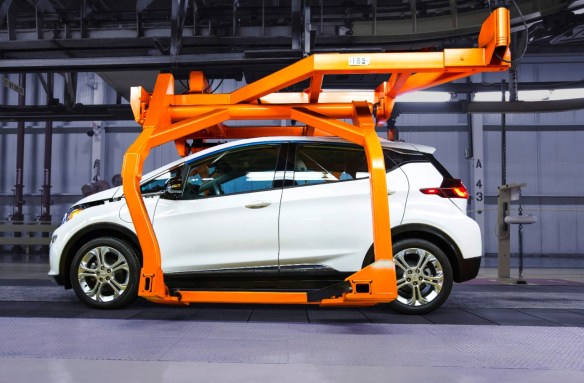
Finally, the assembly line is running at the General Motors Orion Assembly Plant in Orion, Michigan, and Bolts are moving slowly down the line.

The news story I found mentions the sad news that only California and Oregon will get cars before the end of the year, but luckily for me, I’m in California, and my order is in, so I am hoping to see my car something before the end of the year.

It’s an interesting experience in 2016, when instant gratification is the norm, to have to wait for anything. I knew that I wanted an EV, and I knew that the Bolt was the only realistic choice, since it’s (relatively) affordable and has a great range, with its big 60 kWh battery. So, I dashed down to place my order.

But nearly a month in, waiting feels as interminable as the conclusion of the 2016 election. While the latter event is literally right around the corner, I’m not sure when I’ll see my Bolt. And, I’m not sure exactly how much it’s going to cost me on a monthly basis.

Figuring that my car would be with me at least 30 months, I went for the nicer Premier model, with a few upgrades, like leather seats, and upgraded the stereo and safety features, so it’s $43,000 or so before they take the $7,500 off for the Federal tax credit. Then, there’s California money coming to me too, $2,500 worth, as I understand it. But I’ll have to decide how much to put down to keep those payments reasonable.

I’m also turning in my ancient 1993 Plymouth Voyager minivan, my occasional car that will now go to gas car heaven. I plan to put it out to pasture when I’m assured of my Bolt delivery date.

I haven’t bought myself a new car since November of 1990, when I got my Saturn. It was exciting to sell my Honda and buy a new car that was a brand new brand, too. I was the first guy on my block to have one, and I got some attention. I even got noticed by Hal Riney and Partners, who had the Saturn account, so I ended up on the cover of the 1994 Saturn brochures!

img_6728

Look at all that nice dark hair. And I’m posing with my first son, who’s now a grownup father of two. 🙂

My Chevy salesman says he’ll keep me posted on the progress, so I will, at some point, know the status of the build and when it gets put onto a transporter truck for its western trip. Watch this space for updates.

And, visit my new venue, Clean Fleet Report, for my EV and hybrid writings.


Chevy Bolt – Clean Car from a Green Factory

bolt-orion-1280-1280

I’m waiting  for my Chevrolet Bolt to be built. As of October 24, the order is submitted to the factory and accepted by production control, according to my salesman, Don Mays.

So–what kind of factory does GM have in Orion, Michigan? Well, the General Motors Orion Assembly Plant gets more than half its energy from methane from decomposing trash, and has a 350-watt solar array. That’s pretty impressive!

One of the arguments is, why not just use your old car–it’s already built? Why spend all the energy to make new ones? If the factory runs efficiently, there’s less cost to driving a new electric car. It’s a complicated story, and we’ll keep following it.

Meanwhile, I’ll be waiting for the next installment from Chevy.


My Chevy Bolt – The Story Begins

slack-for-ios-upload-1

On Tuesday, October 11, 2016, I stepped into Boardwalk  Chevrolet and sat down with Don Mays to order my own Chevrolet Bolt. This very specific step is the beginning of my second electric car adventure, one that I expect to change the way I write about cars.

Ever since I heard about the Bolt–GM’s 200+ mile all-electric car–I’ve been fascinated with it, and followed all the news reports on it closely. Also, over time, I’ve become convinced that electric cars are a major part of our future transportation solution for working to limit the effects of climate change.

From January to April of this year, I spent a delightful three months with a darling baby blue Fiat 500e, which I named Fidelio. He and I commuted and dashed about town together without using a drop of gas, and it was a very happy experience. However, Fidelio’s 90-mile range was the one down side. So, when I learned that the Bolt would offer more than 200 miles, I was sold.

Don tells me that the order will be placed, and that, as production moves along, he’ll be able to tell me when my car is made and track its progress from the Orion, Michigan plant to Milpitas, CA. Then, it will go onto a truck and be sent to the dealership in Redwood City, CA. Expected arrival? Around Christmas time, if I’m lucky. But it sounds like the West Coast gets the first allocations, and that’s where I live.

I’ve ordered cars before, but never without test driving one. I was one of the first Saturn owners, back in November of 1990. My family also bought one of the first Corvairs, in 1960. So I guess it’s a family tradition to try out new GM experiments.

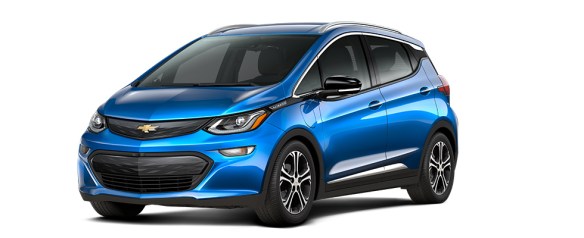
By the way, I ordered my car as the upper level Premier, in extra-cost Kinetic Blue, with the  lighter of two interior colors (gray/white), with the premium audio package (I’ll spend a lot of time commuting in it), and the safety feature package as well. I got the quick charge plug, too. May as well have it the way I want it, and I expect to be showing it off a lot–especially when it’s the first one in town.

Stay tuned!

bolt-9-13-16-blue


Audi A3 E-Tron: Step One

news-2017-audi-a3-e-tron.jpg

The Audi A3 e-tron gives the premium German marque an entry point to electric motoring. Based on the previous generation Sportback wagon, it combines a 150-horsepower 1.4-liter gas engine with a 102-horsepower 75 kW electric motor to make a combined 204 horsepower drivetrain. With 258 lb.-ft. of torque, it pulls the compact wagon from 0-60 in 7.6 seconds.

Electric vehicles, even half-electric ones, use the MPGe rating, which offers an efficiency standard that you can use to compare competing vehicles. For example, you can measure the A3 against the plug-in Prius or the Chevrolet Volt. The A3 e-tron earns an 86 MPGe rating using electricity and gasoline, and a 39 MPG with gasoline only. I averaged 96.4 MPGe during my test week. The window sticker claims I’ll save $3,750 a year in fuel costs over the average new vehicle.

EPA fuel economy ratings are 8 for Smog and a perfect 10 for Greenhouse Gas. The 138 grams per mile of CO2 is lower than most cars, but, of course, higher than an all-electric car.

One way to compare plug-in hybrids is by the range they can drive on electricity alone. The A3 claims 17 miles, and in my 18-mile commute, I found that to be accurate. Just before I arrived at my office, the gauge indicated the switchover. So, I plugged in and had enough to get almost home, and so it went. By charging at both ends, I used very little gas for commuting.

Charging is simple. Plug in to standard 240-Volt (level 2) chargers at work or in other public places, or use your own household current, which is 120 Volts (level 1).  It’s an eight-hour process at home, comfortably overnight. On a level 2 charger, it’s just two and a quarter hours. You won’t be hogging the chargers while others wait. They’ll appreciate that.

The A3 is on the lower end of the range listing for plug-ins, but it still makes a big difference. The Chevy Volt offers an honest 53 miles of charge before switching over to its gas engine, which generates electricity to run the electric motor. The Audi is typical of a hybrid, using the gas engine and electric motor interchangeably as needed.

The A3 e-tron offers four driving modes, which you select on the dash. EV mode uses the electric motor only. In Hybrid mode the car’s computer picks the most efficient power source for the driving conditions—EV, gasoline, or both. In Hold Battery mode, the car is a hybrid only, saving the battery charge for driving all-electric later. The Charge Battery mode uses the engine to charge the battery while you’re driving at freeway speeds.

I ended up taking a six-hour round-trip to an exciting but farther away than I thought microbrewery, so for that trip, the A3 behaved like a normal hybrid car. And that’s what distinguishes a plug-in from an all-electric car. You can pretty much go wherever you want to, but drive hyper efficiently when you stay local.

The 8.8 kWh lithium-ion battery pack sits under the rear seat, and because it doesn’t take up any cargo space, the wagon is fully usable to carry your stuff. Other plug-ins like the Prius and Volt are hatchbacks, so the A3 has an advantage with a lower sill for easier placement of, say, a bass, in my case.

The A3 Sportback wears a new name: e-tron, which Audi will use to identify other, future electric and hybrid models, too. For now, it looks and feels like an A3, which is a good thing. The premium craftsmanship inside, simply presented at this level, is pleasant and feels substantial and carefully thought out. My Misano Red Pearl Effect test car greeted me with a sweet leather aroma when I opened the door for the first time. The switchgear works nicely, the eyeball vents swivel satisfyingly, and the it’s a pleasant place to be.

The A3 e-tron comes in three levels: Premium, Premium Plus, and Prestige. Base price is $37,900. My tester was a Premium Plus, which added $4,100 to the tab. That got me extras like 17-inch, 15-spoke alloy wheels, 3-D optic inlays, the Audi music interface, heated front seats, and aluminum window surrounds. The $2,600 Technology package added a navigation system, Audi Connect online services, and more. They charged $575 for the fancy red paint (a typical Audi upsell). The bottom line came to $46,100.

If you’re an Audiphile, this is your high-efficiency choice. An all-electric e-tron model should be here soon.

Should I Get My EV Now or Wait?

Recently, with lease deals on EVs running at around $79/month (with a few thousand dollars down), I’ve been thinking about picking up one to use when I’m not testing other cars. After my three-month loan of a sweet little Fiat 500e earlier this year, I want to drive electric today, both because  it’s the right thing to do for the environment, but also to practice what I preach. Advocating for a move to carbon-free transportation is fine, but sometimes you have to walk the walk, too.

cq5dam.web.1280.1280

I believe that the upcoming Chevrolet Bolt, with its 200-mile range, vast dealer network, and attractive purpose-built EV design, will be a game changer for the non-wealthy like me. But I suspect that there will be no deals on Bolts, at least a first. There’s plenty of pent-up demand and they’ll have the only game in town–for a while, at least.

So, I’m focusing on the Volkswagen e-Golf again, as well as the Fiat 500e and maybe the Kia Soul EV.

eGOLF-LEAD-1940x1293

The process of elimination removed Tesla from consideration right off the top. It’s way out of my price range, and there are no cheap deals to be had anyway. Others cut from the list include the Ford Focus. It’s a regular car that’s been electrified, and has only a 76-mile range. There’s the worthy and pioneering Nissan Leaf, which was built as an EV from scratch, but is looking long in the tooth with minimal changes since its 2011 debut. The availability of a bigger battery with 107 miles of range in the 2016 model is a small consolation. The Chevrolet Spark EV is cute and has great torque, but it’s kind of tiny. The Mercedes-Benz B250e and BMW i3 are appealing, in different ways, but are not as affordable as the three vehicles I mentioned at the top of this paragraph, if low price of admission is the goal.

In any case, is it time to grab something now or to wait? I’m struggling with impatience but also with the knowledge that as with all things technological, the next improvement is right around the corner. You know that when you take home that new laptop, next week there’ll be one with a better screen or more memory or some amazing new feature.

Here’s what you get if you wait. The new Focus is going to jump to 107 miles of range with the ’17s. The all-new Hyundai Ioniq is arriving this fall with 110 miles of range. The Bolt looms ahead appealingly. The Kia Niro will offer a hybrid in a crossover shape–and perhaps a pure EV someday. What will the next Leaf be able to do? We’re on the edge of a whole new generation of attractive options.

To top it off, as I entertain a deal on the ’16 e-Golf with its 83-mile range, I just read that the ’17 is supposed to get about 125 miles of range with a new, larger battery. So, suddenly waiting a few months seems like a great idea, as long as I don’t need the car right now.

The only down side is that the cheap lease deals may dry up once the next gen cars are out. Who really believes that a $79/month lease is realistic in 2016, anyway? It’s just a way to sweeten the deal on a car that retails in the $30,000-plus vicinity and has limited range. The  companies are willing to move them out at a loss or minimal profit just to comply with regulations and maybe pick up some green cred for doing so.

Perhaps, if you’re really eager, you could take advantage of a deal now on the shortest lease term you can get (24 months?), and save up for the big transition two years from now, when you may be able to snag a Tesla Model 3 that someone ordered on spec or that fell through the cracks. Or, grab a second- or third-year Bolt with the all the bugs fixed. And the new Leaf will be out by then.

As an EV cheerleader, and soon-to-be participant, that may be the best way to get in now at minimal outlay and plan for a long, enjoyable electric car future.

But I remain perplexed. It does feel like sooner is better for the earth, but I want to have the best car for me, too.

Volkswagen e-Golf Delivers

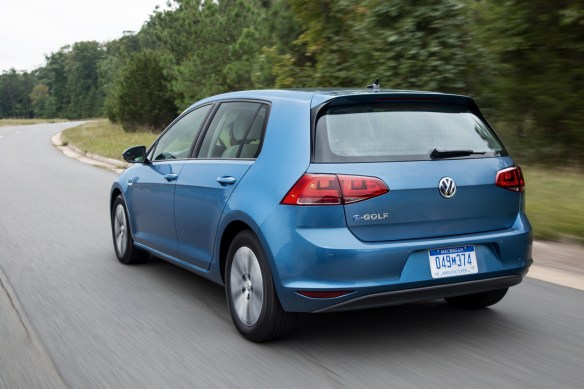
2016_e-golf_5254The Volkswagen Golf has been sold around the world for 40 years. A mainstream model in Europe, it’s less central to VW’s model mix in the U.S. However, with a major redesign for 2015 came Volkswagen’s first all-electric car, the e-Golf, and it was worth the wait.

The e-Golf is aimed at pure electric vehicles like the Nissan Leaf. There is no sacrifice in driving enjoyment or practicality in choosing the electric option. In fact, it boasts the same 95 cubic feet of capacity as the gas version, with its battery tucked away out of sight.

2015_e-golf_3913

The e-Golf’s motor puts out 115 horsepower and 199 lb.-ft. of torque through a single-speed automatic transmission. This electric Golf still delivers the same fine road feel as the sporty GTI, and at 3,391 pounds, doesn’t feel sluggish. Although it didn’t rocket ahead like a GTI, at 10 seconds from zero to 60, the feel of electric motor-driven acceleration is instant and exciting.

Naturally, the driving range of an all-electric vehicle is at the top of any driver’s mind. The e-Golf gets an official rating of 83 miles, but when I charged the car up, I saw a reading as high as 98 miles on the instrument panel gauge. How you drive, what kinds of roads you drive on, and how you program the car’s adjustable settings make some difference, but this car didn’t feel like it would leave you in the lurch.

The official EPA numbers are 126 and 105 highway. That’s MPGe – miles per gallon equivalent. Use these numbers to compare electric vehicles. Pretty impressive.

To ease your range anxiety, VW provides a roadside assistance program. If you run out of charge within 100 miles of home, they will take your car to a charging station and to get you home via taxi or other transportation method on their dime.

To maximize your e-Golf’s efficiency, there are three driving profiles: Normal, Eco and Eco +. The latter two progressively lower the horsepower and top speed, change the accelerator action, and in the case of the Eco + setting, turn off the climate control, to reduce energy consumption. You can also program the amount of regenerative braking to generate a small amount of juice in the normal setting or produce progressively more in two other settings.

VW provides the VW Car-Net app, so you can keep track of your charging, turn the climate control on or off remotely, and monitor performance data for your car. Part of owning an electric is the science project aspect, where you are thinking about what your car is doing rather than just sitting in it and going. It’s important and fun, too.

The VW Golf was all-new for 2015. It’s a two- or four-door hatchback, but also, in 2015 it took on the wagon role from the Jetta. Numerous engines and trim levels are available, but you can tell the e-Golf by its blue accents.

VW originally sent the e-Golf to market as the loaded SEL Premium model. That means full climate control, heated seats, leather steering wheel and shift knob, alloy wheels, heated mirrors, and the like. Now, VW also offers the SE, which shaves thousands of dollars off the price by swapping out the alloy wheels for steel, LED headlamps for standard halogen, and cloth seats in place of leatherette. Federal and state tax rebates help mitigate some of that cost as well.

Charging is simple. However, using household 110/120 volt current, it could take you 20 hours to fill the battery from empty. A 220/240 volt charger, which you’d install at your house if you owned the car, can do it in less than 4 hours. The e-Golf SEL or SE with the optional Quick Charge package has the SAE combined quick charge socket, so you can get an 80 percent charge in 30 minutes in a pinch.

2016_e-golf_5250

It’s particularly quiet inside the e-Golf because when VW removed the vibration-causing gas engine, they went after the little sounds that could annoy you, which were suddenly exposed. The car emits a little sound at low speeds, so oblivious pedestrians are warned of your approach.

Part of owning an electric is the knowledge that you’re reducing your carbon footprint and helping the planet. In that spirit, VW has teamed up with 3Degrees, a renewable energy service provider, to offset the e-Golfs greenhouse gas emissions from its production, distribution, and 36,000 miles of charging.

The SE starts at $28,995 with the SEL at $35,595. The SEL earns its extra price with things like Driver Assistance, Navigation, leatherette upholstery, quick charging, and more. The SE with the quick charge option is probably the sweet spot. Leasing remains the way to get into one of these cars surprisingly affordably.

My Pacific Blue tester was a delight. Electric motoring is smooth and pleasant. With an 11-mile commute at the time I tested it, I had plenty of charge left over at the end of the day. This is an ideal commute vehicle, with its quiet, spacious interior and gasoline-free ways, but as with any other electric car (except a Tesla), you’ll need another car for long trips.
2015_e-golf_4194

Volvo XC90 T8 Hybrid – Unique

The all-new Volvo XC90

The all-new Volvo XC90 is a handsome, luxurious, comfortable, fuel efficient, and expensive large crossover. All all new, it’s a huge step forward for the Chinese-owned Swedish brand.

The regular gasoline versions are badged T6’s, but my car I tested was a Volvo XC90 T8, the world’s first seven-passenger plug-in hybrid SUV.

All XC90s share a potent 2.0-liter four-cylinder engine that uses both super- and turbo-charging to put out 313 horsepower and 295 lb.-ft. of torque. The T8 adds an electric motor and a battery pack to deliver limited electric-only motoring and a total of 400 horsepower and 472 lb.-ft.  of torque. I drove my 18-mile commute entirely on electricity once, but normally achieved just under that. The center screen shows graphical and digital statistics, and where the power is flowing.

Hybrid system settings are Hybrid, the default mode, which switches back and forth from fuel to charge. Pure mode means all-electric. Power mode combines the motor’s instant torque and the gas engine’s size to provide V8 level performance. Save mode lets you retain the battery charge for later use.

An EV range in the teens is typical for plug-in hybrids, and remarkable for a 5,059-lb. vehicle. The EPA gives it a 53 MPGe rating (compare that to other battery vehicles). In pure EV mode, it’s much better. Gas-only delivers 25 MPG. My tester averaged 22.7 mpg over 63 hours and 1,578 miles, including previous journalist loans.

Green scores are 7 for Smog and a split number for the Fuel Economy/Greenhouse Gas rating—7 for MPG and an 8 for CO2.

Pricing for the T8 starts at $69,050. My tester, with the $3,500 Inscription level upgrade, plus a raft of safety, convenience, and style packages and features, came to $84,005. That’s a big price tag, but this car is a great experience.It’s filled with luxury features, including an Orefors crystal shift knob and some beautiful food trim.

The all-new Volvo XC90

The XC90 T8 was named Green Car Journal’s Luxury Green Car of the Year, and is part of what is a welcome resurgence for Volvo, a brand with a historic commitment to safety, today’s latest technology, and now, a greener way to move a family of seven.

Yeah, it’s not a full-fledged EV, but it’s a move in the right direction. I’m look forward to Volvo offering a full EV before too long.

IMG_5801

Mercedes-Benz’s Electric Option–B250e

IMG_5849

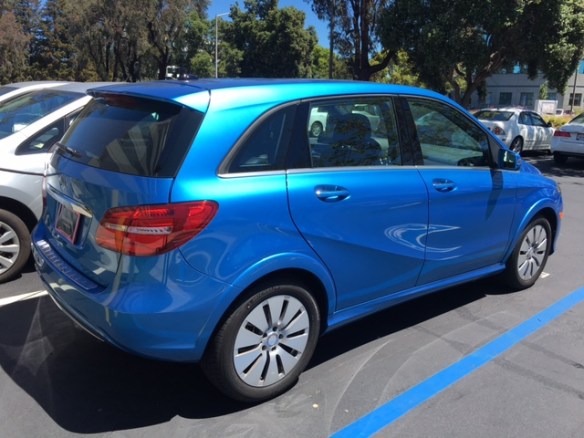
There’s an electric-powered Mercedes-Benz out there, but you can be forgiven if you haven’t noticed. Quietly, the B250e is rolling around town, if you happen to be in California or other EV friendly locales.

The B is a five-door hatchback–not the shape you expect from Mercedes. The B-Class is sold in other parts of the world, including Canada, as a small, utility-minded gasoline-powered car, but in the U.S., B-Class cars are EVs only (labeled Electric Drive). There’s a tiny A-Class sold overseas, too, but you won’t see one here.

It makes sense for the German giant to put an all-electric powertrain in a small vehicle. Roughly the size of a Nissan Leaf, it has less weight to labor the battery pack with. With a folding rear seat, it’s spacious in the back. In the bright blue of my colleague Pam’s new commuter car, it has a friendly aspect to it.

I’ve been eager to test Mercedes’ baby EV, so when I saw one attached to the chargers at my building, I slipped my card under the driver’s side wiper and waited for the owner to respond. Pam did, and offered to show me around the car–and even let me drive it for a few minutes.

The B may look like a generic hatchback (despite it’s dramatic character line that rises up the side), but inside, it feels like a Mercedes-Benz. While not furnished in rare woods, and rich leather, it has dignity and mass, and an instrument panel that looks like a Mercedes-Benz’ should. It feels more upscale than other EVs I’ve tested. It can’t match a Tesla, of course, but it’s not priced as one, either.

Driving the car is, judging from my brief test, pleasant and, of course, silent. There are settings for S (sport), E (eco) and E+ (eco plus), and, I think, a “normal” setting. If you set it to S, you get the full benefit of an electric motor’s instant torque and rocket ahead with a snap. In E or especially E+, the drivetrain feels anaesthetized, but that’s so you use less juice.

Stats: 132 kW electric motor, 177 horsepower, 251 lb.-ft. of torque, 0-60 in 7.9 seconds.

Pam, who stepped out of a reliable Mercedes-Benz M Class SUV, has been getting about 83 miles per charge in her new B, which puts it in the realm of the original Leaf and other cars like the Ford Focus EV and Fiat 500e. Mercedes claims 87 miles. But the future is looming, with 200+ mile range EVs on their way, so I’m guessing that the Tesla-sourced engine/battery will be getting an upgrade before too long. Meanwhile, for a commute from southern San Jose to San Mateo, California, the little Mercedes-Benz EV is just the ticket. Pam has level 2 (240 volt) charging at home and here at work, so she never has to run out, as long as she doesn’t stray too far from the normal path.

Pricing is officially $41,450, but as you might expect, leasing drops costs considerably. Pam leased hers for a little bit more than $300 a month with some money down. The Federal rebate was applied directly to the lease, and her California state rebate is on its way. She relishes her white carpool-lane stickers, too.

The B is a natural competitor to the BMW i3, and, as these two German competitors go, it’s the more sober, elegant one, versus the radical BMW. But by all means, you should cross-shop.

I’m eagerly awaiting my chance to spend a week with this car, but for now, it looks like a winner to me–for the right driver and purpose.

IMG_5850