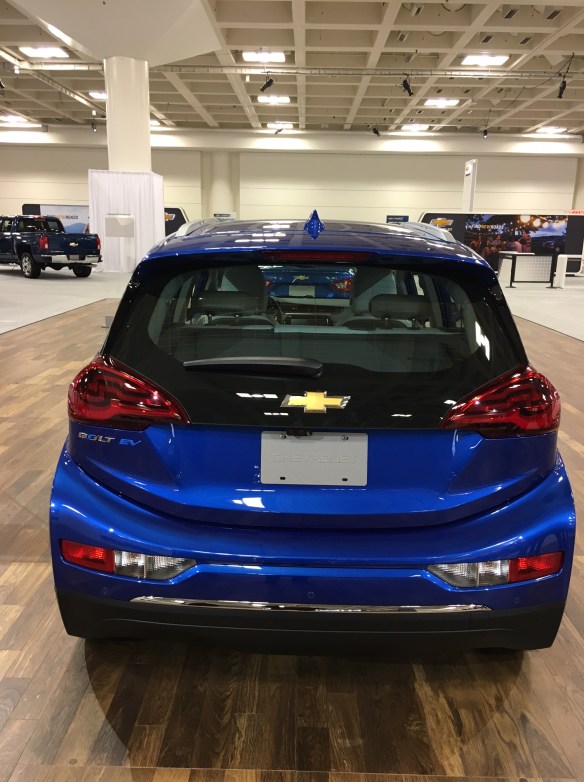
My Chevy Bolt EV is Finally Here!

IMG_7467.JPG

I ordered my Bolt EV on October 11, 2016. Today, January 8, 2017, I picked it up and drove it home in the rain. A little water wasn’t going to stop me from getting my blue baby.

Sometimes, when you get something you’ve been waiting for, there’s a letdown, but today things went fine and turned out exactly as I hoped they would. And thanks to Don Mays and the folks at Boardwalk Chevrolet in Redwood City, it was painless, too, although I was there for over three hours.

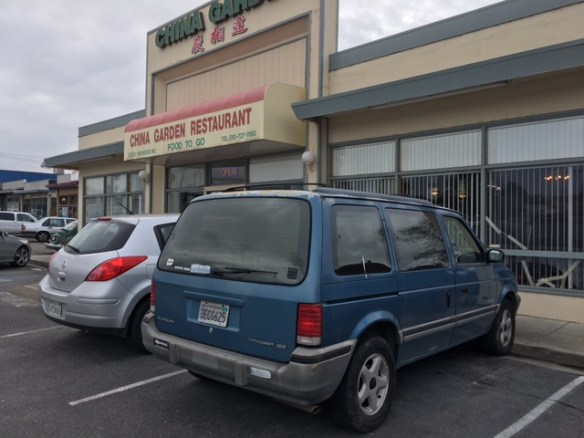
It’s a funny story, really. On Friday, I took my 1993 Plymouth van to the junkyard to be crushed for California’s old gas car buyback program. You can read about it here. On the way home, I got a call from Don, my Chevy salesman, letting me know that he wasn’t exactly sure when the Bolt would land at the dealership–but it would be soon. I had been hoping that by finally getting rid of my ancient ride, I’d clear cosmic space in the universe for the Bolt. And–it turned out I was right. At around 4 p.m. Friday I got the call. The truck carrying my car had just arrived (it’s one of those blue ones).

img_7445

I knew that Sunday was going to be stormy, but we got up and waited for the phone call. At 11:12 a.m., just after the dealership opened, Don called and said my car was ready for pickup. So off we went–my wife kindly offered to drive me over.

When we arrived, we saw two Kinetic Blue Bolts in front. I checked the window sticker and identified mine. It was on the charger. Apparently, when they brought it over from the service area it had just 90 miles on the battery–not full–but it gathered some more while it sat there waiting for us.

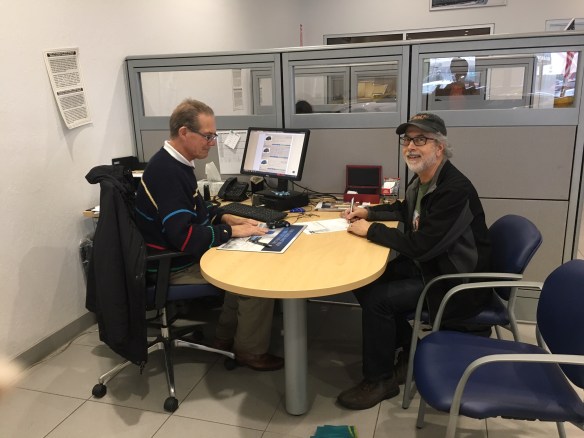
Of course, there’s paperwork to do when you lease a car, but it was easy enough. Interestingly, they ask you to sign an agreement regarding whether to mount a front license plate bracket or not. Apparently this is a big deal to Corvette buyers (who don’t want the holes drilled). I personally expect to wear my plates like the law requires, so I just said, “sure.”
img_7470

The lease process was straightforward. They give you a $2,500 “lease cash” payment, and then take off the Federal $7,500 off the lease price (since I’m not the buyer). You can request what you want the monthly payment to be and how much you want to put down to get it. As it turns out, I had planned to put down a substantial cash amount to lower the monthly payment. I ended up giving them $9,000 ($10,000 minus my $1,000 deposit) and ended up with a $335 a month payment, including taxes. Of course, there’s no January payment–it’s included. I’ll be receiving a $2,500 rebate from the State of California (eventually), and I’m getting $1,000 from junking the van, so it’s not as bad as it sounds.

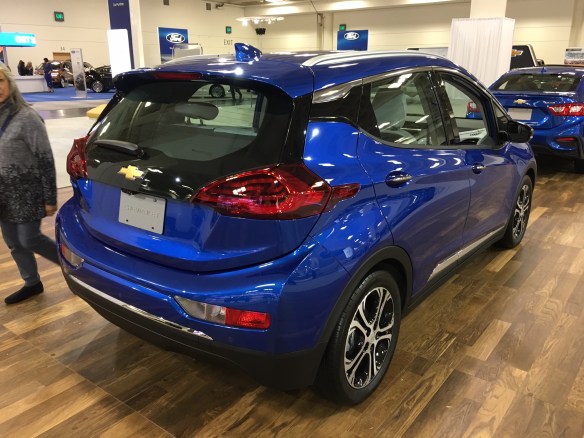
Don brought my dripping wet car into the dealership so we could get pictures (like the one at the top). The car was nicely prepped–shiny and clean. The interior was spotless and with just 3 miles on the odometer. There were even a few pieces of protective plastic still on the door handles. I’ve smelled a lot of new cars as a journalist, but this is the “freshest” of them all so far.

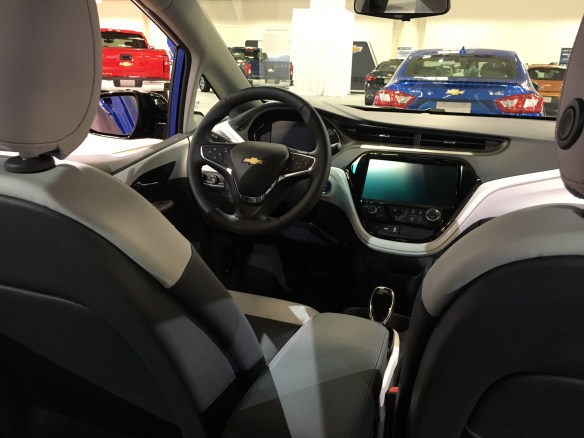
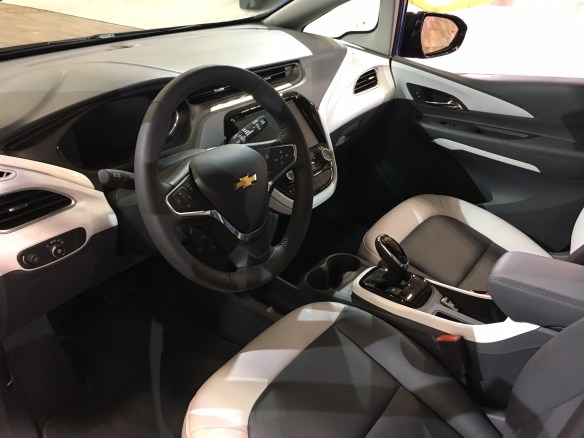
I’m glad I chose the lighter interior. All cars receive the white band across the dash and onto the doors, and white console trim, but mine is light gray on the doors and light gray and white on the leather seats, so it feels bright and airy in there. The other choice is dark gray and light gray. Here’s a cool design element–at night, a blue line outlines the lower dash.

New cars have a lot of electronics in them, and EVs especially require some explanation. I sat in the car while Don showed me some features. While he installed my temporary registration and removed my window sticker, I set up my OnStar account–a GM benefit for safety and turn-by-turn directions, among other things. The SiriusXM radio came right on, as you’d expect.

The Bolt EV has bright, colorful displays in the instrument panel and dash center, so it’s easy to know what’s going on. They put on a little video celebration when you first touch the glowing Start button. Then, the screens appear. They are certainly more interesting to look at than the Ford Sync3 system, which works fine but is more of a monochrome blue. The instrument panel has a large digital speedometer, and the slim typeface is quite stylish.

The steering wheel has some controls on the back, like Chrysler/Fiat products, with volume on the right. You can select audio presets on the left side of the wheel. The front of the right side of the wheel has a set of arrows to make selections from a complex menu of inforation and settings, too.

The back of the left side of the steering wheel contains a paddle to initiate regenerative braking–kind of like putting your foot on the brake. This can add to your range and give your foot a rest.

When the lease process was done, I pulled away, and everything felt right. I cruised along the freeway and through the city of Hayward on my way home. I then took my new car on a couple of errands around town. Nobody noticed it, as far as I can tell, but it was dark and rainy out there.

So, my new Bolt EV is finally parked in my driveway, and my adventure has begun. Stay tuned.

img_7475


Flashback: Fiat 500e Video Review from Last Year

img_5143

On the eve of the arrival of my long-awaited Chevrolet Bolt EV, here’s the finished version of a video review I did on the Fiat 500e EV last April. Unlike my normal one-week test period, I got a three-month loan of this cute little all-electric car. Thanks again, Scott Brown of Fiat Chrysler Automobiles.

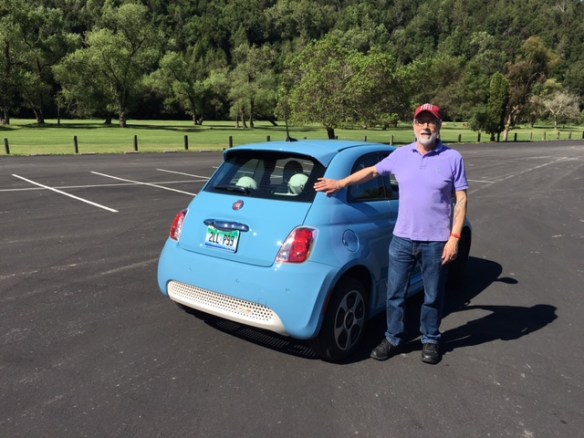
Little did I know when I got my Fiat test car on January 19, 2016 that a year later I’d be starting a new, longer-term EV adventure. But driving this car for three months gave me an appetite for gasoline-free motoring. I named the little blue hatchback Fidelio, and he was a faithful ride.

There are lots of posts on Fidelio on this blog from January through April 2016 to read. Enjoy my wrap-up in this video.


Farewell to My Old Plymouth Van

img_7420

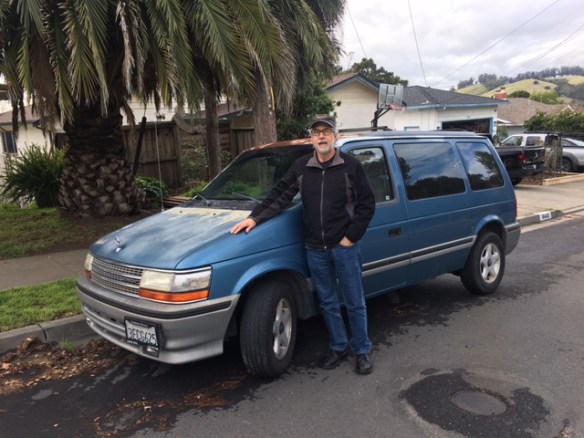
To make way for my brand new, all-electric Chevrolet Bolt EV, I’m sending my old reliable standby car to the crusher as part of California’s Vehicle Buy Back Program. Yes, my 1993 Plymouth Voyager is not long for this world.

I’m not really sad about it, but I do feel a little twinge of nostalgia. My older son drove this car in college, and it was his mom’s and stepdad’s family car before that. I have all the records to prove it was purchased brand new with 43 miles on it on April 30, 1993. They took good care of it so I could neglect it and it would still run fine in 2017.

Of course, the Bolt EV is a great upgrade for me–tomorrow’s technology in place of yesterday’s, with all of the latest safety, entertainment, convenience and planet-preserving features. I’ll be cruising in the 2017 Motor Trend Car of the Year–the 2017 Green Car of the Year, and likely the North American Car of the Year (we’ll find out in the next few days).

But this dirt cheap old van doesn’t really deserve to die. As long as I drive it once in a while to keep the battery charged, put in a few gallons of gas and add air to the tires, it’s a fine fill-in car for when my upright bass won’t fit in the test Mazda Miata. It was invaluable the time I needed to haul a 4 x 4-foot oil painting from the gallery to my living room. Registration is about as cheap as it gets and insurance costs are negligible.

As someone who’s always testing a new car, for me to drive around in a 23-year-0ld minivan with a rusted roof and hood and visible spiderwebs on the mirror supports is a different experience. Nobody smiles at you at the traffic light. I feel like Jed Clampett on the Beverly Hillbillies.

img_7413

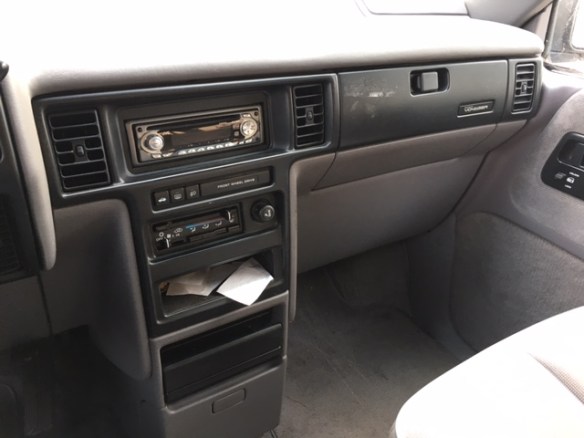
But despite its neglected exterior, the metallic blue van, with only 92,000 miles on it, is actually pretty pleasant inside. Sure there are some stains on the rugs, but the tall, chairlike front buckets are very comfortable in blue plush cloth. The look is 1990s utilitarian, but it seems appropriate here. The bulky pull-out cupholders, the temperature sliders on the climate system, the tiny buttons on the aftermarket FM radio. And there’s room for seven people!

img_7398

The 3.3-liter V6 under the hood of this Sport model hums contentedly when you press the accelerator–it doesn’t buzz like a four-cylinder. The low window line, compared to today’s tall crossovers, provides a panoramic view of traffic around you.

As an SE model, my Voyager has a leather steering wheel – and  check out that classic set of full gauges (working oil pressure and battery charge meters on top)! Airbags were still in their early stages, so the pads are big, too. Like those little horn buttons in thumb position?

img_7399

My Sport Wagon shows off its subtly styled alloy wheels and high-profile tires (yeah, the rims aren’t big or fancy, but they ain’t hubcaps, either).

img_7409

I took my van out for a few errands today. It zipped along just like usual. You can’t see the rust from this angle. The paint on the vertical surfaces is actually pretty decent.

img_7406

Colorful bumper stickers date from my son’s college days. I’ve enjoyed retaining them on my car.

This is a second-generation Chrysler Corporation minivan, an enhanced version of the original ’84 model. Chrysler invented the minivan in the early 1980s and dominated the field for years. Now, Toyota and Honda do. But, of course, today is also the era of the crossover SUV, so minivans are less hip, anyway. Although, as it turns out, the next “cool” minivan is the Chrysler Pacifica Hybrid–my car’s descendant–which is the first of its kind.

But it’s time to move on. Sacrificing our funky, high-polluting old cars is what we need to do en masse to cut CO2 to moderate the effects of climate change. I know that sacrificing an old gas burner for an EV will make a very tiny impact, but we need to do it everywhere. And we need to have clean power plants, too. And we need to share rides. And we need to do a lot of other things. But now, it’s time to say goodbye to an old friend, and welcome a new one.

img_6906

Bill Mattos, One of the First Three Bolt Owners

There’s a lot of excitement over Chevrolet’s award-winning new Bolt EV. Chevrolet promised to begin deliveries in December of 2016, and on December 13, in Fremont, California, three lucky customers drove their Bolts home. One of them was Bill Mattos, a retired law enforcement officer, who happens to live right there in town.

It turns out that Bill has been an EV enthusiast for a long time, since he got a rare opportunity to drive GM’s EV1 back in 1999.

“I was taking my Saturn to the dealership and saw this strange-looking car plugged in there,” said Bill. “It was the EV1. They let me drive it and we burned up a lot of electrons. I was blown away.”

gty_gm_ev1_mar_140904_16x9_992

Bill couldn’t buy or lease one—the waiting list was long, and GM notoriously cancelled the EV1 program—but he decided then that as soon as GM offered another EV, he’d be one of the first people to get one.

He got his chance when the diminutive Chevrolet Spark EV came out.

“I really liked the Spark’s acceleration, and it was easy to get in and out of,” Bill said. “But there was the 85-mile range, and while I enjoyed riding in the HOV lane, I sometimes felt a little intimidated by the big cars.”

Bill’s next EV was the larger Chevrolet Volt—a hybrid. He got the second-generation 2016 model. But not long after, he read about the upcoming all-electric Bolt and got excited.

“It sounded like a Spark on steroids,” he said. “I read everything I could find about it.”

And, Bill told the folks at Fremont Chevrolet to let him know immediately when they started taking orders so he could be the first one on the list. And that’s just what they did. On October 2, Bill drove down to Fremont Chevrolet and placed his order.

As it turns out, Fremont Chevrolet is the top EV seller in the Bay Area (and Fremont also happens to be where EV rival Tesla’s plant is located). So, when GM decided to deliver the first three Bolts there, Bill got a call to come on down and pick up his car. The dealership sent a car for him, since he would be driving his Bolt home.

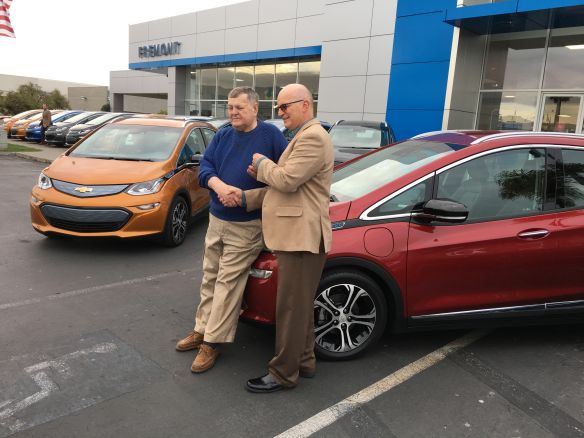
“They had a whole lot of Bolts there, but most were going to other dealers for demo cars,” said Bill. “I originally ordered a silver one, but since I was getting to be first in line, I chose the red one, which included the fast charge port.”

The dignitaries presented Bill with his car, showed him how the features worked, and he was on his way. (Photo courtesy of Fremont Chevrolet. Bill Mattos, left, with Ron Meier, Chevrolet Western Regional Manager.)

bill-mattos-1

Bill really likes the car so far.

“It feels bigger inside than it looks on the outside, and it’s easy to get in and out of,” he says. “And the acceleration is great, although all EVs have that.”

Bill likes the ergonomics of the new Bolt, and how, with its 238-mile range, he doesn’t have to plug it in every night.

He’s had a few challenges using the new displays, but Bill knows it’s just an initial adjustment—and part of being an EV pioneer.

If you’re in the Fremont area and have a hankering for a new Bolt, contact Kurt Mietz, Fleet and Commercial Specialist, at Fremont Chevrolet. Call 650-766-7777 or email to: kurtm@cacargroup.com.

Chevy Bolt Anticipation

img_6908It’s two days before Christmas (and one before the first night of Chanukah). Anticipation is in the air. But I’ve been in a state of anticipation since October 11, when I ordered my Chevrolet Bolt.

As an auto writer, I’m always driving someone else’s car for an article, but I decided that this car is the one I want for me. I think it will be ideal for my needs–even if I’m only spending part of my time driving it.

What I’m trying to learn now is patience. It’s one thing to walk into a dealership, stroll around the lot, find a car you like, and then sit down and negotiate to drive it home. It’s another thing to order a car you’ve never actually seen or even driven and wait. You hope it’ll be as good as you’ve heard.

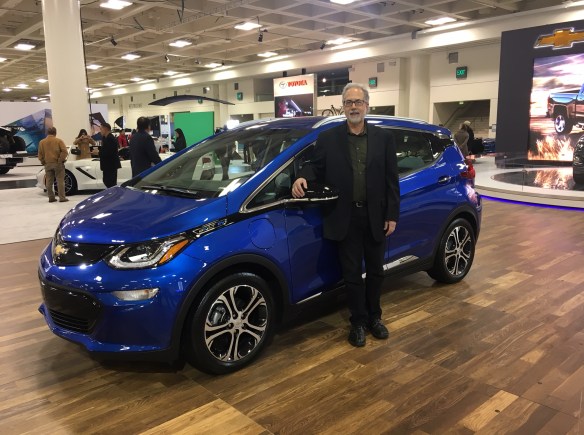
I did manage to get down to the San Francisco Auto Show in November and see a Bolt (see photo above). It was, amazingly, the same color I ordered, and I walked around it, talked with people about it, sat in it, got out, sat in it again, and hovered around it for a while.

I also visited a dealership and drove one. I was pleased that the experience behind the wheel (and in the back seat) was as good as I’d hoped. Having the car win awards right out of the chute was encouraging, too, making me feel like I was making the right choice.

The ordering process itself was simple. I went into the dealership and specified what I wanted–color, features, etc. Then, I waited to hear that the order was submitted. Then, I waited to be informed that the factory had received it. After that, it took a while to find out that the factory was preparing to build the car. Then, I learned that it was built but awaiting transport.

Today, I found out that my Bolt is on its way to California on a train. When it arrives here, it’ll go to a distribution center to be checked out before being trucked over the dealership. When it’ll arrive at Boardwalk Chevrolet in Redwood City is uncertain, but my great salesman emailed me today he may be able to track the progress of the train. That should be interesting.

I wish they could show you your car being built at the factory. I wish they put a little camera with a homing device on it, so you could follow its progress. We’re used to tracking our Amazon purchases from the moment it’s shipped to the minute it lands on your doorstep, so what do you say, Chevy?

Am I being obsessive? I still have a schedule of test cars into the middle of January, and am not giving up my column. But this is only the third time I’ve ordered a car–the second one for my own use–and it’s taking longer than I thought.

It’s definitely a team sport. The Chevy Bolt EV Owners Group on Facebook is approaching 1,000 members. I expect not every single person in that group will sign a purchase agreement or lease, but there’s a real groundswell of interest. As a journalist, I’m hoping to put a real public face on this car, and I plan to take it as far as it’ll go.

A few days ago, I ordered my home charger from ChargePoint. I’ll get it installed and ready for when I need it. I’m hoping to open up some space in my garage during the holiday break, but I’m getting a long enough cord that it’ll reach outside too, if necessary.

Meanwhile, on Sunday, my family will open gifts, and we’ll have a great time together. But my real gift is still on its way. The exquisite pain of waiting makes it all the more exciting.

Lucid Air – Enlightened Personal Transportation

lucid_air_2-25percentAs electric cars go, the Tesla, particularly the groundbreaking Model S, is the pinnacle of style and performance. But in its rear-view mirror, here comes some serious competition—the Lucid Air.
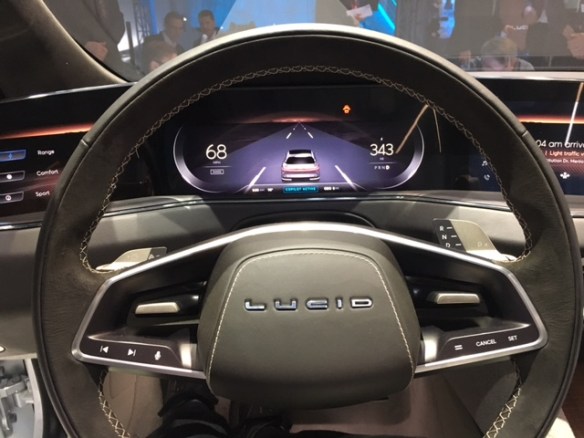
If you’ve never heard of Lucid, that’s not a surprise. Even those of us in the car writing business have heard little. The company renamed itself recently, and they’ve been working quietly to produce not just a concept and a plan, but a real car. I saw it yesterday, and rode in a test version, and it’s the real deal.

Per Zak Edson, Lucid’s Director of Marketing, the car world is stagnant today, with a wide variety of choices that don’t provide a complete experience. The Lucid, however, is designed from the start to combine the feel of a luxury car, the performance of a sports car, and the urban maneuverability of a midsize sedan—all in one vehicle.

The Air, Lucid’s sole car at this point, is meant to relate to you, and be a seamless, personal experience. It’s a new kind of car, a segment-breaker, that is Mercedes E-Class sized on the outside for easy maneuverability, S-Class sized inside, and low and sleek like a sports car. It’s a no-compromise proposition, designed to give you back your energy, space, and time.

Inside, rather than presenting you with a large screen like in a Tesla, the Air gives you an update on the familiar instrument panel, but with more. It’s configurable, and it will know what to show you when you need it. So, for example, the left panel gives you controls for starting up, and once underway, displays your ongoing options.

wheel

The best way to communicate with the Air will be with your voice, just as you would with Siri. And as the car learns your routine, it can give you the best routing to your destination, remind you about stops you should make, and basically, act like the computers in Star Trek. The goal is to keep your phone in your pocket and your eyes on the road. The maximum capability with the minimum effort is the aim here—connected, natural, and adaptive.

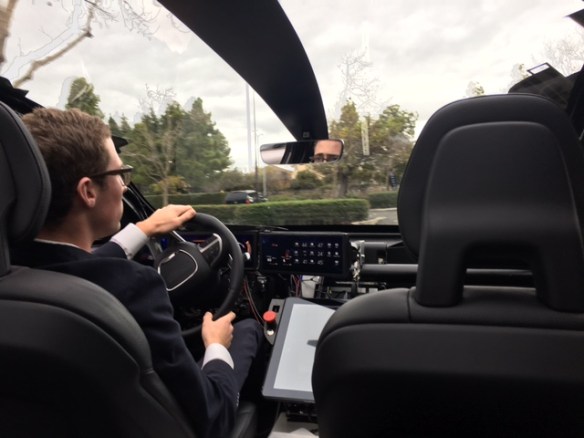
The Air will debut ready for autonomous driving, but you’ll have a manual mode and a co-pilot intermediate step, where the handsome center portion of the instrument panel will show you what’s happening so you can intervene if it’s necessary. I rode in a test vehicle on a closed track and saw how the car knows where it’s going, turns on its turn signal by itself, and shows you what’s going on.

The view in the instrument panel screen changes depending on whether you’re driving or it’s doing the work. As a driver, you’ll see supplementary information, like a bird’s eye view, but while it’s driving, you’ll see what the car sees.

You can change the look and feel of the screens too. And, there is a flat iPad style panel that angles out down low for detailed views and entering information, as needed. Push a button to retract it. Sweet.

The clean, subtle style of the interior is exemplified in the way the 29 speakers in the high-end audio system are incorporated in, subtly hidden in the panels, without garish or clashing grilles. And there’s active noise cancelling, so in this nearly silent EV, you’ll hear everything the music can provide.

The car looks like a futuristic version of a full-size sedan. Derek Jenkins, the designer, used his talents before at Mazda, a small Japanese company known for its clean, expressive designs. In the Air, Jenkins has produced a vehicle with subtle surface transitions and some surprises.

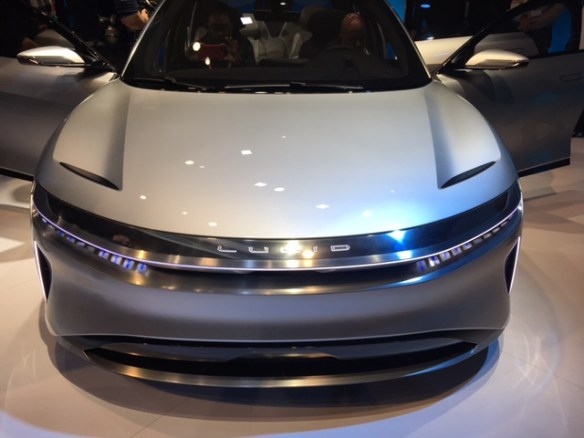
The nose, for example, uses ten little headlamps on each side. Each tiny rectangle contains 4,820 individual lenses, like an insect’s eye, and each uses a gimbal to move with the car as it turns. They were going for a look different from the “two eyes” we’re accustomed to.

img_7236

Below the lighting strips, behind a cover, are the radar, lidar, and cameras needed to permit autonomous driving. And the shape creates a vortex of air to cool the motor components.

Lucid believes that California provides the perfect blend of technical innovation and the spirit and emotion of life there. So, the designers, led by Sue Magnusson, have chosen California-based interior themes, including Lake Tahoe (warm oranges) and Santa Monica (bright, sunny whites), Mojave at night (dark shades) and Santa Cruz.

I got to experience the four themes not only by touching material samples and conversing with friendly Lucid folks, but by sitting in a solitary seat and wearing Virtual Reality goggles. These themes will be knockouts in real life—I got to see Santa Cruz in the debut sample car. The nearly all-glass roof above each theme is astounding, too.

roof

Part of the vision for the Air is of air travel in an executive jet, blended with clean interior design, like a spacious, relaxing room. In opposition to today’s complex, busy lines, the exterior and interior of the car are elegant and refined. And the rear seat is configurable as a limo-like bench or as a pair of reclining chairs. The chairs lean way back, and from there you can look right up through the nearly all-glass roof. And with the ultra-spacious interior, the dash panel looks a half mile away.

view-from-back

How did they get S-Class accommodations inside an E-Class body? Super-efficient packaging.

In a fascinating discussion with David Mosely, Director, Powertrain, I learned about the extremely compact motors, one at each end of the car, that are small enough to fit under your arm (although I imagine they’re quite heavy). Positioning them carefully, along with a new compact type of differential and cooling system, allows for front and rear trunks.

img_7226

Damian Harty, the Director of Chassis Engineering, gave me a tour through the suspension’s various aluminum pieces, each of which fits carefully around the structural components near it. It’s ingenious, and beautiful, too.

How about performance? The two small motors, plus a carefully configured battery that fits beneath the car, deliver a hearty 600 horsepower, good for a 2.5-second zero-to-60 time. The standard 100 kWh battery should provide 300 miles of range while the optional 130 kWh battery is expected to deliver 400 miles. The battery is not a monolith but a carefully shaped essential element of the car. It’s shaped to allow extra legroom for the very comfortable rear-seat passengers.

Safety? I viewed a rugged looking body structure that uses top grade aluminum and is designed to deform perfectly in a crash. The advanced safety systems should ensure that that happens very rarely, though.

Lucid plans to produce its cars in a new, state-of-the-art factory in Casa Grande, Arizona, set to break ground in the middle of 2017. It’ll be a sprawling facility someday, but the plan is to roll it out in three phases. Then, as more capacity is needed, they’ll just expand to fill the space. That saves a lot of startup cost while leaving room to grow along with future volume. By 2022, it should employ 2,000 workers.

Peter Rawlinson, Lucid’s chief technical officer, designed the Tesla Model S and has worked with Lotus and Jaguar. Rawlinson told me the goal with the Air is to create one exquisite and high-priced model, at around $100,000. However, as costs go down and volume goes up, Lucid will be able to offer versions at closer to $65,000. That’s what Henry Ford with the Model T prices, although the two cars couldn’t be more dissimilar.

The employees I spoke with at Lucid all told me about the close collaboration they enjoyed with each other while developing the Air. Designers and engineers were collocated, for example, so styling and technical design could communicate throughout the process. The Lucid Air itself then, with it’s perfectly coordinated components, reflects the team of 300 people who created it.

My Chevrolet Bolt – Pending Production

IMG_6896.JPG

As wait for my Chevrolet Bolt to arrive, I’ve joined two Facebook Chevrolet Bolt groups and other forums. I’m learning more about how cars are built.

I’ve ordered two cars before. The first was my Saturn, back in 1990, and I heard nothing until it was there to pick up. I think I may have simply received a car that matched my request, rather than having it custom assembled for me at the factory. Another time, I ordered a car for my wife. They said it would be two months and it ended up being six weeks. But I never had any idea of the flow.

So, in this day of instant information, I was expecting to hear from my salesman that my car was getting loaded on the truck and was on its way. But so far, no news.

Then, I read on a forum about the Chevrolet Live Chat line, and tried that. Presto! In a few seconds I found out that my car, with its six-digit alphanumeric ID number, was in the Broadcast status–meaning they have set up the computer at the plant to build it. The Targeted Production Week (TPW) is next week–12/12/16. I signed up to get weekly updates, too.

I’m a little disappointed, because that means the car could arrive in January, but there’s really nothing I can do about it. I didn’t put the absolute first order in (my salesman said he had a bunch of them already), so I’ll just wait. There’s not really any rush, is there?

There’s a lot of talk about the Bolt, with it winning awards and all. I’ve even see the electric billboard on my commute showing it as the Motor Trend Car of the Year winner! But I’m personally feeling anxious for it to get here. I sure don’t want them to rush it, though. And what if they build it tomorrow? Isn’t “made on a Monday” bad luck? (just kidding).

More as it happens.

img_6910

Chevrolet Bolt Wins Another Award

img_6902

While anxiously reading every possible piece of news about the Chevrolet Bolt as I await mine, I learned that another award happened–Time magazine named the Bolt one of the 25  Best Inventions of 2016!

It does seem to be in between the too-expensive but long-range Tesla and the limited-range other guys in the Bolt’s price range.

Thanks, Time magazine.

I’ve been reading posts on Facebook from my Chevrolet Bolt EV Owners Group, and folks have a variety of things on their minds–some of which hadn’t crossed mine. I don’t really care how the heater works, for example, although it’s a question for EVs, which don’t have the radiator fluid to use as a source of heat. Some are waxing positive on the styling–others less so. The seats fit some but not all. People in states other than California and Oregon are grousing about having to wait for their dealers to have any in stock.

I’m expecting my car before January 1st, and every day I wait to hear if it’s built yet. But soon, this space will be where you can get the skinny on what it’s like to live with one of these groundbreaking cars.


Chevrolet Bolt in the Flesh!

img_6934

Finally, I’ve seen and touched a real Chevrolet Bolt! I got my chance at the San Francisco Auto Show, where they had a single car. And–it was the same Kinetic Blue that I’ve ordered mine in! And, as a Premier level model, it was essentially identical to my long anticipated new ride.

I approached it from the front, and it looked, well, like it was supposed to look. It’s not large, but it’s not small either, and stands tall–nearly as high as a crossover, but not as chunky. The smiling face had the fill panel with energetic lines on it and a big gold Chevy logo and gleamed in the show lights.

img_6909

The paint looked lustrous and I ran my hands over the car, “petting” it, to get a true feel of the body. The chrome trim is not skimpy, and the roof rails are a gleaming silver.

img_6927

The taillamps are bold, with a sharp edge along their tops and the “electronic” theme pattern in them. The new logo is different from the Volt’s.

img_6914

I popped the hood, which proved to be very lightweight, and used a prop rod. The flat, silvery motor is tucked in there, minus the usual radiator, water pump, and other internal-combustion-engine accouterments. There is still a container up front, but it looks like folks are being warned NOT to put radiator fluid in there.

img_6901

I stepped inside. It looked like the photos, but I also got the sense of height and the gray/white contrasts. I think this is the lighter interior scheme–the one I ordered–with partial white on the seats and a white lower half of the dash. The doors are dark, with just a little white extending into the top.

img_6904

Plastics are good GM grade, but not Audi level luxury. We all understand that the premium pricing of the Bolt, for its size, is for the 900-pound battery, but the fittings seemed well done and similar to the all-new 2016 Volt, its plug-in hybrid sibling.

The instrument panel was totally blank, as today’s screens are, so I couldn’t evaluate it, or see anything on the center display either. The thick, leather-wrapped wheel feels good in your hands, and has the requisite redundant buttons for audio, info, phone, cruise control, and even a heated steering wheel. The rearview mirror is thick, as it also functions as a backup camera (when the car’s on).

img_6917

The seats are narrow but nice and firm–perfect for 167-pound me. A large person might not take to them as well. The back bench sits higher than the front buckets, for good visibility but also leaving plenty of battery space below.

img_6912

I tried sitting behind the driver’s seat that was set for me and had a couple of inches of legroom, so a Bolt should accommodate full sized folks back there.

IMG_6926.JPG

The rear hatch wasn’t operational (they turn off all EV functions for these cars at shows, apparently), but we were able to drop the rear seats and see the space in back, including the sturdy “false floor” that provides a smooth surface and also hidden storage.

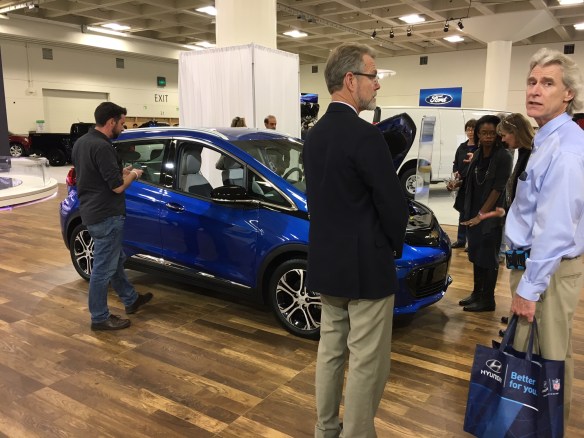
The car was just sitting there, without signage or hoopla, but two nice young women were there to answer questions, and we had a pleasant conversation. One of them took a few really nice photos of me with my beloved car. I also spoke with numerous other show goers who were interested, and that provided a sense of camaraderie. I expect I’ll be having more of these when I get mine, and I welcome that as a chance to sound the rallying cry of Go Green!

img_6936

I should have some help in that, since the Bolt, this week, won three important awards. First, it’s the 2017 Motor Trend Car of the Year. It’s also named to the Car and Driver 10Best list, and is the Green Car of the Year, from Green Car Journal, announced at the Los Angeles Auto Show. An auspicious start.

img_6907

Now, I’ll await word from Don Mays, my salesman at Boardwalk Chevrolet in Redwood City, California, that my car is built and on its way. He told me that delivery is expected before Christmas, so that’s about a month away. I’m eager to put it on the road to see what it can do.

img_6930


Kia Niro Hybrid Crossover Spotted at the Mall

kia-niro

I was walking through the mall tonight with my wife, just after purchasing new sheets at Pottery Barn and look what I saw. It’s the new Kia Niro!

I’ve heard about this hybrid crossover for a while now, and expected to see one on the road or at a dealership soon. This one is here to show off.

Kia is smart to introduce a compact crossover, sized between the boxy Soul and the venerable Sportage, that has similar fuel economy to a Toyota Prius. The new Prius, the poster child for hybrids and the highest performing one, fuel economy wise, is an acquired taste visually. What folks seem to want now are crossovers, and the new smaller ones are hot hot hot. So Kia is in the catbird’s seat here.

I sat down in the car, and although I couldn’t get the seat to adjust (the battery, apparently was drained), I could tell that Kia is using the same clear, no-nonsense styling inside, with premium materials, to convey high competence, value for the money, and in the case of a crossover, that ride high feeling.

The Niro has a dual clutch six-speed automatic–not a CVT–so you can feel the gears shift normally and even move them manually. Of course, I didn’t sample that in the mall, but the Niro should at least emit a more sonorous sound than the moan of a CVT.

The 1.6-liter four-cylinder engine, mated to a 43 hp electric motor, contributes to the overall 146 horsepower. That motor will likely be as smooth and silent as motors are. My understanding is that there will be a hybrid and a plug-in hybrid version.

The young woman managing the display gave me a free Niro bag to carry things in, and took my information for future updates. Of course, I expect to hear from the automotive PR folks at some point soon, but this’ll tell me what interested car shoppers will get.

The thank-you email told me I could download the Niro app and configure a car on my iPad, so I did that. It took a while to download. It shows a musical video of the Niro zooming through a city – with no driver… Is this a look at their future autonomous vehicle?  Then–out to the country! A quick roll through a charging station (not stopping) and onward. You can click a button periodically to get details on the topic they’re presenting, such as Exterior Tour and Fuel Efficiency, all shown to a high-tech beat.

I’ll be looking forward to a real test of this car soon.