David Hochschild — California and the Dawn of the Clean Energy Era


David Hochschild

On Wednesday, October 24, David Hochschild, a commissioner on the California Energy Commission, delivered some hopeful news about the progress California is making to reduce climate pollution. His talk, sponsored by Acterra, took place at the Foster Art and Wilderness Foundation in Palo Alto and was titled, “Sunrise from the West—California and the Dawn of the Clean Energy Era.”

Hochschild was appointed by Governor Jerry Brown to the California Energy Commission in February 2013 in the environmental position. A longtime solar energy advocate, he worked with San Francisco Mayor Willie Brown to put solar panels on public buildings, and cofounded the Vote Solar Initiative, an organization advocating for local, state, and federal solar policies. He served as executive director of a national consortium of leading solar manufacturers and worked for five years at Solaria, a solar company in Silicon Valley.

Hochschild’s goal now is to “bring light in dark times,” when the national government is going in the opposite direction from what we need for clean energy development. He believes that California can show the rest of the country—and the world—how it’s done.

First, he showed how predictions of the growth of solar and wind were way too low. While the line on the graph for the prediction of solar implementation barely moves up, the actual installed solar generating capacity jets up at a steep angle.

On a different graph, going down in exactly the opposite direction, is the line representing the value of the top four coal companies. They have lost 99 percent of their value in recent years.

“It’s the beginning of the end of an era,” said Hochschild.

Hochschild disparaged the long history of subsidies to the oil industry—which are still going strong with no end date. Meanwhile, the much smaller subsidies for solar have short time spans.

“This causes a tilted playing field,” said Hochschild. “We’re wasting money propping up the oil industry.”

California’s economy has grown, as has its population, but the state’s emissions have gone down, except in one area—transportation. But with the passage of SB 100 with Governor Brown’s signature in September, the state is on track to reach 100 percent clean energy by 2045.

Hochschild explained that the 100 percent number represents “clean” energy, which is still being defined, but would not include nuclear. To get there, we will need to have diversity in the portfolio, including wind, solar, hydroelectric, geothermal, and others.

“For years, skeptics have said that moving to clean sources of energy would ruin the economy, drive up unemployment, and raise energy rates, but it hasn’t,” he said.

California actually leads the rest of the U.S. in renewables installed but has had 46 percent economic growth while over the same period the U.S. has seen 35 percent.

“Because we set energy standards, we use half the energy that the U.S. uses,” said Hochschild. “These old arguments are just wrong.”

Hochschild said that as a large market, California can affect manufacturers’ decisions on what to build. For example, our standards on the energy efficiency of TV sets saves consumers $1 billion a year, but the effect is magnified because companies choose to incorporate those standards into their products for everyone.
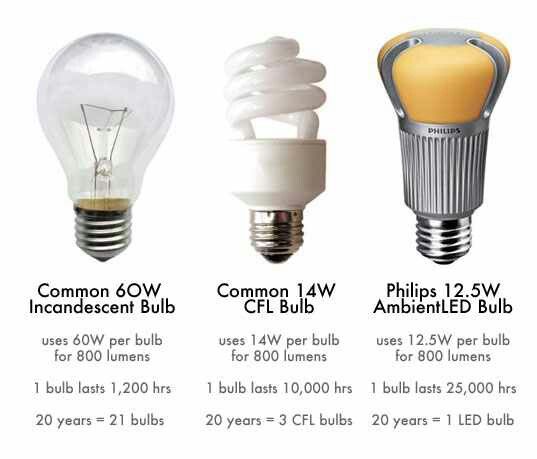
Three light bulbs

One easy way to save energy is to switch to LED light bulbs from traditional incandescents, which are being phased out. Starting on January 1, 2018, stores in California were permitted to sell the incandescent bulbs they had in stock but couldn’t order more. As it is, customers are embracing LED bulbs, which cost a little more (prices have been dropping) but last 20 to 25 years and use 80 percent less energy than incandescent bulbs.

Newer LED bulbs are available in a soft white and other shades, so they feel more familiar, emitting a warm glow. The compact fluorescent bulbs, which tended to have a harsh light quality, have faded away now that LEDs have taken over.
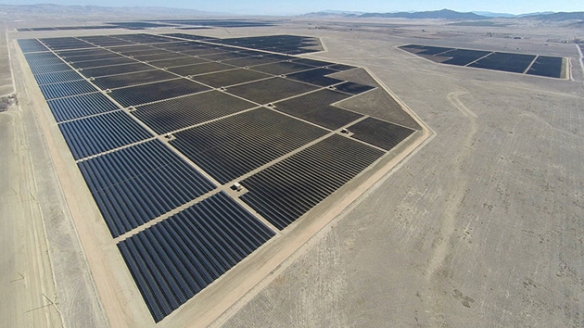
Topaz Solar Farm

Topaz Solar Farm in California

Hochschild displayed images of large solar farms in the California desert that are producing vast amounts of electricity. The technology is improving so fast, he said, that they were able to incorporate improvements into the panels and the installation process mid-project.

The major computer and software companies, such as Google and Facebook, are all signing on for 100 percent renewable energy. Hochschild showed an aerial view of Apple’s massive donut-shaped campus, covered with 17 MW of solar panels.

The list goes on. California has the world’s second-largest lithium-ion battery plant (behind Tesla’s giant Gigafactory in Nevada). California leads the nation in energy from biomass, too.

Block Island

Block Island Offshore Wind Farm in Rhode Island

Offshore wind farms are developing—we saw the Block Island offshore wind farm in Rhode Island – the first one in the U.S. Offshore farms are easier to construct in the East, Hochschild explained, because the Atlantic shoreline is shallow, while the Pacific’s drops off. However, there is a new way of creating offshore wind energy in the Pacific Ocean by installing floating platforms for the windmills, tethered down to the sea floor. There are some significant benefits.

“Offshore wind installations out at sea are not only invisible from land, but more important–the wind blows more of the time out there—60 percent versus 35 percent on land,” said Hochschild. “And because it blows at different times of the day from the times when the sun is shining, it can offset times when solar panels aren’t generating electricity,” he added.

Offshore windmills are more expensive to install, but with greater capacity, they catch up by generating more energy.

Regarding employment, there are 86,400 solar workers in California. That’s more than the workers in every other energy industry. And, it’s growing, as solar installations are increasing, reaching about a million in California.

Hochschild believes that the best plan for clean energy would be to electrify all services and run them off a clean grid as we reduce use of natural gas. He talked about how much natural gas is used in homes today for furnaces, stoves, water heaters, and some dryers. But some new homes are being built without gas lines at all.

“It saves $3,000 right away by not having to run the gas pipes,” he said.

The good news continued. One hundred percent renewable energy will power the state’s high-speed rail system, when it’s built. California institutions have taken $6 trillion out of investments in fossil fuels.

Hochschild compared the fossil fuel industry methods now to the tobacco industry in the 1950’s. Service personnel during World War II were given cigarettes as part of their rations, building lifelong habits. Advertisements showed celebrities like Marilyn Monroe smoking, and even a doctor. Hosts smoked on TV. About half of the population were cigarette customers then.

“The industry was selling cigarettes and also doubt about the health risks,” he said, comparing it to the way fossil fuels are denying climate change today. “But with rigorous campaigns and limitations, such as placing warnings on the packs, removing cigarette ads from TV, raising the age to buy cigarettes, and increasing taxes, smoking is at about 15 percent now, and is heading down. We need to do the same thing with the fossil fuels industry.”

Electric vehicles are part of California’s plan to reduce CO2, and the state adopted the Zero Emission Vehicle Action Program in 2013. In January, Governor Brown signed Executive Order B-48-18, which sets goals of building 200 hydrogen fueling stations and 250,000 electric vehicle charging stations for 1.5 million EVs by 2025. The goal is 5 million EVs a year by 2030, which means that 40 percent of new vehicles would have to be EVs by then.

Per the ZEV Action Program’s website, in 2017, 5 percent of vehicles sold in California were EVs. There are now about 474,000 EVs in California, so there’s a long way to go to meet the goals, but sales are increasing, and Hochschild thinks it will accelerate.

“100 percent clean energy is solvable—but it’s not a silver bullet—it’s silver buckshot,” Hochschild said. “It is a combined effort of developing clean energy sources, increasing battery storage, lowering demand, and creating a regional grid,” he added. He also said that it’s likely that the first 80 percent of the way will be easier, while the last 20 percent could be more challenging.

So, although things look dire, California is leading the way, and will be doing a lot more in the future.

Acterra is a San Francisco Bay Area 501(c)(3) nonprofit based in Palo Alto that brings people together to create local solutions for a healthy planet.
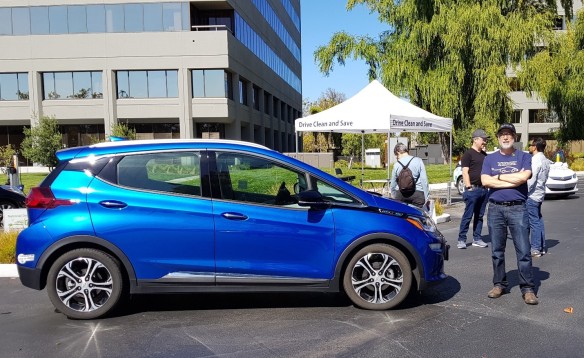
National Drive Electric Week 2018

2018-NDEW-group-4000

Since 2011, a national electric car event has been held every year. Originally called National Plug In Day, it later expanded to become National Drive Electric Week. It’s actually nine days long, as it includes weekends on both ends.

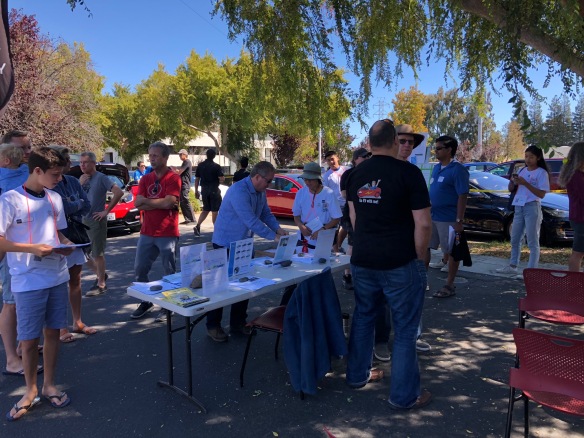
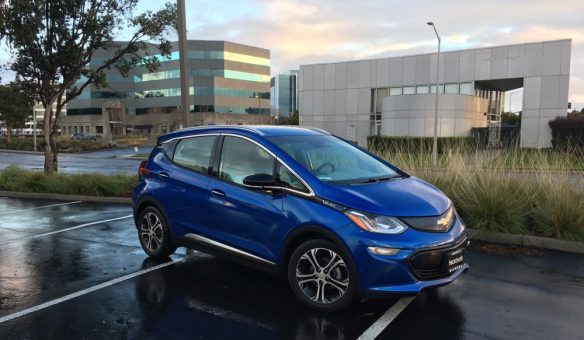
This year, I participated in two events. First, I hosted one at work for fellow employees, and later, I attended another, larger event, where I let people drive my 2017 Chevrolet Bolt EV to experience electric motoring firsthand.

Marketo Event, San Mateo, CA

Marketo hosted its second annual National Drive Electric Week event on Thursday, September 13th. The weather cooperated, and the event went off without a hitch, although attendance was lower than anticipated. It’s understandable, though—people are working!

NDEW Marketo Bolt

Me with my Chevrolet Bolt EV–now an NDEW show veteran.

Display cars included three Tesla Model 3s, a Tesla Model X, my freshly washed Chevrolet Bolt EV, a Nissan LEAF, a Volkswagen e-Golf, a BMW i3, and a Chevrolet Volt. One of the Model 3s was available for rides.

Allyson Gaarder from the Clean Vehicle Rebate Project showed attendees how they could receive California rebates for buying a variety of electric cars.

Vehicle owners gave attendees a tour of their cars and enjoyed talking with each other about the pleasures of electric motoring.

Nissan supplied some swag, including water bottles, mini backbacks, pens, and tiny fans that attach to your phone. Attendees received a red token good for a $5 discount at the adjacent food trucks.

Acterra Event, Palo Alto, CA

On the last Sunday of Summer, Acterra, the Palo Alto environmental nonprofit, hosted its third annual National Drive Electric Week event. Acterra’s mission is to bring people together to create local solutions for a healthy planet, and they always put on a great show.

IMG_3033

Nissan brought a fleet of LEAFs for show and driving.

EV enthusiasts shared their favorite electric rides with eager attendees. Booths provided information about rebates, vehicle charging, and a solar energy vendor presented solar options. Allyson was there with her booth and California rebate information. Event sponsor Nissan brought a small fleet of new LEAFs for show and drives.

I watched the parking lot fill with Chevrolet Bolt EVs, BMW i3s, Nissan LEAFs, Tesla Model 3s, and even a low, sleek Fisker Karma. One guy brought his now rare Honda Fit Electric, and there was at least one tiny Chevy Spark EV and a cute little Fiat 500e.

This was a popular event. Altogether there were 70 vehicles, representing 15 makes and models. More than 260 people registered and vehicle owners and fleets conducted more than 520 rides or drives!

The beauty of these events, which Acterra hosts year-round, is the chance to learn about and sample multiple EVs in the same location, away from aggressive salespeople. With EVs, the owners are often more knowledgeable about the cars than a typical dealership employee, and they can certainly talk about day-to-day life with a plug-in vehicle.

This event is both a car show and a ride-and-drive. Although it’s a little annoying to have to to readjust my seat and mirror settings when the day’s over, and having strangers drive your car can be a little nerve wracking, I like to let attendees get a personal feel for what driving an electric car is like.

IMG_3040

Luckily, all the people who took the wheel of my car were competent, responsible motorists, so I didn’t have any worry the entire afternoon. With high demand, I was busy non-stop.

In most cases, I took the people for a ride around the short test loop, and then had them drive it. I felt it would make them more comfortable, and it let me explain the features first. Luckily, the Bolt itself is pretty straightforward and controls are where you expect them.

People were surprised at the Bolt’s spacious interior, especially the generous headroom. One 6-4 gentleman pulled the seat all the way back and then forward a little! My drivers were also impressed with the video camera rear-view mirror, which gives a wider, clearer view than a regular mirror.

When driving, my guests were fascinated by the low or high brake regeneration. If the transmission lever is in “D,” when you lift your foot off the accelerator, you keep rolling along, like with a normal automatic. In “L” mode, as you lift up your foot, the electricity flow is reduced, slowing the car. This lets you do “one-pedal driving.” It’s a wonderful way to maintain extra control of your car while generating extra battery power and saving your brake pads.

At 4 p.m., we assembled inside the Acterra offices for the official launch of the newly renamed Karl Knapp Go EV program. Knapp, a beloved Stanford science professor of Civil and Environmental Engineering, promoted electrified cars and motorcycles for many years, and has been an inspiration to many. We had some food and drinks and watched a short video about Karl. Sadly, Professor Knapp is ill and was unable to attend.

After the reception, I gave three more people rides, so I was one of the last to leave. It’s fun to share your EV, and I hope all of my drivers will go out and get their own! Electric cars are the future, and soon there will be many more choices.

National Drive Electric Week is presented by Plug In America, the Sierra Club, and the Electric Auto Association. Sponsors include the Nissan LEAF (Platinum), Clipper Creek (Silver), and eMotorWerks (California Regional).

The Last Gasoline Car

Someday, somewhere, the last car powered by gasoline will roll off the assembly line. It should be taken directly to a museum to mark the end of the an era.

1912-ford-model-t-2-lg1-300x191

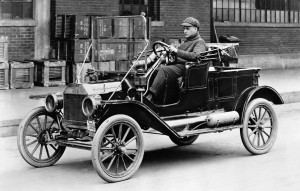
Ford Model T

Cars have been part of our lives for more than a century, and most of them have been powered by gasoline. Now that we know that their emissions are a major source of the carbon dioxide (CO2) pollution that causes global warming, we must switch to electricity–or other options, such as hydrogen fuel cells, bicycles, car sharing, or even not driving at all.

Although the U.S. is not setting a timetable to cease producing gasoline cars, after the Paris Agreement, some other countries stepped up, particularly in Europe. In 2016, Germany said they’d ban new gas cars after 2030. In 2017, Norway, already a major EV-adopting country, said 2025 for them. India says it’s going for 2030, too. France and the UK are talking about 2040. China has a big incentive to clean up their smog, and is moving quickly to EVs, but has not stated a year yet. Naturally, there are some caveats, as items like heavy-duty trucks and buses will not hit 100% as early as passenger cars.

In the U.S., it’s going to take something else. People will have to want electric cars. We will need to provide long-range batteries, convenient charging, plenty of model options, and most of all, a friendly price. From what I hear and read, the day the electric car becomes a better deal than a gas car is coming soon, as battery prices drop and production volume makes manufacturing cheaper per unit.

Of course, we need to have political support for these kinds of limits, but that is neither the policy of the current administration nor the general sentiment of Americans who value freedom of choice. I believe that when electric cars are more appealing and cost no more, a massive shift in the market will take place.

I am doing everything I can to encourage people to check out EVs and see the benefits. I’ll be hosting an event at my office on September 13th and participating in another one on September 16th as part of National Drive Electric Week. These low-pressure parking-lot meetings let people check out the cars with no salesmen and learn more about the smooth, quiet, quick-accelerating EVs from the owners themselves. I enjoy sharing my Kinetic Blue 2017 Chevrolet Bolt EV, and people are often amazed at what they see and experience.

DSC_5085

My Chevrolet Bolt EV at the 2017 National Drive Electric event in San Mateo, CA

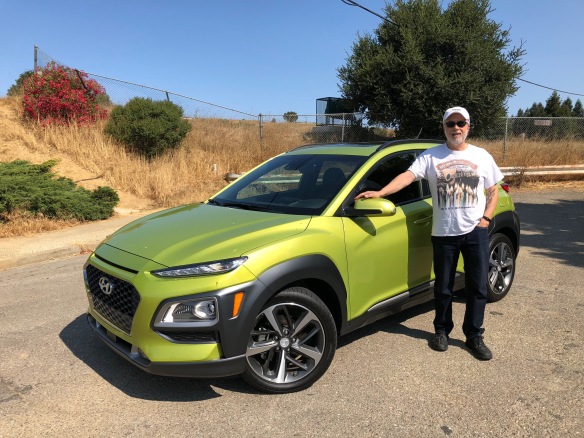
For me, the last gas car just happened. After 26 and a half years of automotive writing, I have finally said “The End” to testing cars that run only on gasoline. The final car is the new Hyundai Kona small crossover. An electric version with an amazing 258-mile range is on its way, but I wanted to sample the car now, so I drove the gasoline version for a week. The car’s shape, size, styling, and driving feel are what buyers want, so an electric one will be a great choice. It could even be my next car when my Bolt EV lease ends on January 8, 2020. And look at that Lime Twist paint!

IMG_2772

2018 Hyundai Kona

Although I would really prefer to limit myself to testing only pure battery electric vehicles (BEVs), there simply are not that many out there yet, and there are reasons to encourage some folks to opt for hybrids. So, my compromise is–if it has an electric motor, I’ll give it a test, even if there’s an engine in there, too. If it’s a plug-in hybrid, I’ll try to minimize gasoline consumption.

Hybrids and plug-in hybrids still offer significant environmental benefits over traditional cars, and may be the only viable option for some people with limited access to charging. Hydrogen fuel cell vehicles are still a bit of a science experiment, but, if you live near a hydrogen station, they can do the job.

Prius face

The latest Prius

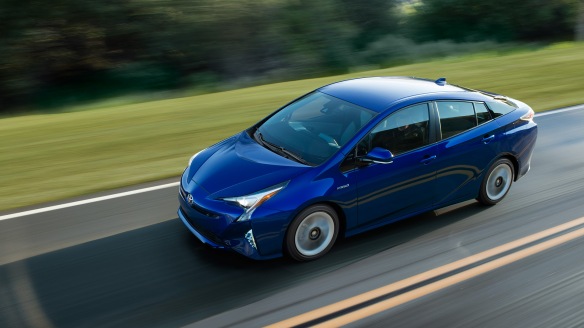
The hybrid car has had a good run, thanks particularly to Toyota, who introduced the first Prius at the end of the 20th century. They’ve sold millions of them around the world since. Hybrids can as much as double your fuel economy and half your carbon emissions by pairing a gasoline engine with an electric motor. Sometimes, they enable driving without the engine–while requiring zero effort from the driver.

A plug-in hybrid, with a chargeable battery on board, allows some pure EV miles, often in the 20-30 mile range. This means you can plug it in–even at home in your 110-volt socket in the garage–and get to work–and maybe even back–with no gas.  But with the engine and gas tank still in the car, you can hit the road and go anywhere you want anytime. Downside? When you’re driving it as an EV, there’s still a lot of extra weight with that idle engine in there.

A pure electric car is great, but you need to consider how and where you’ll charge it. Sale and lease prices are a bit higher than gas cars today, mostly because of the high price of batteries, and there aren’t that many model choices yet. But that’s changing as batteries get cheaper and more models are introduced. The lower price of electricity versus gasoline and the lack of significant maintenance both help reduce the costs of driving an EV.

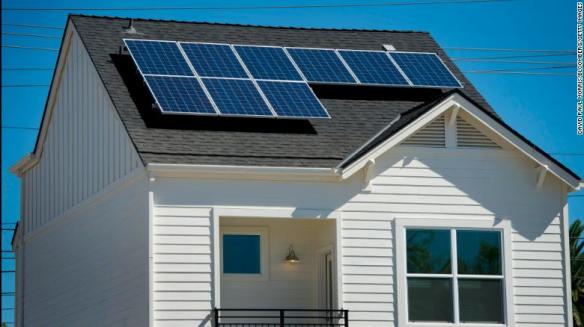
180508165948-solar-panels-roof-file-restricted-exlarge-169

Of course, hanging over this entire discussion is the issue of where the electricity is coming from. If it’s from the solar panels on your roof, that’s about as clean as it gets. Some communities have plans where you can sign up with your energy provider for sustainable energy from wind, solar, hydroelectric, and geothermal, which is a step forward.  If your power comes from coal, your EV is not going to be as clean, but it will get better over time as the electric grid moves to renewable sources.

It’s taken a century to set up our electrical grid and it’s not going to change overnight. But we need to do what we can, as fast as we can, to move to renewable energy.

For a quick explanation of the climate crisis, please read A Dose of Climate Reality

Rose Motorcars – Affordable EV Destination

IMG_2918

Driving an electric vehicle (EV) is one thing you can do to lower your carbon footprint and help fight global warming and climate change. But electric cars start at a higher price than gasoline-powered ones, so what if you’re on a tight budget?

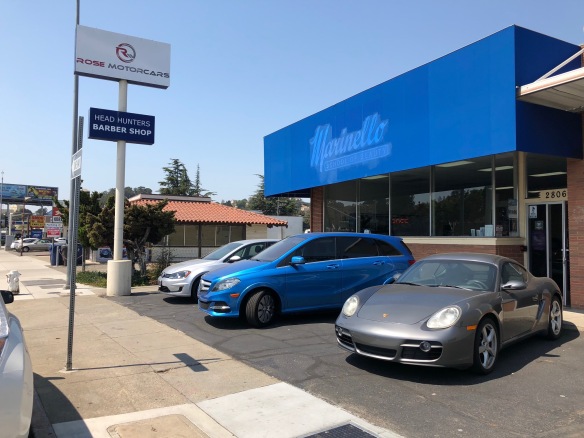
The answer is to find a used EV. And in my community of Castro Valley, California, there’s a dealer that specializes in them—Rose Motorcars. I had a chat with Derek Dorotheo, 35, who calls himself a “car matchmaker,” and is nothing like a stereotypical pushy car salesman.

Rose Motorcars was founded by Lyle Dizon and his two high-school friends, David Florence and Leo Beas. The company started eight years ago over the hill in San Ramon, and wasn’t focused on electric cars. However, they found a niche, and they now stock quantities of affordable EVs in their Castro Valley location, a former beauty school. Rose is the name of Dizon’s mother.

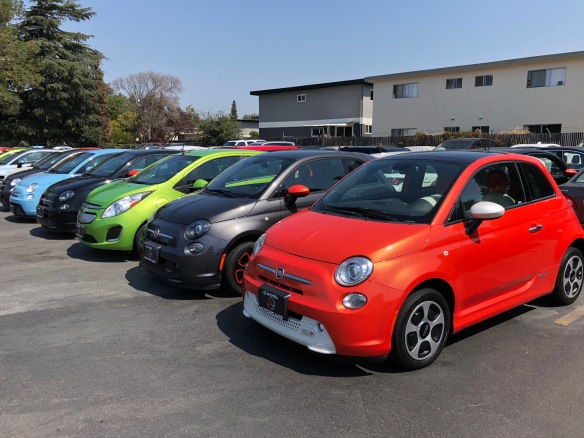
The cars I saw in their lot included a line of brightly-colored Fiat 500e’s (their most popular item) and Chevrolet Sparks, sporty Volkswagen e-Golfs, a few tiny Smart EVs, a pristine white Mitsubishi i-MiEV, a boxy Kia Soul EV, a bright blue Mercedes-Benz B-Class, and in the small showroom, a couple of shiny Teslas.

Rose acquires its cars mostly from auto auctions, but they also work with finance companies and wholesale partners on off-lease vehicles. They can buy directly at auction for a customer. They sell to individuals and also can ship a truckload of cars to a dealer elsewhere in the country who is seeking the little EVs.

Taking an online stroll through the current inventory, sorted by price, you’ll see four Teslas, followed by a 2017 Chevrolet Volt at $25,888. Then come the VW e-Golfs at $15,000, and a Nissan Leaf at $11,950.  After that, the Sparks and Fiats come in under $10,000. There are lots of choices between $7,000 and $9,000. And these are inspected, 2015 models in clean condition with 20-25,000 miles or less, with a few outliers. With the price of a new Fiat 500e starting at $32,995 before federal and state rebates and tax breaks, this is a huge difference. And since electric cars are simpler and require little maintenance, the cost of running them is lower, too.

Granted, a Fiat 500e with its 84 miles of range is not going to cut it for a family of 5 or road trips out of town, but for the daily commute, it’s ideal. I know, because I drove a 2016 Fiat 500e for three months and it was perfect.

Rose Motorcars is a no hassle, no haggle dealership, and wants you to be happy. For Castro Valley residents, they offer a 48-hour test drive, so you can see what the car is like to live with. You could grab it one day and try a run to work and back or do your weekend errands. While it’s not large, a little 500e or Spark hatchback would do fine for a run to Costco.

You can also set up a FaceTime or Skype call to look at your car and buy it from home and Rose will ship it to you. They offer financing and take trade-ins, electric or not. In fact, they had a rare Pontiac Aztek in the back lot!

So, you don’t need to spend a lot to help reduce CO2 and enjoy the pleasures of electric motoring. Just visit Rose Motorcars—in person or online. They’re located at 2806 Castro Valley Blvd. and are open from 10 a.m. to 7 p.m. Monday through Saturday and 11 a.m. to 5 p.m. Sunday. Find them at www.driverose.com.

IMG_2919

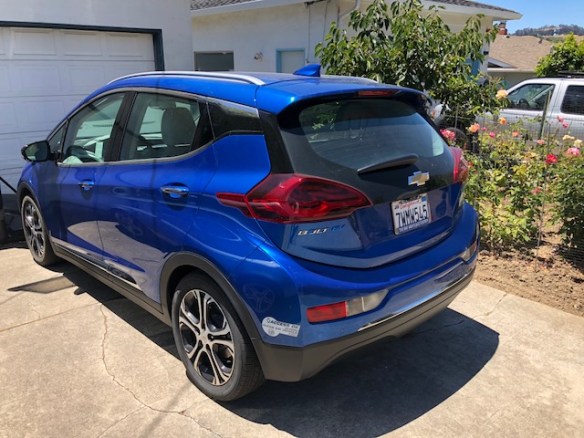
My Chevrolet Bolt EV at a Year and a Half

Bolt 7-8-18

Today marks the exact halfway point of my three-year lease on my 2017 Chevrolet Bolt EV, and the report is positive. I’ve accumulated 13,920 miles and have seen consistent range of 200-plus miles through the whole 18 months. Most of the time it’s between 220 to 230 miles, even with the heat/AC turned on. Other than a couple of minor glitches in the entertainment system, which haven’t reappeared appeared lately, the car has been trouble- and service-free. It has never gone back to the dealer, although I’m supposed to get the tires rotated.

What’s also been completely consistent is the silent, smooth trips I’ve taken, and the ability of the car to accommodate whatever I want to carry. That means an upright bass, two bass guitars, an amplifier, and multiple stands and cords for gigs with Fault Line Blues Band. I do not frequent places like the Home Depot or Costco, but if I did I’m sure I’d have no problem carting home loads of whatever I bought.

I did run into a situation a couple of weeks ago where the Bolt’s 238 miles of range was insufficient. I needed to drive 300 miles (each way) to Arcata, California to attend the Humboldt Chamber Music Workshop at Humboldt State University. For a story on my happy week there, please see this story on Medium.

In any case, I surveyed the route online and found nothing much available for charging, so I borrowed a vehicle from the press fleet and pressed on. It was the gas-powered Ford EcoSport, a small crossover that occupies the bottom slot of Ford’s six-vehicle SUV menu. It did the job fine, but so would my Bolt–if the charging infrastructure was more developed. Here’s the EcoSport story

What I recommend for anyone considering an EV is to think carefully about how often you need to take a trip of more than the range of your car. In my case it’s perhaps two, maybe three times a year. That means that I can still drive all-electrically nearly all the time and then just borrow or rent a hybrid or gas-powered vehicle for those rare times when it won’t do the job. It sure beats burning fuel all year long just so you can have one car that does everything.

If you can’t do this, then a plug-in hybrid is still a reasonable choice. Just look for the most electric range you can get. The Bolt’s sibling, the Volt, does a fine job of enabling local driving with its 53-mile EPA battery range and carries an engine that kicks on when it’s needed to change the battery. That way, you’re free to go anywhere. The downside is that you still have an engine, radiator, oil, etc. to deal with like in an ordinary internal combustion engine (ICE) car. But driven mostly within the battery range, it’s essentially an electric car.

In summing up, as I’ve stated before, the Bolt EV has filled my needs so perfectly and pleasantly that it has become “my car,” rather than an object of journalistic attention. I keep a notepad in the car but only use it to write down interesting music I hear on my SiriusXM channels and custom license plates I see that I think might amuse my wife. This is good news, because other than the range limitations mentioned above, and availability of a place to plug in at home or work, there’s no reason why you can’t live happily with an EV.

Note: You may wonder why I haven’t posted a story here since April 16th. Other than my Bolt being completely familiar (nothing new to report) I have written seven stories on other vehicles and published them in the San Leandro Times, Tri-City Voice, and Clean Fleet Report. Please visit these sites if you want to read me regularly (All the EVs, hybrids, and alternative fuel cars end up on Clean Fleet Report).

More soon.


Acterra Shows How to Go EV

IMG_1914

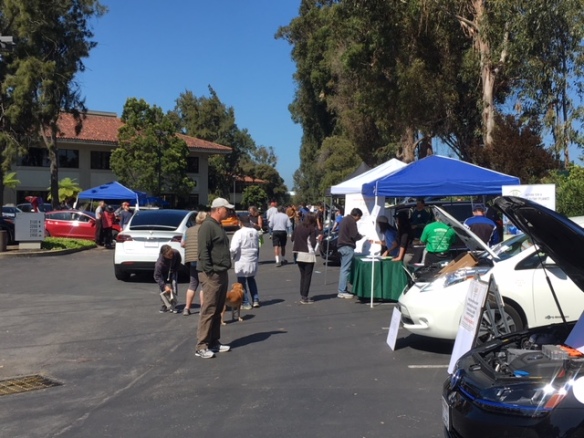
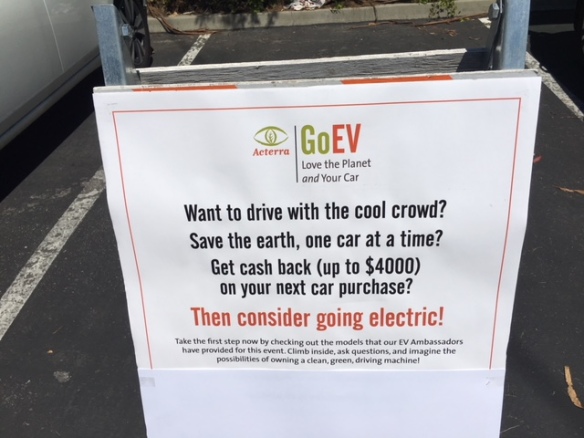
On a beautiful Spring day in Palo Alto this Saturday, April 14, EV owners offered test drives and showcased their vehicles to attendees of the 2018 Earth Day Festival in Palo Alto. The event was put on by Acterra, a Palo Alto-based group that brings people together to create local solutions for a healthy planet. As an Acterra EV Ambassador, I brought my Kinetic Blue Bolt EV, and was joined by owners of Nissan LEAFs, Volkswagen e-Golfs, BMW i3s, Fiat 500Es, Teslas, and other popular electric vehicles.

I was one of the folks who left their car parked, and had many interesting conversations, answering questions and demonstrating features of the car, while helping people understand how much fun it is to drive an EV, and how we deal with their few shortcomings.

My car (the Blue Bolt EV) was first in line of the staged vehicles, next to a VW e-Golf and Nissan LEAF–two direct competitors.

IMG_1908

We owners had fun chatting when no visitors were around. Everyone has a story. The VW e-Golf next to my car was a late ’16, so the lease deal was amazing, after a significant down payment, just $75/month!. The white ’16 LEAF behind it, owned by my friend Greg, was purchased used, at a significant cost saving over a new one. And that’s a good example of how to get into EV driving without a huge initial outlay.

Not only were cars on display, but a number of them were also available for test drives, as seen by the orange Bolt, black BMW i3, and silver 2018 Leaf driving through the area in the photo below. This gave attendees a chance to get behind the wheel and viscerally sense the smooth, quick, quiet EV benefits. There were three Bolts available, as well as the two stationary ones, so we were well represented.

IMG_1916

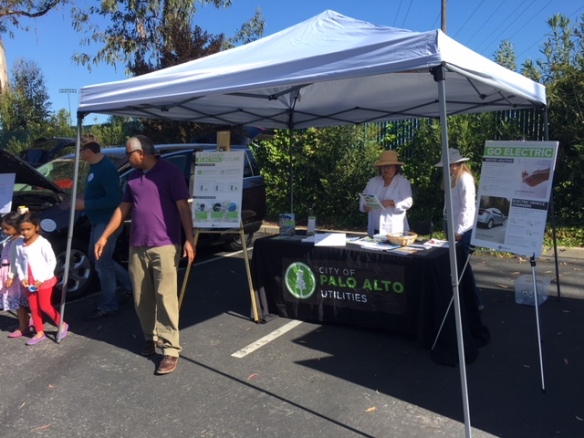
There were information booths, including Acterra, charger manufacturer ChargePoint, and the City of Palo Alto. I spoke with Hiromi Kelty, City of Palo Alto Utility Program Manager, who told me that 20% of Palo Altans drive EVs compared to 3% statewide. She also told me about the EV Charger Rebate that organizations in Palo Alto can receive when they install EV chargers – up to $30,000. For more information, go to cityofpaloalto.org/electricvehicle or call (650) 329-2241.

IMG_1913

I showed my car to dozens of people, and had some interesting conversations. I allowed one 6-foot-5 man to adjust my seat, steering wheel, and mirrors to see if he fit in the car and could see if he was driving. The good news is that he did fit! The bad news is that it took a while to get my driving position back to normal. But I was glad to do it.

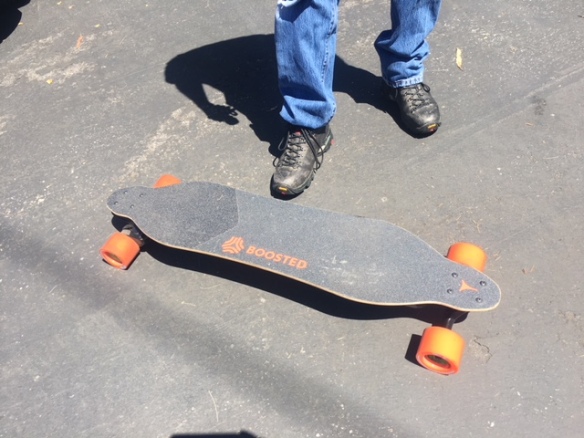
One man, who was sharing rides in his new Tesla Model 3, brought along a battery-powered skateboard. At $1,500, it an expensive toy, but could be useful for traveling between mass transit and your workplace, or for good clean fun. I declined a test ride.

IMG_1922

When the session was over, around 1:30, we put away our signs, folded our tents, and drove our EVs home. It felt like a worthwhile experience. I only hope that someone we spoke with will decide to get their own EV.

IMG_1919

One Great Year with My Bolt EV

img_7467

On a rainy Sunday, January 8, 2017, I went to my Chevrolet dealer to pick up the Kinetic Blue Chevrolet Bolt EV I’d ordered on October 11, 2016. One year later, with 9,952 miles on the clock, the car has turned out to be everything I’d hoped for.

It’s been a great commuter, and I got to drive it to see my granddaughters 85 miles away without having to stop to charge. It hauls all my musical gear with ease. It has been completely reliable. And, it’s fun to drive, too.

Read a complete rundown on my Bolt EV’s first birthday on Clean Fleet Report.


EVs, Hybrids and Green Events of 2017

cropped-img_7514.jpg

For 2017, I decided to focus my attention on hybrid and plug-in vehicles. Over the 12 months, I tested 35 cars, of which more than half – 20 – were either full EVs, plug-in hybrids PHEVs), or hybrids. About half of the cars were hybrids, and a quarter were EVs or PHEVS. This was a big change, as for the last 25 years, I’ve driven a car a week (52 a year).

My EV focus was enhanced when I began submitting content to www.cleanfleetreport.com in addition to my newspapers in 2016. I also rejuvenated this blog, which I had originally filled with impressions of the Fiat 500e that I borrowed for the first quarter of 2016.

The centerpiece of this new EV emphasis was my 2017 Chevrolet Bolt, which I leased on January 8 and have put nearly 10,000 miles on over the year, much of it during those weeks when I wasn’t driving a test vehicle.

I also ventured into covering events, including National Drive Electric Week, during which I hosted an event at my office and I attended two other ones. At the Cupertino NDEW event, I met Greg Bell, who introduced me to Acterra, an organization that promotes EV use and other environmental efforts. I attended two Acterra events where important speakers delivered valuable content, which I captured in two articles that appeared both in my blog and in Clean Fleet Report—and on Acterra’s website as well. At the end of the year, I sampled Gig Car Share, a ridesharing service that uses Ridecell software.

While reading An Inconvenient Sequel: Truth to Power, Al Gore’s second book (and movie), I saw a story about a man who changed careers in order to work in the green industry—and learned he was local. I later met with Wei-Tai Kwok over lunch and toured his company, Amber Kinetics, which manufactures energy storage devices.

I plan to continue my green vehicle and industry focus in 2018, with additional expansion into anything that contributes to a greener future—interviews, research, and more vehicle drives, of course.

Here’s an alphabetical list of the EV and hybrid vehicles I tested in 2018, with brief summaries. 

Note: These stories, except for a couple that aren’t written yet, are available on Clean Fleet Report.

Acura MDX Hybrid – A big cruiser, this car has significantly improved fuel economy, an incremental improvement over the regular gasoline model.

BMW i3  – Still odd looking (it grows on you), this car is a pure EV, but can be had with a small “range extender” gas engine. My tester had the extender, but I never used it. The ’17  upped the estimated range from 72 to 114 – a much more useful proposition.

Chevrolet Bolt EV – The Bolt is the first “affordable” pure EV with a truly usable 238-mile EPA range. I love mine, and have achieved more than 200 miles of range with no problems, other than an occasional glitch to the entertainment system (which recovered automatically). Motor Trend’s Car of the Year, among other honors.

Ford C-Max Hybrid – This European design is a comfortable and usable car, but lost some favor when its initial fuel economy numbers turned out to be overly optimistic. Its EPA numbers are 42 mpg overall, about double what the gasoline version of its sister vehicle—the Fusion—gets. The Energi model, which I didn’t test, has a plug and a larger battery for local all-electric motoring.

Ford Fusion Hybrid and Energi – This handsome sedan uses the same drivetrain as the C-Max, and offers both hybrid and Energi (plug-in) versions. I tested both. The hybrid averaged 41 mpg while the Energi got 101.4 MPGe, using nearly no gasoline at all.

Honda Clarity PHEV – This plug-in hybrid sedan is a brand-new effort from Honda. Initial impressions (I’ve had it two days) are it’s handsome on the inside, despite plastic wood trim, but a little weird on the outside. I got 43 miles of range with the initial charge, which was enough for a Saturday’s worth of errands. The Clarity also comes as a hydrogen fuel cell version (I drove it briefly at an event), and a full EV version with a disappointingly small 89-mile range. I plan to test these other two Claritys in 2018.

Hyundai Ioniq – I drove the full EV and the Hybrid versions of this all-new car. If you want a Prius or a Leaf but hate the wacky styling, this is your car. The EV has a stellar EPA rating of 136 MPGe combined. A plug-in hybrid is due in 2018.

Kia Optima PHEV – This handsome large/midsize sedan has a 27-mile EV range, so I used no gasoline all week to commute. Only when I ranged further did I dip into the tank, so I averaged 99.9 mpg during my test week.

Kia Niro – This attractive and right-sized crossover makes sense as a hybrid, and is now coming out as a plug-in hybrid. I drove the entry-level FE and top-of-the-line Touring. I got 43.8 mpg in the Touring and 48.2 mpg in the FE. There was about a $7,000 difference between them. A pure EV version would be a game-changer.

Lexus ES 300h – This traditional sedan adds a bit of luxury to the hybrid package. I earned 33.1 mpg during my test week, a bit below the EPA estimates. My option-packed tester listed at more than $48,000.

Toyota Camry Hybrid – I drove both the 2017 version and the all-new 2018 model. The ’17 scored a disappointing 28.9 mpg, but the ’18 hit 37.9 mpg, and is all-new, inside and out.

Toyota Highlander Hybrid – Toyota put its hybrid platform under a family-size crossover, and added some efficiency to it. I averaged 25.0 mpg; the gasoline model I tested a few years ago hit 20.6, so that’s a nice improvement.

Toyota Mirai Hydrogen Fuel Cell – Odd looking, but drives like a nice big sedan, although it’s not as big inside as it looks. Essentially an all-electric car you never plug in, you do need to fuel it, and hydrogen fuel is pricey and hard to find! But, if you lease one now, Toyota picks up your fuel tab for the three-year term (up to $15,000).

Toyota Prius Prime – This is the plug-in version of the latest Prius, and it slightly tempers the radical styling front and rear. Its 25-mile range is useful for all-electric commuting, while its hybrid personality lets you drive wherever you want to with no problems. I averaged 70.5 MPGe during my test week.

Toyota RAV4 Hybrid – As a compact crossover SUV, the RAV4 is positioned at the center of the car market now. As a hybrid, it has 28 percent better fuel economy numbers than its gasoline version.

VW e-Golf – The Golf is a wonderful driving car, but the original e-Golf’s range was a paltry 83 miles. The new one, with minor styling enhancements and larger battery, is boosted to 125 miles, which is much more usable.

These are the events, interviews, and services I covered in 2017.

Western Automotive Journalists Media Days – This writers group, which I co-founded in the early 1990s, has a wonderful annual event that combines on-road driving, a day at Mazda Raceway Laguna Seca, and a festive banquet. Auto scribes and manufacturer representatives connect and renew their assocations. I tested a number of EVs at this event and as always, had lots of fun.

Brett Hinds (Ford) interview and Third Industrial Revolution screening – Ford Motor Company sponsored a screening of Third Industrial Revolution, a film based on the book by Jeremy Rifkin. The film features Rifkin himself making the important points of this visionary tome to a young audience. Hinds is the Chief Engineer for Electrified Power Systems, and in our 1-on-1 interview he described what Ford has planned for the future.

National Drive Electric Week – This annual event’s purpose is to expose more people to the virtues of electric motoring by having owners show off their cars. As a Bolt driver, I hosted one at my company during the week, and attended two Saturday events, where I participated and networked like crazy. Sponsored by Plug In America, the Sierra Club, the Electric Auto Association, and the Nissan Leaf.

Silicon Valley Reinvents the Wheel – This annual event, cosponsored by the Western Automotive Journalists and the Autotech Council, is jam packed with speakers, booths, cars, and a lot of excitement. It’s a great place to network and learn what’s coming.

Opening of New Hydrogen Station in San Ramon – Hydrogen fuel cells in electric vehicles are an exciting but complicated technology. A big issue is infrastructure, so the opening of station #29 (of a planned 100) is a step forward. I used this station later when I tested the Toyota Mirai.

Steve Westly Acterra event – The former California Controller had a lot of positive things to say about the growth of sustainable power generation and the rise of EVs.

Carl Pope Acterra event – On his book tour for Climate of Hope, which he co-wrote with Michael Bloomberg, Pope spoke of the many challenges and successes of the move to a sustainable energy future.

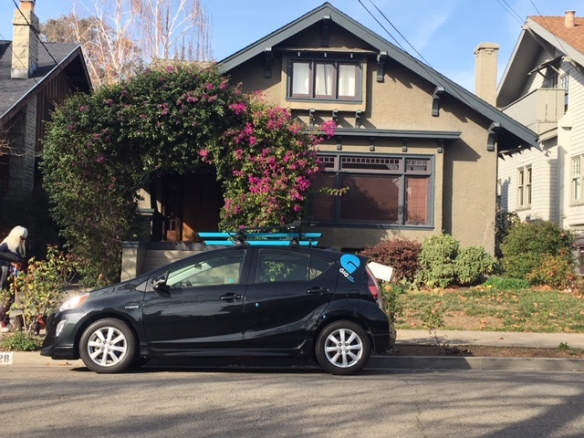
Gig Car Share test – I heard about Gig Car Share while researching Ridecell, and sampled a vehicle while I was out getting a haircut. If you only need a car occasionally, it’s ideal. Just download the app and you’re on your way. And the cars have bike racks!

Gig Car Share – Alternative to Ownership

IMG_0805

While there’s lots of talk about driving a green EV or hybrid vehicle, what if you could avoid owning a car at all, and only use one when you needed it? Taking Ubers or Lyfts is one way to get yourself somewhere quickly, but sometimes you want your own car for an hour or a day. Gig Car Share, a car-sharing service available in major parts of Oakland and Berkeley, California, can help you out.

I recently heard about Gig Car Share, which is run by AAA using Ridecell software, and decided to check them out in person. I happened to be in the “home area” getting my hair cut, so I used the app to find a car. There turned out to be one in the next block, which I took for a short ride.

The app, which I easily downloaded the day before, worked as advertised, and I was able to do the whole thing for a few dollars.

Read my full story in Clean Fleet Report. And stay tuned for when I dig a bit deeper into the story behind this fascinating technology.

VW’s Iconic Past Meets its Aspirational Future

VW couple - rain commercial

Last night, my wife called me into the family room to watch a Volkswagen commercial. In it, a young couple is driving their VW Microbus through the sunny countryside, as it turns out, to Woodstock. Combine an iconic vehicle with an iconic soundtrack (Joe Cocker’s A Little Help From My Friends), on its way to an iconic event and the effect on me was breathtaking.

Everything was perfect–the hair, the 1969 Ford in the background, the look of joy in the eyes of the long-haired, bell-bottom-jean-wearing flower power enthusiasts. They stop to pick up a couple girls. During the also iconic rainstorm (with the famous standing couple recreated amidst the crowd) our Microbus owners offer sanctuary to several other people from the downpour. When it’s over, and the bus is stuck in the Woodstock mud, a few attendees happily push them free. Power to the people! I’m not sure what could be better than this.

I went upstairs afterwards and watched the commercial a few more times on my iPad with the headphones on. As the tears streamed down my cheeks I thought about how Volkswagen was using one of its greatest historical strengths (and one of my generation’s most powerful images) to try to rebuild trust after the Diesel emissions scandal.

It’s stunning, really, how this giant car manufacturer can hit all of my buttons. The cleverness and creativity of this ad is only equaled, perhaps, by the same cleverness and creativity that brought about the Diesel emissions scandal itself. But in any case, it worked on me.

VW has had great advertising before. Back in the 1960s, VW featured brilliant, self-effacing ads through Doyle Dane Bernbach that were perfect for the time. The little, cheap but efficient and reliable Beetle and its brethren were the perfect vehicle for the later 1960s alternative lifestyle practitioners. In fact, in 1969 they sold more than half a million Beetles.

Volkswagen, with its troubling present, is working to move forward by evoking both the almost sacred relationship many of us had with our basic VWs back in a time of social change and the hope we have for saving our planet with new technology. While they show us Beetles and Microbuses, VW is working to bring us an entire line of electric Volkswagens under the I.D. brand, starting in 2020 (a futuristic-sounding year).

There’s an I.D. Buzz all-electric concept vehicle out now that owes much to the Microbus. It appeared at the famous Pebble Beach auto show this year in Monterey, and also in the December issue of Automobile magazine, which I had just been reading a half hour before I was summoned to the family room. The clever folks at the magazine drove the futuristic yellow Buzz along with a gorgeous 1952 original model in a long, illustrated cover story.

IMG_0349

The commercial, by the way, is touting the company’s new People First six-year bumper-to-bumper limited warranty–another effort at trust building. The message is meant to hit much deeper, though, and it sure did with this baby boomer.  My first two cars were air-cooled Volkswagens, and I’m at the very heart of the target of this remarkable commercial.

The real challenge is whether Volkswagen can build enough business in EVs to make up for the loss of its Diesel cars–and reputation. Meanwhile, they just introduced the huge new Atlas crossover SUV to compete in that successful market segment. Back to the real world, where you have to make a profit selling what people are asking for. The Buzz isn’t due until 2022, which sounds like a long time from now. But 1969 was a long time ago, wasn’t it?